
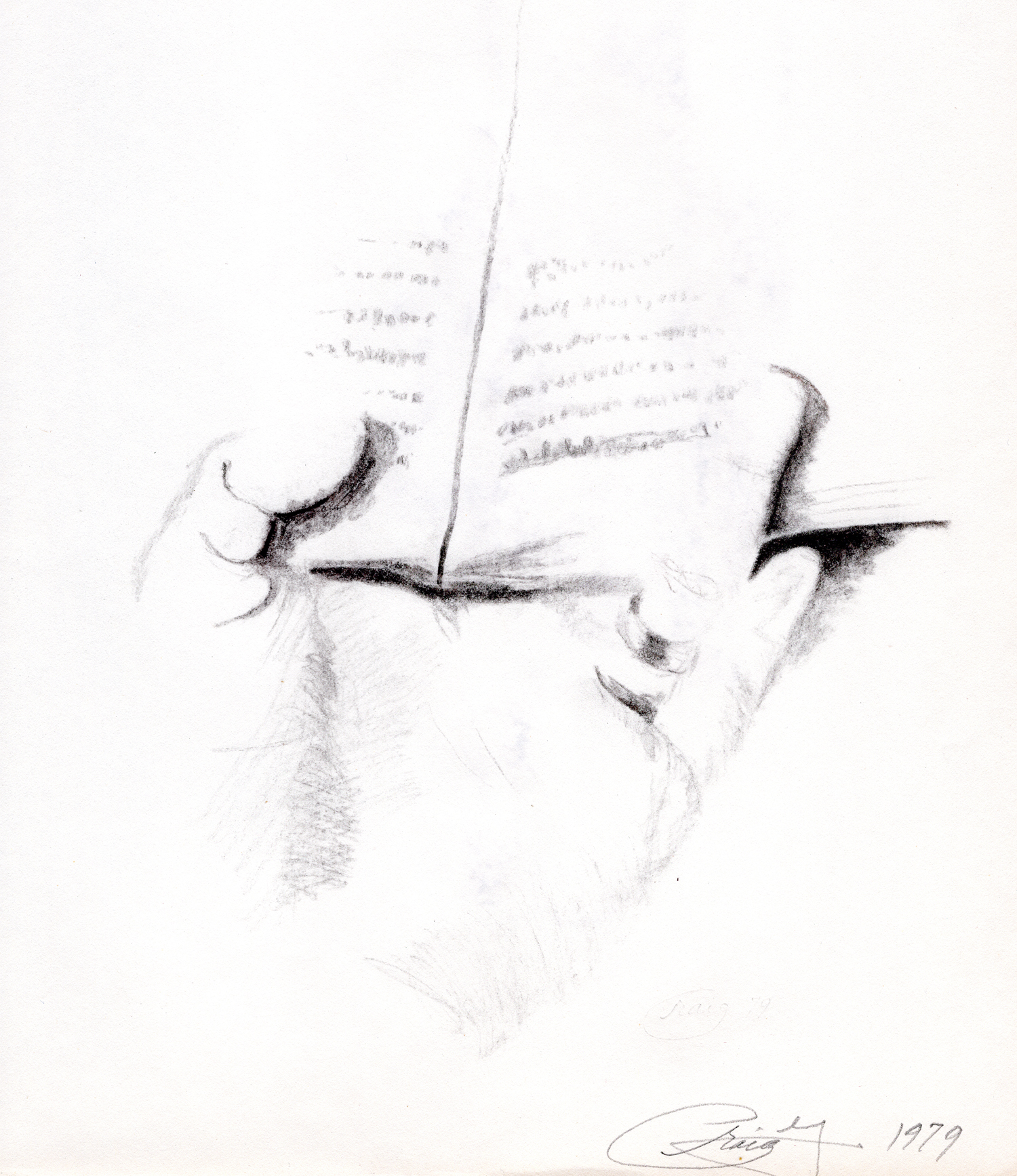
THE STUDENT, charcoal, copyright 1979 by Craig Gallaway.
The critical link between education and political ideology is becoming more obvious all the time. President Trump’s recent outing of “Critical Race Theory,” as it has been practiced now for at least fifty years in the halls of higher education, is a timely case in point. Critical social theories that pit various identity groups against each other (whether by race, or gender, or something else) derive ultimately from Marx’s theory of class warfare, which pitted the proletariat (the working class) against the bourgeoisie (those who owned the means of production). According to Marx, Lenin, and Stalin, the revolt of the working class would lead ultimately to an ideal economic community where everyone is more or less equal, happy, and well adjusted. The history of the Bolshevik revolution, and then of Stalin’s “Five-Year Plans,” not to mention the economies of Russia, China, and other socialist regimes to this day, tells a very different story; but more on that anon.
What is not in question, however, is the widespread deployment of critical social theories (echoing Marx’s lead) over the last fifty years or so in our American institutions of higher education (see, for example, Heather MacDonald’s The Diversity Delusion). When students go to college or university today, whether they are studying humanities or sciences, they are sure to receive a large dose of training in multicultural studies, or diversity training, or critical theory as applied to any subject they choose to study. Thus, in an English studies department, one may not read a lot of Shakespeare or discover the tremendous treasures of human wisdom stored there, but one will surely learn how to peg him as a white male representing an alleged tradition of racism, sexism, and classism. Critical theory has become the unexamined orthodoxy of our age.
The pervasive and often unexamined influence of critical social theories in the classroom actually makes it rather difficult to go to college today without being to some extent indoctrinated. Critical theories about race, or gender, or language, or history, are presented at most colleges and universities as the enlightened path, the path of virtue, of “wokeness,” noble character, and justifiable outrage. These theories also have the advantage of reinforcing the need of adolescents leaving home for the first time to separate from their parents as they form their own identities. And then, too, the world view and ideology on offer becomes a general movement among one’s peers. It can be difficult to think independently in such an atmosphere.
And yet, the assertions about history and economics and other subjects that come forth from the so-called “critical” theorists, often have the grave disadvantage of not being based at all on a truly critical or realistic view of these subjects or the evidence needed in each case to draw measured conclusions. One sees this at work, for example, in the actions of demonstrators and protestors today who endorse the racial bias theory of the 1619 Project, and yet can’t distinguish, in their frenzy to tear something down, between the statue of a great abolitionist and human being such as Frederick Douglas, and one of a confederate general. Likewise, interviews on college campuses with randomly selected students often demonstrate an alarming ignorance, not only of the horrendous record of international socialism in various countries during the twentieth century, but also of the history and political structure of our own country. Nevertheless, these young people are stoked for revolution and ready to follow “woke” political leaders, such as A.O.C. and the “squad,” or AntiFa and Black Lives Matter, in fomenting a socialist violent take-over in America.
By contrast, one could wish that at least some of these folks could embrace a more truly critical and realistic approach to the study of socialist politics and strategies as these have actually worked out in various places. One can discover a great deal online, for example, simply by searching for the history of Pol Pot in Cambodia, or the results of Mao Zedong’s “Great Leap Forward” in China, or Stalin’s “Five-Year Plans” for economic development in Russia.
The first of Stalin’s plans, for example, ran from 1928 to 1933. It was focused on heavy industrial development, which Stalin promised to increase by as much as 350% under the Communist regime. Though this goal proved completely unrealistic, and Stalin reset his goals numerous times, the regime did boost industrial output by a remarkable 80% during the period. The human and economic costs of this expansion, however, were hidden behind Soviet propaganda, and its Western supporters such as Walter Durante whose glowing and Pulitzer-Prize-winning reports appeared in The New York Times. In reality, Stalin’s industrial miracle was bought at a cost of forced labor, mass incarceration, and the hoarding of agricultural products from the countryside, so that somewhere between 6 and 7 million ethnic minority peasants (Ukrainians, Tartars, Kulaks) starved to death. Not exactly a victory for the economy as a whole!
The fundamental problem with Stalin’s Five-Year Plans was that they underestimated the importance of individual initiative and creativity to propel thousands of people in a complex economic system to discover the best way to work and the best way to meet the needs of their countrymen. Instead, Stalin, like socialist theorists such as A.O.C. and Bernie Sanders today, claimed to have enough knowledge, foresight, wisdom, and virtue, to construct an economic system from inside a government agency that would outperform the free market. As Thomas Sowell argues in his book, The Vision of the Anointed: Self-Congratulation as a Basis for Social Policy, this claim to elite vision and knowledge is always the Achilles heel of socialist or communist theories. In reality, no one actually has that kind of knowledge and foresight. So, programs spawned in this way display a miserable record of failure, waste, and subterfuge, especially when it comes time to raise taxes for funding the next year. Sowell’s book is full of documented examples from our own American experiment with “The Great Society” under Lyndon Johnson.
Having observed the anti-intellectual bias of contemporary college students and Marxist demonstrators, one can perhaps be forgiven for doubting if they will ever be willing to take this critically realistic step, and examine the real evidence of history. Or, will the groundless assertions of their idealism and ideology blind them until they pull the house down around their own heads. The truly critical thing is whether or not one can learn from actual evidence; but the current generation also has against it in this regard the prevailing philosophical attitude of post-modernism which declares that all world views and philosophies are really nothing more than competing power games of vested interests by different identity groups. And so, we come back, despite the terrible history of Marxist economic ideas, to the Marxian critique of culture which pits us against each other.
Against the relativism of post-modernism and cultural Marxism, I recommend something very down to earth, that can be illustrated from the life of one of my own college mentors. When I went to Regent College in 1974, one of my most memorable professors was Clark Pinnock, whose courses on Systematic Theology and The Politics of Jesus I took with great relish. Clark was a brilliant man. A logician to be sure. And never one to brook any nonsense from his students, as I had to learn on more than one occasion. He was also, at that time, a voting member of the Communist Party in Vancouver, though he didn’t advertise this to us in the classroom. Under Clark’s leadership, I was introduced to the Marxist theologies of liberation as practiced in South America, and to the ideas of the Sojourner’s community in Washington, D.C., and their leader, Jim Wallis (who also taught at a Regent mid-term). I learned in this way of concepts such as “the preferential option for the poor,” and of the need to be suspicious of capitalism, as it can succumb to the greed of fallen human beings. In other words, along with my education in basic Christian theology, I was receiving an education in political ideas; and I was only partly aware at the time of the alternative viewpoints on any of these subjects that could be presented by others. I was a bit like some of the woke generation today, and perhaps so was Clark.
Imagine my surprise, a few years later, when I learned that after traveling in South America and visiting countries such as El Salvador and Nicaragua, Clark Pinnock went public with a complete about-face regarding the advantages of capitalism and the free market. As a result of his travels and further studies, Clark saw how poorly the economies of other countries performed under the awkward control of socialist regimes and, by contrast, how much better people responded when they were allowed to farm and bring their goods to market under their own ingenuity and creativity. Clark’s conclusion was that free markets were to be preferred to socialist economies if one’s true goal was to see the standard of living rise among the poor. And this was a lesson that was being learned elsewhere as well by the late eighties, for example, in China and in Sweden.
Perhaps the most important insight that can arise from this brief reflection on the relation between education and politics in our time, given the pervasive influence of critical social theory in the academy (and now also in public schools, corporate offices, among entertainment celebrities, and mainstream media), is the importance of embracing a truly critical approach to the study of history itself. Clark Pinnock was once committed to a Marxist analysis, but further study of real events and concrete evidence convinced him to change his mind. Despite the lazy minded trends of postmodern philosophy on college campuses, serious historical study is not a subjective power game between competing identity groups with opposing vested interests. Whatever point of view we may begin with as a result of experience or education, we can and should remain serious students of history and evidence. Only so can our grasp of political ideas remain open to discovering what is true and what is not.
 Faith and the Arts