
DINNER WITH THE SUB-WARDEN
Overview Question
Having accepted Sub-Warden Curry’s invitation to dinner after the all-day faculty meeting (where Bragdon Wood was sold!) and hoping to strengthen his position in the “progressive element” at the college, Mark attends the gathering in Curry’s rooms with several elite college faculty and sponsors including Rev. Busby the bursar, Curry himself, and Lord Feverstone, the latter an important political figure with connections in London.2
As the evening progresses, it becomes clear that these men do not really know each other in a personal way, nor are they loyal to each other. Both Busby (as a representative of the college) and then Feverstone (as a representative of the NICE) expound their views on “man, nature, science, and society,” and then speak at length about how the elite leaders of the NICE will take over all of the major institutions of society. All of this echoes what we saw in the introduction (8/3/22) concerning the modern worldview with its administrative state and its neo-Marxist “long march through the institutions.” Meanwhile, Mark is watching every move to see where his best opportunity will arise to join the “inner ring,” if he can only figure out where the real “ring” is.
Question: As you read the speeches of Busby and Feverstone in Part 1, what specific cultural institutions do they name or allude to as they spin out their visions for the influence of the NICE in the college and in the wider world? How are these same institutions at play today in the culture wars of America?
DEEPER-DIVE QUESTIONS
1. At the faculty dinner, after Curry and Busby have left, Feverstone belittles them and declares them to be mere pawns in the grander scheme of the NICE, which is global in scope, not just local or academic. What parallels for this two-tiered struggle for power between the local (regional or national) focus, on one hand, and the global (or interplanetary!) focus, on the other, can you discern in the geo-politics of the world today? And why is it important (for us as for Lewis) to mark these levels?
2. Still in Part 1, Mark becomes flushed with excitement as Feverstone verbally runs down the college men and goes on to paint a picture of the administrative state in which “some men have got to take charge of the rest.” What does this scene tell us about the pattern of loyalty and honor that one may expect (not only between Mark and Feverstone) but also in an administrative state that is based strictly on natural reason and individual freedom, as opposed to the values of religion, family, congregation and community that guide the traditional lifeworld?
3. In Part 2, after lunch with the Dimbles, Jane hoped her anxieties about her dream would go away. But they didn’t. So, when Mark comes home from his dinner, he finds her in an unusually vulnerable mood. But then in Part 3, the next morning, Jane is angry and defensive about having let herself get upset in the first place. What do these layered reactions say about Jane’s struggle with her own personal formation? Are there hints about her own nature that she has a hard time accepting given her preferred self-image?
4. In the final Part of chapter 2, Jane and Mark are moving in opposite directions, one by fast sports car to Belbury, the other by slow train to St. Anne’s. How do the details of Lewis’s descriptions reveal not only the two very different geographic destinations, but also the two opposing worldviews (modern and traditional) that are, so to speak, hidden in the landscape?
_________________________________________________________________
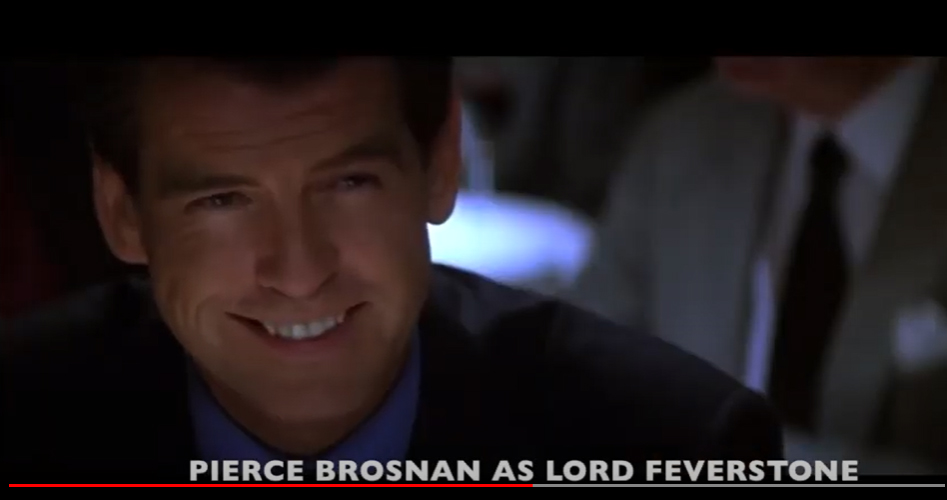
- A new cast has recently been announced for this movie version of THS which will, at the time of this writing, feature Hugh Grant as Feverstone. Other new cast members include: Daniel Day-Lewis as Ransom, Emily Blunt as Jane Studdock, Emma Thompson as Grace Ironwood, and Jeremy Irons as Frost, plus a host of other great picks. Should be a worthy effort if our government, in contrast to Feverstone’s vision for 1940s England, can wean itself from further lockdown and emergency powers.
- Lord Feverstone is also the Richard Devine of Out of the Silent Planet, the first volume of the space trilogy. Devine/Feverstone is an old classmate and enemy of Dr. Ransom, the Director at St. Anne’s. In the first book, Devine and his partner Edward Weston kidnap Ransom and try to use him to gain control of the creatures on the planet of Malacandra (Mars). But Ransom fights back and makes some surprising discoveries about interplanetary spiritual powers. The portrayal of good and evil in the first two books will add much to the understanding of these themes in THS; but as Lewis himself says in his Preface, though the stories form a sequence, each “can be read on its own.”
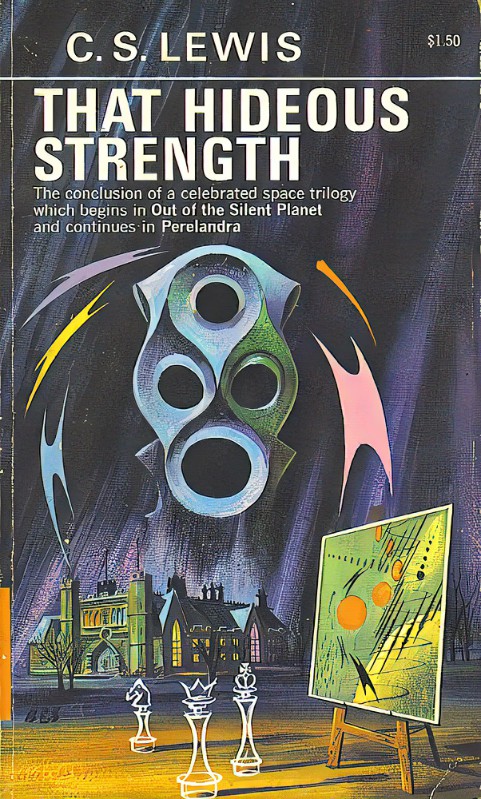
- The illustration for this 1965 Simon & Schuster cover with its picture of a) the college, b) the chess game pieces, c) an interplanetary map, and d) a symbol of mysterious power floating overall, suggests the various “levels” of interest and engagement for the different kinds of actors who support the NICE (in keeping with Lord Feverstone’s own description in Chapter 2). At one level, there are those, like the college faculty, who support the NICE simply because it promises to increase their salary. And then there are those somewhat higher up, like the administration of the college or Mark himself, who see an opportunity to rise within the frame of regional politics. And then, yet higher (or spiritually lower as the case may be), there are those like Lord Feverstone and the leaders at Belbury who represent forces that want to use the NICE to dominate and control the whole world or even the universe. One reason it is important to mark these levels is that, as in Dante’s Inferno, they reveal different motivations and degrees of evil that betray people at each level. This is also relevant as we try to take stock of the spiritual forces at work in the geo-politics of our own time. Some people at the lower levels of involvement are what the Marxists have called “useful idiots,” for they do the regime’s dirty work and are later dispensed with. One such group was the Red Guard in Mao’s China who were banished to the wilderness after helping to oppress the general population into subservience. Lewis was clearly aware of these different levels in the culture war of his time. And he explores this issue in greater detail as the story proceeds.
 Faith and the Arts