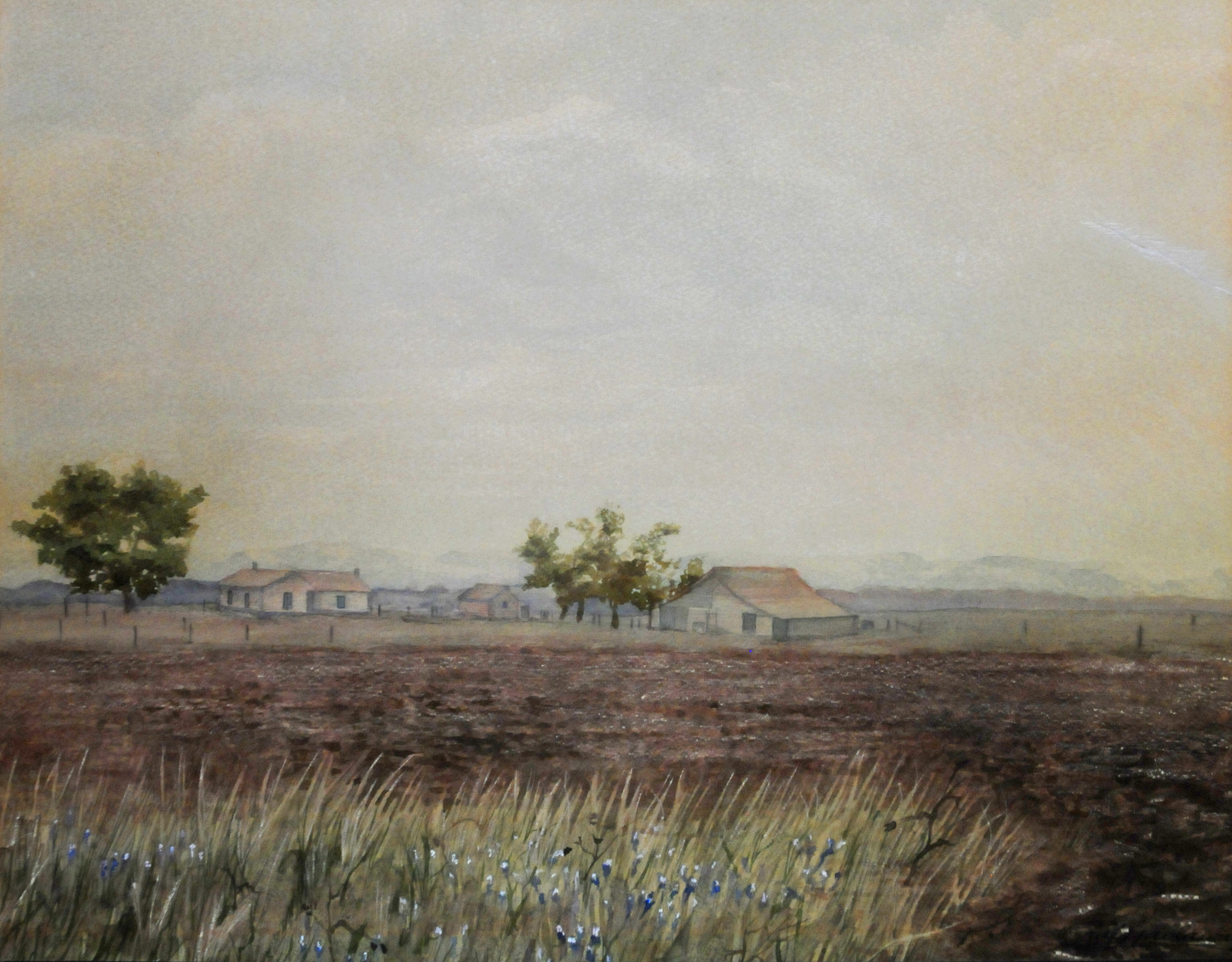
Title: Glen Cove, watercolor by Craig Gallaway, copyright 1970. After getting lost as an eighteen-year-old in the free-wheeling idealism of the late 1960s in the Haight-Ashbury district of San Francisco, I returned to my family in Texas and began to try to “re-member” what had been the deeper soil of my life, my upbringing, and my faltering faith. This painting was an attempt to remember and to honor the first fruits of that legacy from my grandparents little farm in West Texas. Remembering and honoring that legacy was a crucial step in my own recovery of our national heritage, and a preparation for the battle now at hand.
What follows is an outline in seven parts for an overview of the battle mentioned in the title above. I plan to post the first part, “The Administrative State,” on July 4th, commemorating The Declaration of Independence, and thus ringing our founders’s own clarion call against all such states. And then I will post a new part about once a week into the month of August. My sense is that many of us are in need of clarification about the many issues that beset our country at this time in our history, particularly as we approach the presidential election in November. This is my attempt to contribute to such clarification. I know there are those on the opposite side of this battle who will regard my views as misguided (to put it mildly) as I already regard many of their views. Having the perspective set forth in one place, however, with many details included, may help both sides, and those in the middle (or on the outside) to see more clearly all that is at stake in the outcome. That is, at any rate, my hope.
1. The Administrative State. A brief review of the history of the administrative state from Woodrow Wilson to Joe Biden, 1900-2024.
2. The Expansion of the Administrative State Under Joe Biden. An overview of how the Biden state has expanded its power, based on the analysis of Thomas Sowell in his book, The Vision of the Anointed: Self-Congratulation as a Basis for Public Policy.
3. The Anglo-American Conservative Tradition. What it would mean to recover our cultural and constitutional heritage based on the principles of the Anglo-American Conservative Tradition (AACT) as shown in Yoram Hazony’s book, Conservatism: A Rediscovery.
4. The Anglo-American Conservative Tradition (continued).
5. A Critical Time in Our Nation’s History. An assessment of the seriousness of our current cultural calamity based on a comparison with Hitler’s Germany in the 1930s, as shown in Eric Metaxas’s Letter to the American Church.
6. The Way of Faith. Reflections on the recovery of the AACT by means of three biblical principles of faith that will help us: a) restore the religious foundations of our culture, b) correct course both in the church and in the state, and c) avoid the disaster of the authoritarian state into which we are presently careening.
All Hallows Eve, watercolor, by Craig Gallaway, copyright 2004 by Gallaway Art.
For several years Deb and I have been learning to celebrate Halloween in a specifically biblical and Christian way, and to help our grandchildren, Colin and Rose, do the same. We haven’t wanted to cast a sour note over all the outdoor fun of dressing up in costumes and going trick-or-treating. But neither have we wanted to let the great church tradition of All Hallows Eve get lost among the loose collection of ideas (both ancient and modern) that haunt every advertisement on TV with ghouls, ghosts and spooks, and that sometimes get mixed up in a more serious way with notions of witchcraft, sorcery, and even fascination with the dead (necromancy). All of the latter really belongs to a different, non-biblical worldview.
So, without writing a doctoral thesis, how can one go about this task? How about starting with the word “Halloween” itself? This word, as anyone can find with a little online research, is a shortening (circa 16th century) of the Old English and Scottish dialect for the phrase “All Hallows Evening.” That is, the evening of October 31 prior to the day on November 1 when the church celebrates all of the “Hallows.” And what then or who are the “hallows”? They are the “holy ones,” that is, all of the saints, both living and dead. They are not holy in the sense of being perfect people, as though they have “already arrived” (Philippians 3:12-14). Rather, they are being made holy (hallowed) because they have put their faith in Christ and given their lives into his guidance and care. But why then should we celebrate all of these living and dead saints together? No better answer can perhaps be given than that provided by the verses of the great 19th century hymn, “For All the Saints.”
For all the saints, who from their labors rest, who thee by faith before the world confessed, thy name, O Jesus, be forever blest. Alleluia.
Thou wast their rock, their fortress, and their might; thou, Lord, their captain in the well-fought fight; thou, in the darkness drear, their one true light. Alleluia.
O may thy soldiers, faithful, true, and bold, fight as the saints who nobly fought of old, and win with them the victor’s crown of gold. Alleluia.
O blest communion, fellowship divine! We feebly struggle, they in glory shine; yet all are one in thee, for all are thine. Alleuia.
And when the strife is fierce, the warfare long, steals on the ear the distant triumph song, and hearts are brave again, and arms are strong. Alleluia.
From earth’s wide bounds, from ocean’s farthest coast, through gates of pearl streams in the countless host, singing to Father, Son, and Holy Ghost: Alleluia.
All Hallows Eve, then, is about the communion of the saints above with the saints below. Or, to put it another way, it is about the fellowship of the church triumphant (already at rest and waiting for the great day of the Lord, the day of resurrection and judgement, Rev. 6:9-11) and the church militant (still engaged in spiritual warfare on the earth until the Lord has put all of the rebellious forces and powers back in order under his authority, 1 Cor. 15:20-28). As in the Epistle to the Hebrews (chapter 11), we who are still alive take courage and example from those who have gone before and who show us how to be faithful. And in contrast to the ancient (and some modern) pagan festivals, such as Samhain, this is not a matter of trying to interact with the dead, or to call them up so that we might communicate with them or make use of them in some way. Rather, it is a celebration of the great purpose of our Creator to which we, like they, have been called to participate: the restoration of the world and of our own lives as subjects, stewards, worshippers, and partners with and under God.1
With this biblical worldview as our framework, then, Deb and I have created over the last few years an album of photos and stories for our grandchildren, an album for All Hallows Eve that informs the children about their own immediate ancestors who have gone before them, and upon whose shoulders they stand as they also take up the calling to join the spiritual battle, and to become whole and fully human beings in the care and under the power and guidance of the risen Lord. This effort seems all the more important when set against the recent attacks of “woke” activists, where the religious and moral traditions of our ancestors have been ridiculed and defiled without serious understanding, honor, loyalty, or respect.
What follows below, then, are the simple stories and pictures of some of our Gallaway “hallows” that we have added to the album for this year, 2023. We hope you will enjoy our stories; but also, we encourage you to recall similar stories of faith from among your own ancestors and forebears, and to remember them together for the benefit of your family and others.
“The prayer of a righteous man accomplishes much.” (James 5:16)
Uncle Ben Galloway in his store with an employee (not great Grandad Ira) in about 1915.
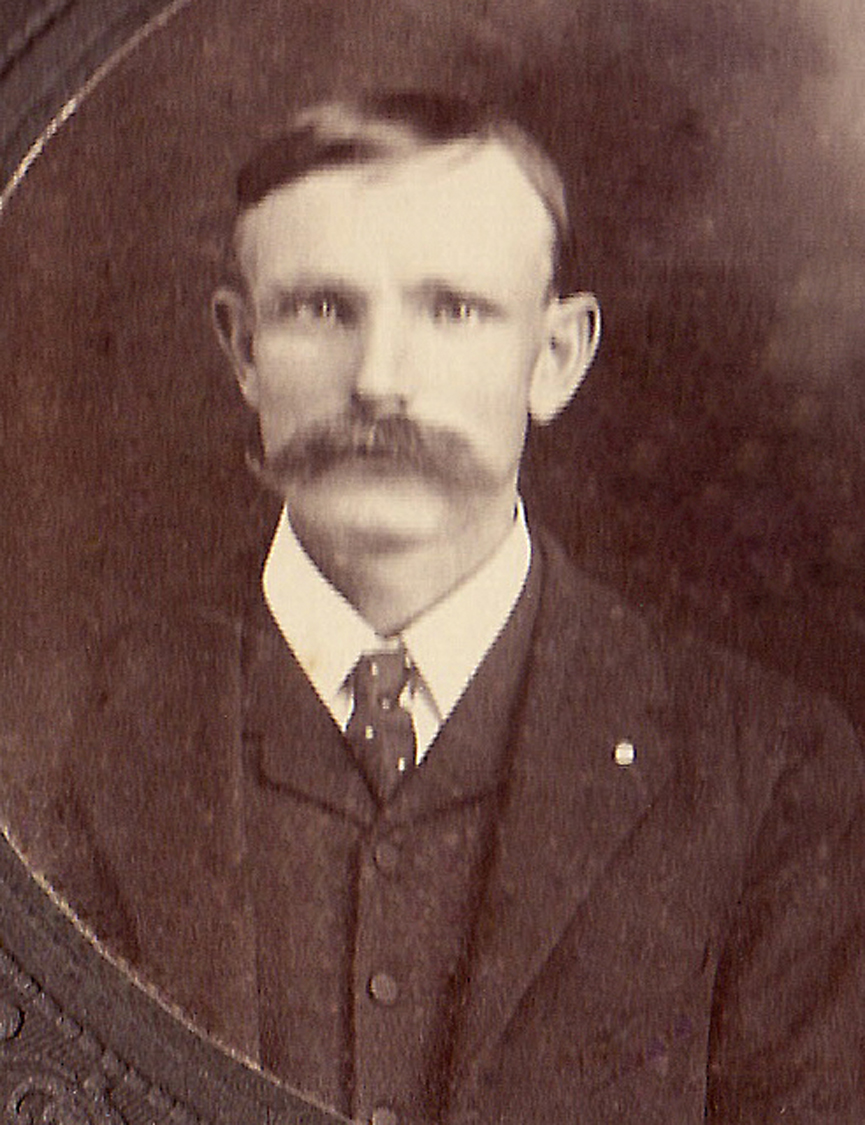
Uncle Ben was the uncle of your great grandfather, Ira. That makes him your second great uncle on your father’s side of the family. He owned a hardware and farm implements store in Friona, Texas, where Great Grandad Ira worked for him as a teenager in the 1930s.
Uncle Ben was a kind and generous man. During the Great Depression, he knew that everyone was poor and that the preacher had not been paid for several months. So, he went to the bank and made a personal loan of several hundred dollars, and then took Grandad Ira with him to the preacher’s house.
Uncle Ben as a young man about 1900.
“Some of us got together and came up with this back pay to keep you going,” he said to the preacher.
Back in the car, Grandad Ira asked uncle Ben why he had lied, saying “some of us,” when it was really only Uncle Ben.
“Well, there’s me, and there’s you, and then there’s the banker. That’s ‘some of us,’ isn’t it?” was Uncle Ben’s response.
And so, Uncle Ben made Grandad Ira part of a secret gift. And now, your own uncle, Ben, is named after him; and then, in a way, so is young Colin whose middle name is also Benjamin. This is a good legacy among the saints.
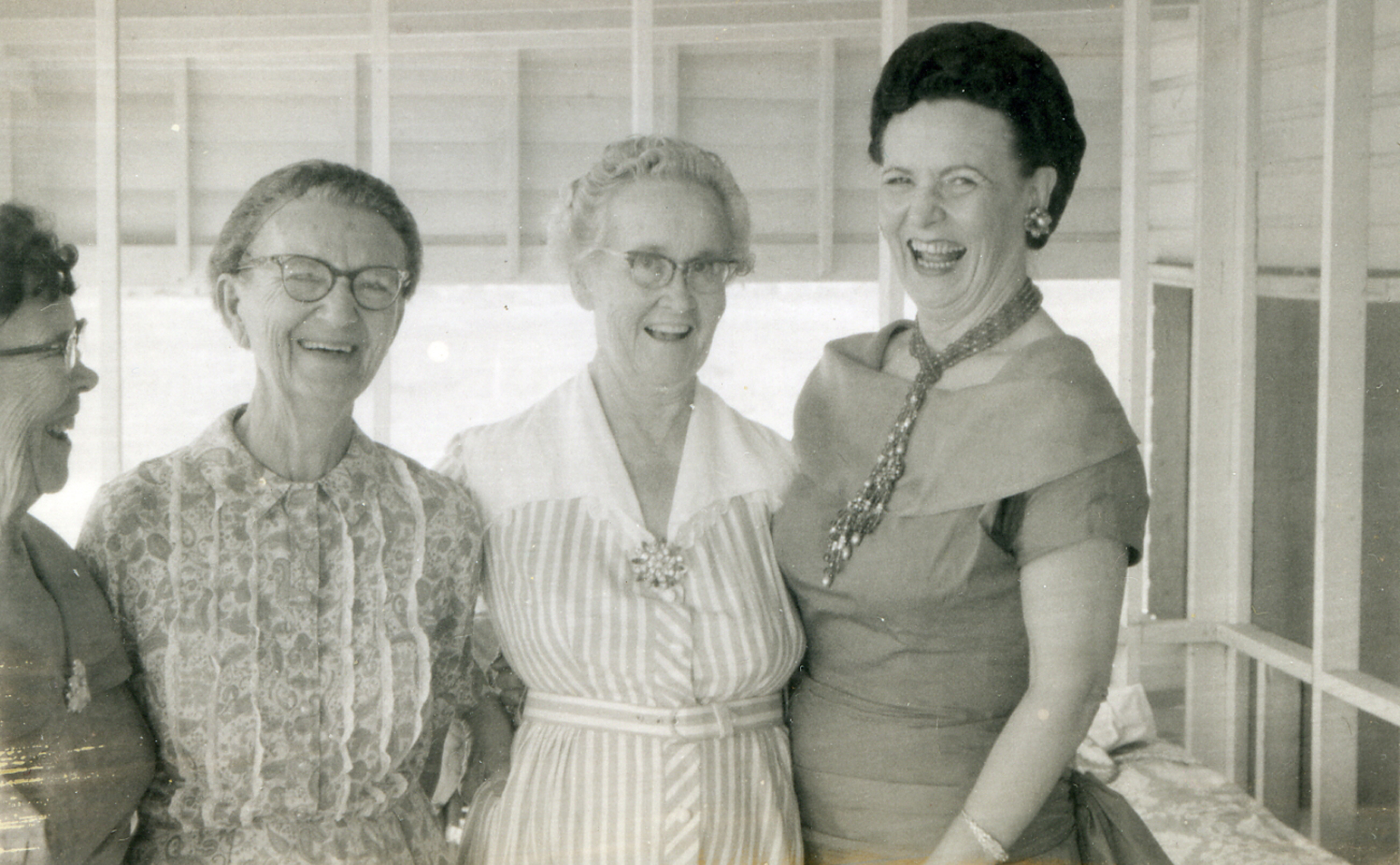
L to R: Lula, Nellie, Alma Lee, and Julia, about 1920.
Mama Gallaway (Julia, your second great grandmother, on the right above) and her sisters were born between 1880 and 1903. They were women of faith, humor, and interesting character. When Mama was very sick one time—the doctor even said she might die—Lula, Nellie, and Alma Lee gathered at Lula’s house in Glen Cove, Texas, a few miles away from where Mama lay in her bed. They gathered to sing hymns and to pray for their sister.
The next morning Mama was much better. She told them how she had come to them during the night “in the spirit,” and how she had heard their prayers and listened as they sang. She even knew the very songs they had sung, and what they had said to one another.
Nellie, Mama, Lula, and Alma Lee together on the front porch of Mama’s house in about 1956.
And so, God gave them a gift. Not only was Mama’s life spared, but they also shared and remembered this event of close, spiritual communion with each other for the rest of their lives.
Now they are all gone from this earth; but they are surely still singing before the throne of God as they await the great day of resurrection and celebration.
_________________________________________________
Footnotes
It is important to notice in this regard that the New Testament is far more interested in the ongoing effort and the ultimate destiny of the people of God (see Romans 8:18-39; 1 Cor. 15:35-58; and Rev. 21-22) than in any detailed description of the current intermediate state of those who have died or “fallen asleep” in Christ. Excellent reading on these matters can be found in the works of N. T. Wright, Surprised by Hope, and The Resurrection of the Son of God.
The cover art for the 2014 edition of That Hideous Strength by C. S. Lewis, published by Kindle and by Create Space Independent Publishing Platform. The image suggests the taming of fallen Venus by her more powerful original in the good order of creation. In this way, eros finds its true home within the greater virtue, the greater heart of agape. How is this a symbol for Jane and Mark, for St. Anne’s future, and for ours?
VENUS COMES TO ST. ANNE’S
Overview Question
In this final chapter, Lewis brings a few things to a sort of penultimate completion, for example the roles of Merlin and of Dr. Ransom. At the same time, he leaves us with a set of characters and questions that, rightly engaged, pull us back into the world of our own lives (our families, our congregations, our communities, and nation) to ponder our own course on the road ahead.
We have seen in earlier chapters how Ransom and Merlin, and the members of the community at St. Anne’s, have so far responded to the spiritual battle with Belbury and Edgestow in which they have been engaged. Now, in the final chapter we overhear, so to speak, their conversations about the ongoing battle that they have yet to face, and the parameters within which they must make their battle plans for the future. These parameters include hints about the ongoing “conversions” of Mark and Jane and the others at St. Anne’s (Parts 1 and 2); but also some more explicit statements about the nature of Logres, going forward, when the community at St. Anne’s must be prepared to meet again and to fight back against “other Edgestows” (Parts 4 and 5) under the same kind of distorted leadership as before (e.g., Curry, the well-informed man in the train of Part 5). This brings us to our final Overview Question:
Taking the story of THS as a whole, especially the sense of future direction that arises in the final chapter, what would you say are the key principles—both at St. Anne’s and for us—that define the goal of their/our lives, and the signs that they/we are in fact making progress toward this goal?
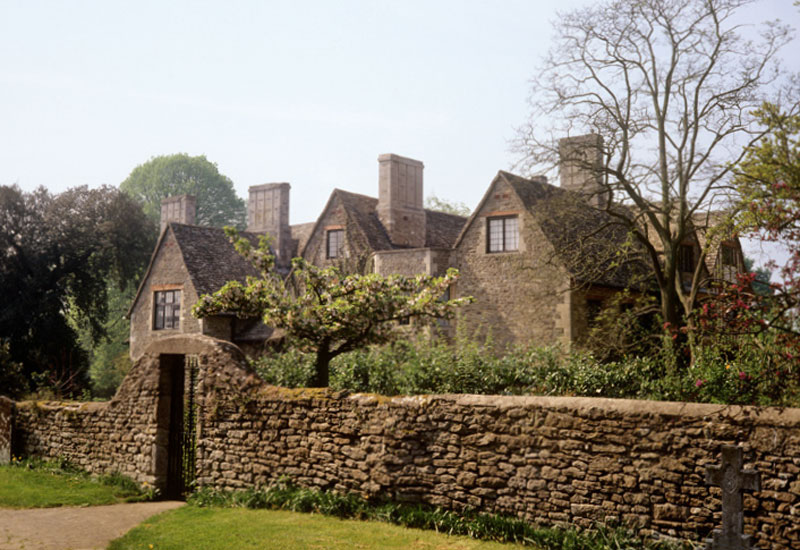
“Just” another English manor house with gardens and natural stonework suggesting the kind of place and culture created by the community of St. Anne’s on the Hill in Lewis’s story. And yet, this is also the kind of place that represents and symbolizes the critical spiritual values, virtues, and strengths of Logres in the history of England which are determinative for the future of this tradition. How is all of this attacked by the Belbury and the NICE of our day?
DEEPER-DIVE QUESTIONS
1. In Part 1, after the debacle of the banquet, Mark is making his way to St. Anne’s on the Hill to find Jane and to give her “her freedom.” What are the signs that the conversion already begun in him is really taking root and expanding into various parts of his personality and the habitual way of life (the lifeworld) that he had formerly considered so important? What does this portend for Mark’s future, his marriage, and his potential for a different role in society?
2. In Part 2, Jane is with the other women of St. Anne’s trying on beautiful dresses in preparation for a great meal that the men of St. Anne’s are preparing. What are the signs in Jane’s thoughts and attitudes that the conversion already begun in her is also expanding into the wider regions of her personality and her former habitual way of seeing herself and trying to present herself to others? What does this portend for Jane’s future, her marriage, and her potential for a different role in society?
3. In Part 3, Lord Feverstone comes to his end swallowed up in an earth quake at Edgestow. He dies in a manner reminiscent of the sons of Korah in Numbers 16, and for the same reason: He has placed his own fame and fortune above everything else in life, and so he vanishes into nothing. At the same time, Part 3 gives us the last mention of Merlin who rides away on a horse yet, as Jane has seen earlier in one of her dreams, he has also been like a pillar of light used up completely in God’s good work of deliverance at Belbury. What do these very different “ends” tell us about the worldviews and lifeworlds of Merlin and Feverstone?
Anyone who knows the reality of farming or ranching, or any life that is lived closely within the powers and forces of nature, also knows how these powers offer immense opportunity for the training of the virtues and the fruits of the Spirit. This is the world of God’s continuing creation (creatio continua) in which we live and move and have our being, and within which we give thanks for our sufferings because we know that our Maker is using them to remake us in the image of his son, our Lord (Romans 5:3; 8:29). It is also the world of everyday ordinary life when we embrace this life with all of its challenges, in Christ.
4. Part 4 begins with Camilla’s question, “Why Logres, Sir?” which she asks of Ransom; though it is Dr. Dimble and Grace Ironwood who do most of the answering. In their answers, they talk about the importance in Logres (the ancient realm of King Arthur, which we commented on at some length already in Chapter 13) of a certain understanding of “Nature” (what I would call creatio continua), and of the tradition of faith and freedom that “haunts” English history all the way back to Arthur (and before), and of how this tradition must often be pursued in the most mundane ways, as they have in fact been pursuing it steadily at St. Anne’s. Working with your earlier answers in Chapter 13 and elsewhere, how would you define the meaning and significance of Logres, both in the story and in the present world of American culture and politics which also reaches back into this history?
5. At the end of Part 4, there is also a discussion about the status of other countries in relation to Logres (this haunting of England) and about the seeming unfairness of the judgement of the people of Edgestow. What do the conversations about these two issues tell us about the traditional worldview, at least as C. S. Lewis understood it and recommended it through the characters in his story? What parallels can you find in Lewis’s other works to support your answer?
6. Part 5 is all about the future prospects of Curry, the Sub-Warden (“Dean”) of Bracton College. This is the Curry who in Chapter 1 manipulated the faculty of Bracton to sell Bragdon Wood to the NICE with a view to padding the purse of the college as well as his own career, and without even considering the moral or spiritual dangers. In Part 5, Curry discovers a way to turn the tragedy of the destruction of Edgestow and the college into a “providential” turn of affairs for himself. Why is it significant in the story that Lewis portrays Curry as the kind of man that people will see as empathetic and wise, though in reality Curry is only thinking of the future (and even of God’s providence) in terms of his own fame.
Garden With Beans and Flowers, watercolor by Craig Gallaway, copyright 2005 by Gallaway Art. A simple painting of a well-kept garden seems an appropriate image by which to contemplate the future imagined in the story for Jane and Mark, St. Anne’s, and Logres. For a garden is symbolic in the traditional worldview both of where we began, and of how we move forward toward the goal of the New Creation. There is, of course, a battle to engage along the way; but then we have our Lord’s own Spirit and power to guide and strengthen us.
7. The final part of the chapter, Part 6, is focused on the theme from which the chapter takes its title: “Venus Comes to St. Anne’s.” In addition to all of the echoes of Genesis 1 among the animals (“be fruitful and multiply”), why does it make perfect sense, given where the story of THS begins (with Jane contemplating the emptiness of her marriage) that the story would end in a chapter with this title? That is, with Jane and Mark Studdock coming together as husband and wife in a way they have never before been able to do? What are the chief virtues that seem to characterize this new potential for marital union? And how will this practice of faithful marriage strengthen their ability to promote the cause of Logres in England going forward?
This is the cover image for the 2012 edition of That Hideous Strength published by Harper Collins. The image portrays the destruction of John Wither, Deputy Director of the NICE, by Mr. Bultitude, the bear ennobled by Dr. Ransom at St. Anne’s. This is probably the great deed prophesied of Mr. Bultitude by Merlin in Chapter 13. The larger meaning of this event within the traditional worldview of St. Anne’s has to do with the proper stewardship of creation at St. Anne’s versus the heartless, utilitarian manipulation of nature at Belbury.
BANQUET AT BELBURY
Overview Question
In an odd sort of way, the overview question for this week provides an occasion to evoke two rather contradictory emotions: On the one hand, to breathe a sigh of relief (and hope, even joy) as we watch the terrible villainy of the NICE at Belbury at long last pay itself out in death and destruction; yet, on the other, to consider soberly (bravely and even sorrowfully) the hard result that this implies for those in our own time who have followed the worldview and the lifeworld of Belbury. These results, in other words, are both sad (Saturn) and hopeful (Jove).
What I suggest, then, as a way to take in and understand the chapter as a whole, is to follow the action of each Part and to ask at each stage a single Overview Question:
How do the actions and events of each Part demonstrate the logical results of following either the fallen eldil (as at Belbury) or the good eldil (as at St. Anne’s and in Merlin)?
This means that you will be looking as you follow the actions of Wither or Merlin, Frost or Fairy Hardcastle (and others) for signs either of the good eldil, or the fallen ones. Signs, that is, and for example, of the heavenly Mars (courage, patience, etc.) or the fallen shadow of Mars (domination, coercion, etc.). Or, for two very different examples, signs of the good Venus (kindness, life giving help) or the fallen Saturn (despair and indifference rather than “good grief”).
To do this, you will need to remember what we learned about the planets in the last chapter and in Chapter 12, where we also discussed the virtues and the passions that characterize the good angels (God’s messengers) and their fallen counterparts. And try to keep in mind how this is both a joyful and a sorrowful exercise because we are talking about a real world, our world, not just a fictional one.
This panorama of the English countryside reminds us, in keeping with the traditional view of “nature” in That Hideous Strength, that God’s good creation persists in the wider world and at St. Anne’s even as the evil work of the NICE is collapsing in the town of Edgestow and at the banquet at Belbury.
DEEPER-DIVE QUESTIONS
1. How does the collapse of language (i.e., the power of Mercury) at the banquet—first with Jules, then with Wither and throughout the room—illustrate the logical consequences of the post-Enlightenment exaltation of the individual (i.e., individual freedom and “reason”) and the denial of the traditional understanding of God, truth, and reality? What signs can you discern today of this kind of collapse in the speeches and responses of our elected officials and other leaders of business, media, society and, yes, even the church?
2. Why does the dissolution of language and meaning at the banquet (and in society today) lead to the shadow side of Mars—that is, to mindless violence, bravado, and murderous coercion (rather than to courage, fortitude, and self-control, etc.). Which characters, in which parts of the chapter, clearly illustrate this dissolution of the true power of Mars? What actors illustrate fallen Mars today?
3. Which of the good eldil shine forth in the actions of Merlin when he frees both the animals and the human prisoners (including Mark and Mr. Maggs) and how is Merlin’s way of sending them forth also a recovery of the good order of creation (“nature” rightly understood as commanded by the Creator of all, Maleldil)? As a corollary to this question: Why does it make sense, from the standpoint of the traditional worldview, that the animals would attack the advocates of Belbury to destroy them? Is there some sense in which nature itself will ultimately “refuse” to support what is evil? How is “nature” reasserting itself today in rejection of woke anti-nature ideology?
4. In Parts 4, 5, and 6, Wither, Feverstone, and Frost, each in his own way, enacts the logical consequences of the worldview that they have all embraced and tried to live by (their modern lifeworld). How do the murderous actions of Wither, the self-absorbed and self-centered actions of Feverstone, and the suicidal actions of Frost, demonstrate the consuming passions of the dark eldil–that is the passions of fallen Mars, fallen Jove, and fallen Saturn, respectively? What actors and agencies in the spiritual battle of our cultural, political, and media wars today seem determined to embrace these same or similar passions represented by the fallen powers as they are also described in Scripture? (For Scriptural descriptions see, for example, Romans 1:18-32; Ephesians 4:17-6:20.)
The angelic figures of the eldils in C. S. Lewis’s space trilogy are drawn from the allegorical interpretation of the planets (Mercury, Venus, Mars, Saturn, and Jupiter) as described in classical and Medieval literature. See, C. S. Lewis, The Discarded Image. The artwork above comes from the cover of a Study Guide for Lewis’s space trilogy by Vicki Tillman.
THE DESCENT OF THE GODS
Overview Question
In this chapter, especially in Part 1, Merlin is finally equipped with the virtues of the heavenly powers that he will need in order to do battle with the fallen powers of Belbury. Our overview task, therefore, is to draw out (at least provisionally) some conclusions about how best to understand the nature and character of these powers, both in their true, created form and in their fallen, corrupted deformation.
We may begin with a quick review of insights that we have already gathered from earlier chapters. In Chapter 9, for example, we saw how Lewis was using the classical and Medieval identification of the planets and virtues to portray the angelic beings known as the eldil. Thus, Mercury, Venus, Mars, Saturn, and Jupiter represent five specific powers or virtues that are built into the natural order of God’s good and unfolding creation.[i] And then, in Chapter 12, we saw (in keeping with the biblical sources of the traditional worldview) how each of these good powers can be corrupted and turned to evil purpose by the fallen angels or eldil. Furthermore, in Chapter 13, we discovered the telling insight that while the dark eldil are quite willing to work by coercion and domination to achieve their goals in human society, the good eldil insist on working only through human beings who willingly choose to be obedient partners with God in caring for and restoring the good creation (the 7th law). In this way, as we suggested in our questions for Chapter 13, the role of Merlin in Lewis’s story actually becomes our role as free human beings under God’s power and guidance to fight back against the cultural dissolution of our own time. In other words, we need the same virtues and strengths for our battle that Merlin needs and receives in the story!
All of this echoes, of course, with themes from Scripture about spiritual warfare (Ephesians 6); about our Lord’s battle with the fallen powers (1 Corinthians 15:20-28); about the “fruits of the Spirit versus the works of the flesh” (Galatians 5), and also with Jesus’s own description in the beatitudes about the traits that characterize those who are committed to the victory of God’s kingdom (Matthew 5). Indeed, if we keep these scriptural themes in mind, we will gain many insights into the nature and character of the battle between the powers as Lewis portrays them, and as they are relevant to our own battles today. This brings us to the Overview Question for this week:
What are the virtues and strengths that Lewis associates with each of the planets–that is, with the good eldil and the good order of creation? How do these relate or compare to Paul’s list of the fruits of the Holy Spirit in Galatians 5? Also, what are the vices and corruptions that arise when these powers are misused, misconstrued, or made into idols?
As you read through Lewis’s powerfully poetic descriptions of each eldil in Part 1, keep in mind the insights from earlier chapters, and the aforementioned Scriptural themes. Try to create a basic chart or “map” of the virtues, strengths, and spiritual fruits that are given to Merlin (and to the other people at St. Anne’s). How do each of these work, and what would they look like if they were corrupted? It may help to think about different characters, both at St. Anne’s and at Belbury, as you ponder the embodiment and practice of each of the virtues and vices. For example, in what way do the Dimbles or Dr. Ransom reflect the virtue of Venus, while Fairy Hardcastle and even Mark and Jane (at least at the beginning of the story) reflect the corruption and dissolution of this created power? Remember, these planetary virtues, rightly understood, align with the fruits of the Spirit and with the beatitudes of the Kingdom of God. As such they represent strengths that we also need for our “Merlin” work today.
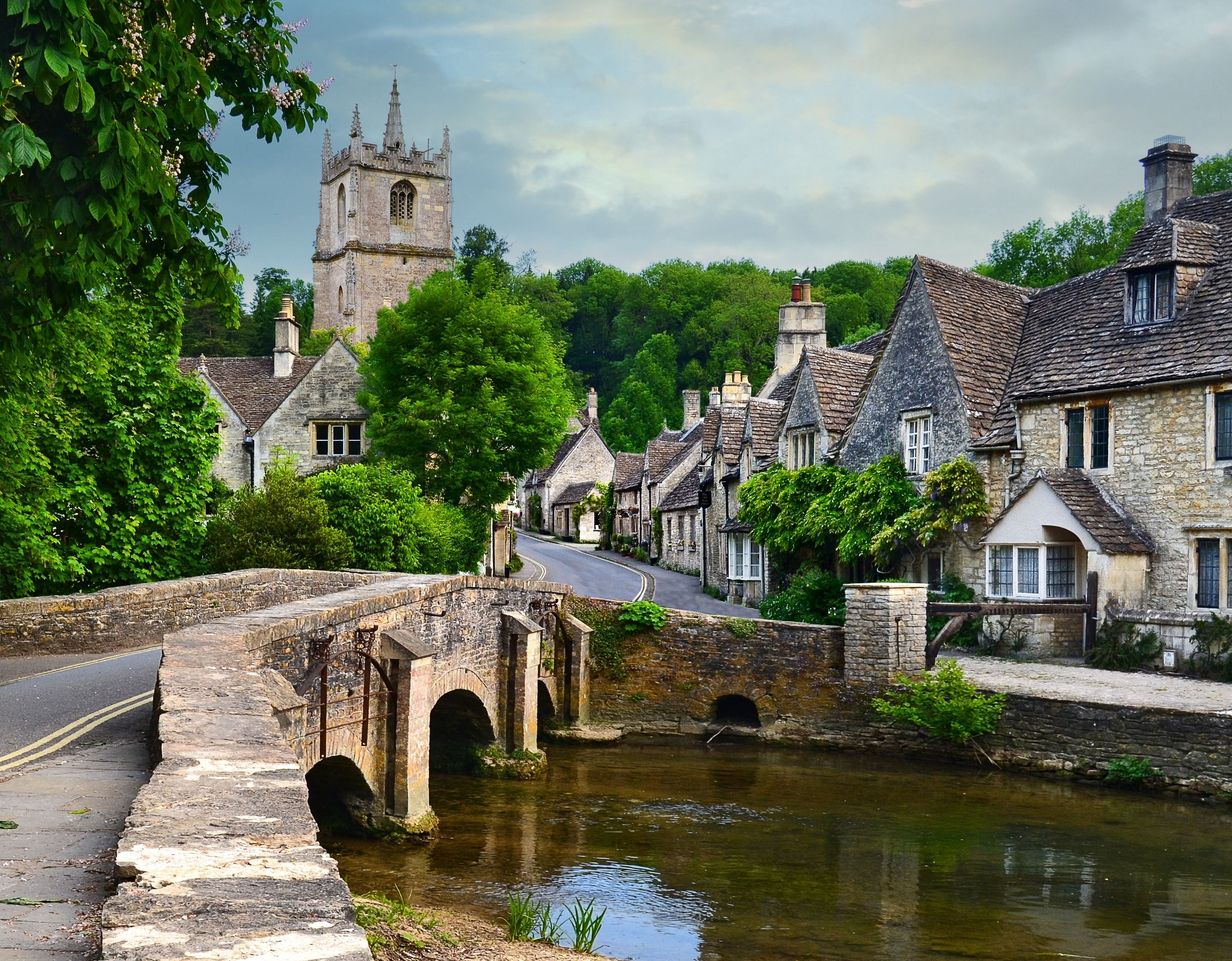
This image of an English village by a river suggests the kind of place and culture (like the village of Cure Hardy in Chapter 4 of THS) that keeps pulling Mark Studdock’s memory and conscience away from his job aspirations at Belbury. This type of place (and its people) are surely the source in Mark’s mind and heart for what he calls “Normal.” And it is this connection with traditional society and the traditional worldview (its cultural, moral, and religious values) that finally strengthens Mark enough to resist the “objectivity” training of Prof. Frost.
DEEPER-DIVE QUESTIONS
1. One of the really curious and funny things about Chapter 15 (in Parts 2 and 3) is the way Wither and Frost are reduced by Merlin (who is now among them at Belbury and fully equipped with the heavenly powers) to a pair of bowing and scraping buffoons. These great leaders and spokespersons for the future of technocratic society and its ideological “science” are almost completely duped about the true identity both of the Tramp and of the real Merlin. What account can you give for this deficiency of intelligence on the part of Wither and Frost? What explains their epistemological blindness? As you ponder this question you might also consider a similar pattern in the following sources: [a.] the inability of the fallen powers, according to Paul, to understand what Jesus was about at the cross (1 Cor. 2:8). [b.] The short-sightedness of the White witch in the Narnia Tales to understand the “deep magic” of Aslan’s willing sacrifice at the stone table. And [c.] The inability of Sauron in Tolkein’s trilogy to foresee that anyone would try to destroy the ring of “power.”
2. As you read through Parts 2, 3, and 5, try to identify places or moments in the action where you can see the powers of the good eldil shining through the actions of Merlin. Where is the Mercurial power of language, wit, and intelligence at work? What about Mars and the capacity for courage in the face of danger? Or Venus and the virtue of charity and the spiritual fruits of agape and kindness? At the same time, watch for the shadow side of the dark eldil in the various attitudes (vices and passions) of envy, anger, or suspicion, that arise among the characters of Belbury. Can you think of any ways that Merlin’s actions might provide a model for how we engage the agents of destruction today?
3. In Part 4, Mark’s battle with the dark eldil comes to a head in the “objectivity room” when Frost demands that Mark commit an act of sacrilege against the Christian religion by defacing one of its central symbols, a crucifix. Mark is still not a Christian believer; but his conversion toward what is Normal has also been a hard turn away from the wanton abolition of all traditional religious and moral values. In the course of his struggle to resist Frost’s demands, Mark comes to realize that the cross is not just a story; but something that really happened. Furthermore, he realizes that the cross is what, as he puts it, the” crooked” does to the normal and the “straight,” indeed, what Belbury will do to him. He realizes that the man on the cross was the embodiment of what is good, and true, and normal. In the end, even though he knows Frost may kill him, he refuses to enact the defamation; and suddenly Merlin breaks into the room to release Mark from the diabolical training. How does Mark’s battle with Frost over the meaning of the symbol of the cross illuminate what is most deeply at stake in the spiritual battle between the heavenly powers of the Creator (Maleldil) and the dark fallen powers of Belbury?
[i] Lewis also has Dr. Dimble (in Chapter 13) call these powers “intelligences,” that is, types of creaturely intelligence that are built into creation itself, and are amenable to human beings made in their Creator’s image. Thus, for example, to understand language (Mercury) or love (Venus) or courage (Mars) or grief (Saturn) or joy (Jove) aright is to be faithful and true to the nature of our own creation. But to subvert these, or to misconstrue them for the cause of rebellion and self-centered power (by turning them into their shadows: linguistic trickery, lustful conquest, domineering violence, willful indifference, and mindless debauchery) is to plant the seeds of our own destruction.
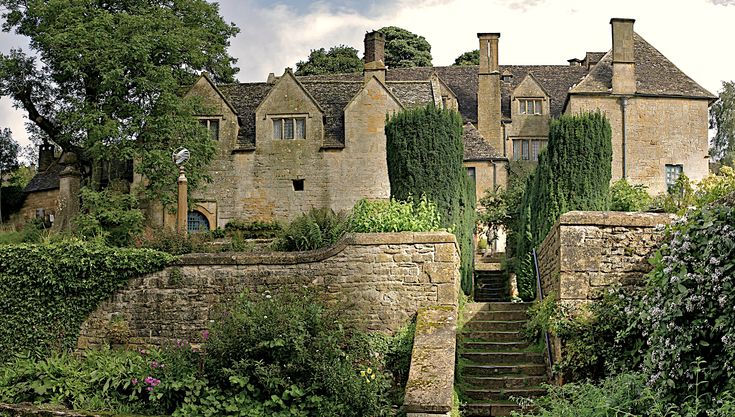
An English manor house and grounds suggests the kind of place–with gardens and stone walls in close proximity with nature–that Lewis describes as the setting for the traditional community of St. Annes. We might imagine Mr. MacPhee at work in his garden, or Camilla and Arthur Denniston standing out on the hill watching the weather and rejoicing in the clouds of an English sky.
“Real Life Is Meeting”
Overview Question
In this chapter, both Jane and Mark move further along the path of what can only be called, in Christian terms, “conversion.” They have come a long way since the beginning of the story. They are both being converted from their earlier formation in the Enlightenment worldview, during their college and professional years; and they are being converted to what we have called (from the beginning of our study) the traditional worldview. The latter also includes what we came in the last chapter to identify with the role of Merlin in Lewis’s story: Merlin the advocate of God’s order of creation in nature, and of Christian marriage, and of English common law with its conservation of basic human rights and freedoms (the 7th law) as these are shaped by biblical faith. All of these are integral parts of the traditional worldview (lifeworld) as it came to expression in England from the Middle Ages onward until it was challenged head-on in the 17th and 18th centuries by the anti-tradition and anti-religious worldview of the Enlightenment.
Jane and Mark are being converted from their former college training and formation; and both are coming to see and appreciate why the traditional worldview (with its inherent lifeworld) holds much that they now want to re-embrace if they can only discover how. But each of them comes to this by a different set of means or mediations. This brings us to our Overview Question for this chapter:
Look carefully at Mark’s “conversion” in Parts 1 and 4 (note Lewis’s use of the term) from Prof. Frost’s deconstruction of all traditional values, and toward what Mark only knows to call the “Normal.” Then, look closely also at Jane’s struggle (in Parts 2 and 5) first with Mother Dimble’s traditional ways about marriage, and then with her own licentious fantasies, until she turns in the garden (after her talk with Ransom) toward the “presence” of God. Based on your observations, try to identify the means by which each of them is helped along this path of conversion. What kinds of things are involved in each of their cases (e.g., mentors, memories, conscience, innate or instinctual longings or repulsions, Scripture, and other traditional echoes). By what means from within the traditional worldview are Jane and Mark drawn into the orbit of God’s further influence and healing?
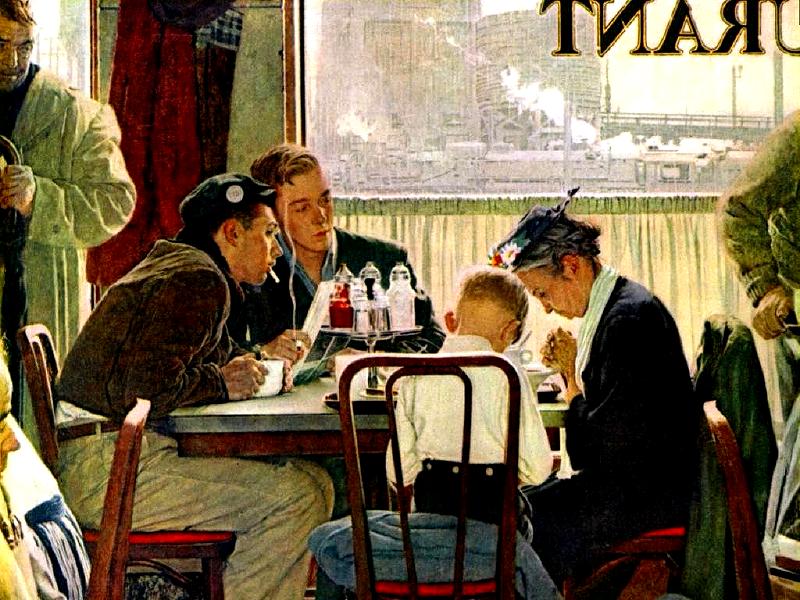
Norman Rockwell’s painting, Saying Grace (1951), though set in America, reflects the place of religious faith in mid-twentieth century English culture as well. The deep biblical roots of the Christian religion were still visible in public life but were beginning to be pressed to the margins and to become a novelty.
DEEPER-DIVE QUESTIONS
1. The title of this chapter may hold a clue to the importance of several “minor” characters at this point in the story, characters whose impact we might be inclined to ignore unless we understand the deeper significance of the conversion that is taking place in both Jane and Mark. For example, in Parts 1 and 4, Mark is introduced to the Tramp—Frost’s and Wither’s false Merlin—whom they hope will help them advance their plans to combine ancient magic with modern technocratic controls. During Mark’s sentry duty, however, he finds that he is able to bond with the Tramp in a way that is more grounded in common humanity than he had ever achieved in his efforts to join the inner ring of power with Frost and Wither. Similarly, Jane is at first put off by Mother Dimble and Ivy Maggs because they represent a kind of storied traditional role for women and marriage to which Jane has been averse; but then she begins to discover that they are part of something that is much deeper and truer to real life than her habitual feminist ideas have led her to believe. Why is it that these “common people,” with their uneducated and even uncouth ways (the Tramp), embody the promise of meeting real life in a deeper and truer way? What is the source of this real life that Jane and Mark are meeting in these common people?
2. In the middle of the chapter, Part 3, we find a brief digression on the fate of Mr. Bultitude, the bear. Lewis goes to some lengths (as he always does in his descriptions of the bear) to notice how Mr. Bultitude’s way of processing information is not the same as that of a human being. Mr. Bultitude does things by instinct, not by moral choice, reflective deliberation, or conscience. This echoes Lewis’s traditional sense of the hierarchy among animals, humans, and angels (an echo of his love for the “triadic” thinking of the Middle Ages[i]). The result of this triadic thinking is to highlight, by contrast and comparison, the specifically human task of being human. How do the innate limitations of Mr. Bultitude’s instinctual behaviors help to clarify the specifically self-reflective and moral nature of the choices and loyalties that are now required of Mark and Jane if they are to complete their conversions and become fully “human” in the traditional sense?
3. All along the way in our study of THS, since we began early last August, we have tried to evaluate the relevance of Lewis’s insights regarding the cultural battles of his time (the mid-1940s) with the cultural and political battles of our own. With only three chapters after this one left to consider, this may be a good time to take an interim inventory. Here are some of the major discoveries that we have made along the way so far. Consider briefly how each one of these may find a counterpart in the events and agencies of our own day.
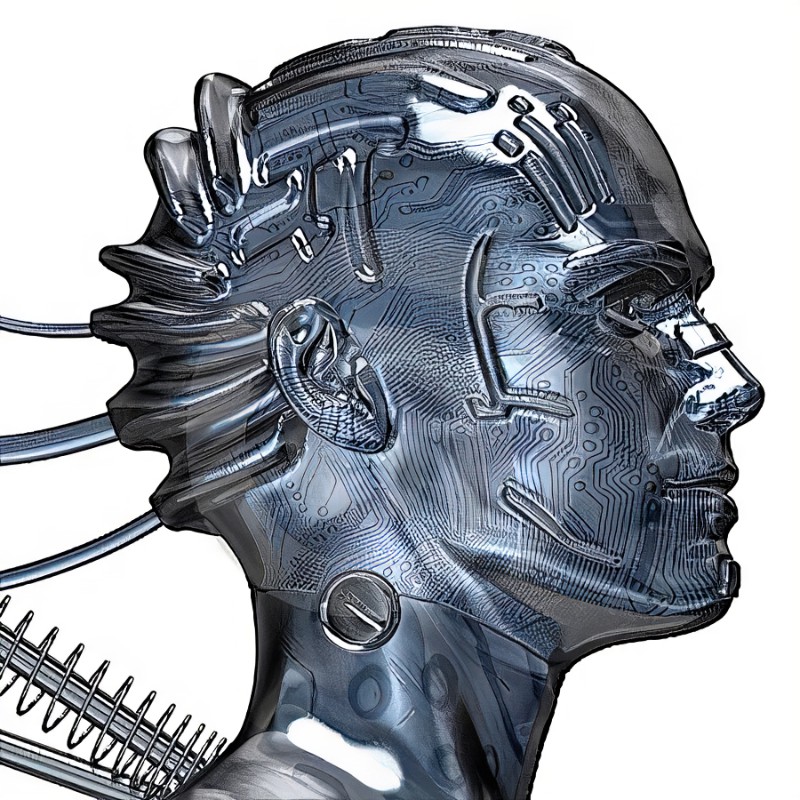
A high-tech image of a head suggests the kind of technocratic vision of the future promoted by the NICE. This has only grown and become more lurid and explicit since Lewis’s day among groups like the WEF and the “transhumanism” movement.
a. In Chapter 2, the faculty and Feverstone discuss how their ideology will spread through all the institutions of society—including education, politics, science, business, the press, etc. (cf., the neo-Marxist Long March Through the Institutions). Where is this sort of thing taking place today?
b. Also in Chapter 2, we saw how Busby and Mark and others endorse a kind of “applied science” which is really a mask for their social ideology and a way to gain control both of society and academia, for example, by rejecting traditional scientists such as William Hingest (who still require empirical evidence to support their claims). Where have we seen this sort of thing today?
c. In Chapter 6, Mark caves in to the NICE and assumes the role of an “activist journalist,” writing propaganda articles that whitewash the NICE for public consumption. What are the primary arms of activist journalism today, and on what stories have they practiced this kind of white washing? Are there any news agencies today that practice traditional journalism?
d. In Chapter 7, Jane discovers that she has held a view of marriage and sexuality that is centered, like her Enlightenment worldview, on the freedom of the individual self (self-expression, self-definition, self-indulgence). This has led her to regret her marriage to Mark, and to be vulnerable to adulterous thoughts. Where do we see this self-centered view of sexuality and even of marriage in our culture today?
e. In Chapter 8, Filostroto proclaims to Mark his vision for a future technocratic society where people are programmed by technology, and where human beings achieve a kind of immortality through artificial intelligence. Where do we see this kind of ideology at work today?
f. In Chapter 10, the NICE take control of Edgestow as the four stages of cultural revolution come full circle with the declaration of emergency powers. At the same time, normal people become jaded against their fellow citizens in a kind of mass formation which allows them to “stay under the radar,” protect themselves and their own jobs, while they “go along in order to get along.” Where have we seen this sort of thing at work today?
g. In Chapter 11, Jane goes with other members of the St. Anne’s community to look for Merlin, and they all find themselves shaken awake by the nominal degree of their own faith when they have to face some kind of real spiritual power or danger. Where have we seen, in recent events, the awakening of faith as a result of coming face to face with the denial of human rights and basic freedoms, including the freedom of religion and conscience under God?
h. In Chapter 13, Ransom explains to Merlin why God will only work to set things right by working through human beings who are willing to be his partners in the work of restoration (the 7th law). Where in our political debates today do we find this concern to preserve the role of human conscience and agency under God? And where do we find this calling either manipulated (made to serve a prior state agenda), rejected, or simply absent from the discussion of how to restore and renew society?
[i] C. S. Lewis, The Discarded Image (Cambridge, 1964) pp. 56-57, 71-72.
Blue Current, watercolor by Craig Gallaway, copyright 2008. Clear water flowing over exposed rock, reflecting the blue light of the sky, reminds me of the waters of baptism. And those waters represent, for those who put their lives in his hands, the cleansing and transforming power of Jesus’s life, death, and resurrection at work in their lives by the presence of his Spirit. A fitting image for the renewal of our covenant with our Maker and Redeemer.
Here is a shortened version of John Wesley’s Covenant Renewal Service which he began using with the Methodist people in England in 1755. It was especially used at the beginning of the New Year to give the people an opportunity to think seriously about their calling to embrace whole heartedly the life of faith. This version leaves out two longer sections of the original service (Thanksgiving, Confession) which are needed in order to experience the full depth and breadth of the service. I have shortened these in the interest of making the central prayer more accessible (in violet type face below). You can find various versions of the service online. The best ones stick close to Wesley’s original.
If you have access to a United Methodist Hymnal, No. 606 is the hymn that Charles Wesley wrote especially for this service, Come Let Us Use the Grace Divine.
Leader: Let us pray. Almighty God, unto whom all hearts are open, all desires known, and from whom no secrets are hid; cleanse the thoughts of our hearts by the inspiration of Thy Holy Spirit, that we may perfectly love Thee, and worthily magnify Thy Holy name; through Jesus Christ our Lord. Amen.
Scripture Readings: Jeremiah 31:31-34 . . . . The renewal of the covenant.
John 15: 1-8 . . . . . . . . . . The vine and the branches.
Leader: What does it mean to renew our covenant with God?
Dear friends, the Christian life, to which we are called, is a life in Christ, redeemed by Him from sin, and through Him, consecrated to God. Upon this life we have entered, having been first admitted by faith into the new Covenant of which our Lord Jesus Christ is the mediator, and which He sealed with His own blood, that it might stand forever.
On one side the Covenant is God’s promise that He will fulfill in and through us all that He has promised in Jesus Christ, who is the author and perfecter of our faith. That His promise still stands we are sure, for we have known His goodness and proved His grace in our lives day by day.
On the other side we stand pledged to live no more unto ourselves, but to Him who loved us and gave himself for us and has called us to serve Him, that the purpose of His coming might be fulfilled.
From time to time we renew our vows of consecration, especially when we gather at the table of the Lord; but on this day we meet expressly, as generations of our fathers and mothers have met, that we may joyfully renew and solemnly reaffirm the Covenant that binds us to God.
Let us then, remembering the mercies of God, and the hope of His calling, examine ourselves by the light of His Spirit, that we may see wherein we have failed or fallen short in faith and practice, and, considering all that this Covenant means, may give ourselves anew to God.
(This is where the longer sections on Thanksgiving and Confession occur in the original service.)
The Covenant
Scripture Reading: Romans 12: 1-2
Leader (with the people now standing):
And now, brothers and sisters in Christ, let us bind ourselves with willing bonds to our Covenant God, and take the yoke of Christ upon us. This taking of His yoke upon us means that we are heartily content that He should appoint us our place and work, and that He alone is our reward.
Christ, our King, has many services to be done; some are easy, others are difficult; some bring honor, others bring reproach; some are suitable to our natural inclinations and temporal interests, others are contrary to both. In some we may please Christ and please ourselves, in others we cannot please Christ except by denying ourselves. Yet the power to do all these things is assuredly given us in Christ, who strengthens us.
Therefore, let us make the Covenant with God our own. Let us engage our heart to the Lord, and resolve in the strength of His Spirit never to go back. As we kneel again together, let us make the Covenant with God our own.
Leader: O Lord God, you have called us through Christ to be partakers of the new Covenant in Him. We take upon ourselves with joy the yoke of obedience, and engage ourselves, for the love of Thee, to seek and do Your perfect will. We are no longer our own, but Yours.
Leader and People together:
I am no longer my own, but Yours. Put me to what You will, rank me with whom You will; put me to doing, put me to suffering; let me be employed for You or laid aside for You, exalted for You or brought low for You; let me be full, let me be empty; let me have all things, let me have nothing; I freely and heartily yield all things to Your pleasure and disposal.
And now, O glorious and blessed God, Father, Son, and Holy Spirit, You are mine, and I am Yours. So be it. And the Covenant which I have made on earth, let it be ratified in heaven. Amen.
Closing (All stand)
Leader: Lift up your hearts.
People:We lift them up to the Lord.
Leader: Let us give thanks to our Lord God.
People:It is fitting and right that we should at all times, and in all places, give thanks unto Thee, O Lord, Holy Father, Almighty, Everlasting God.
Leader and People together:
Therefore, with angels and archangels, and with all the company of heaven, we praise and magnify Your glorious name; evermore praising Thee, and saying, Holy, Holy, Holy, Lord God of hosts; heaven and earth are full of your glory. Glory be to Thee, O Lord most high. Amen.
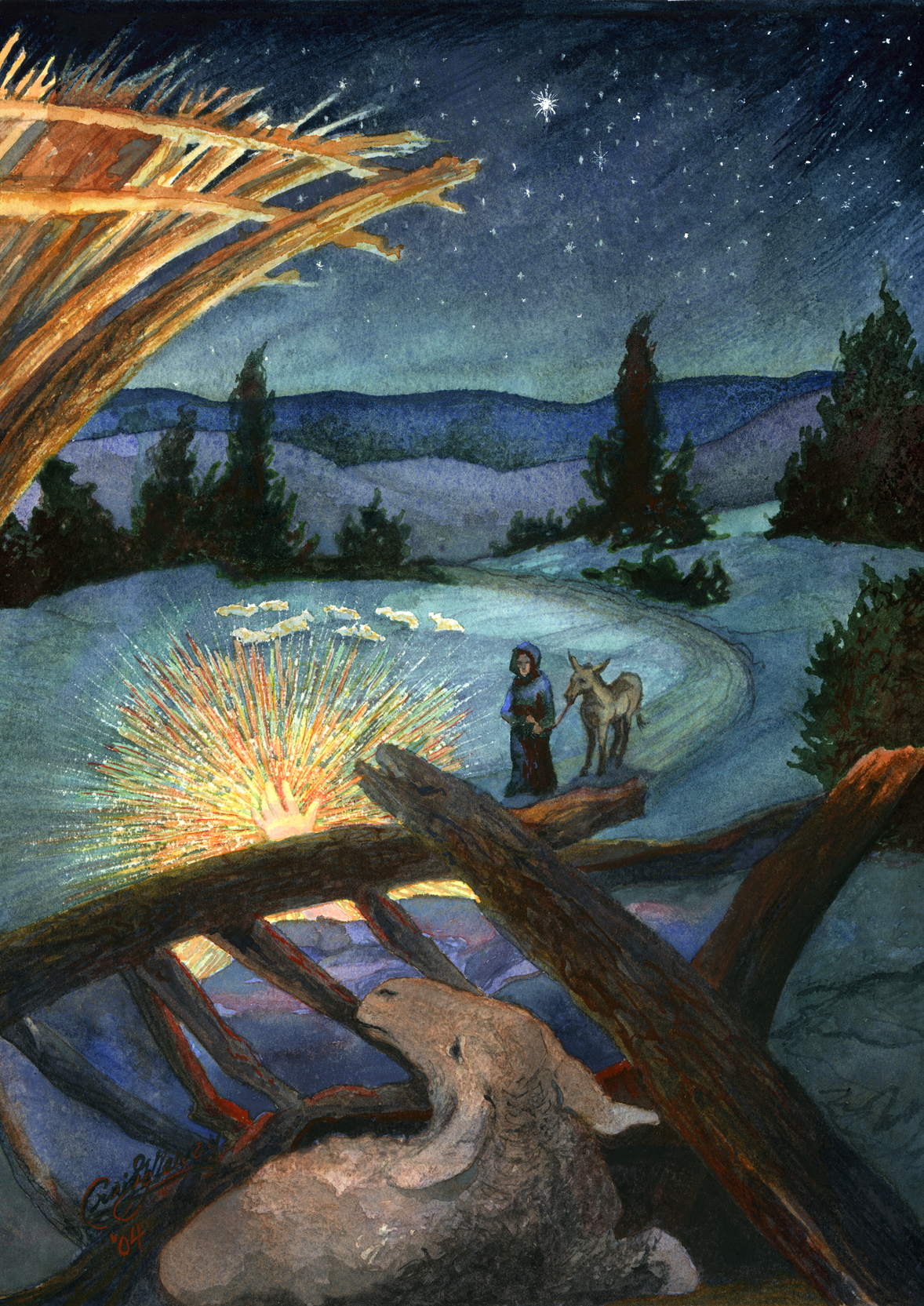
All Creation Is Waiting,” watercolor by Craig Gallaway, copyright 2004. The child is born; but that does not mean his work is done, or his mission complete. “The whole creation waits in eager expectation,” says Paul in Romans 8, for the great day of the Lord which will be, even then, only the end of the beginning. Is that Joseph in the background, bringing a donkey that he and Mary and the baby will need for their flight to Egypt? Even so we find ourselves still on this road of New Creation with our Lord.
It is Christmas Day 2022. We celebrate the anniversary of our Lord’s birth and incarnation. The Son of God has come into the world and, in his own human body, lived an entirely faithful human life. He was faithful even in the face of death; therefore, he has defeated sin, death, and the fallen powers that had disordered and misshapen human life before. And now he is risen and reigning and providing his Spirit to bring his faithful life, death, and resurrection into our lives as well; to deliver us also from all of the fallen powers that continue to try to get their grips into us and the world at large.
Week by week through Advent we have tried to remember some of the essential parts of our lives where his coming has made, and is making, a huge difference in how and why we live as we do in him. For he is still in the process of restoring these and other parts of our lives as we make our way with him toward the day of our own resurrection, the day of judgment, the wedding banquet of the Lamb, and the fulfillment of the New Creation already begun in him and in us. And so we can sing with Charles Wesley’s refrain, “Come thou long expected Jesus . . . born thy people to deliver”:
Deliver us from our “normal” fears and anxieties, as your grace and promise delivered Mary on the eve of your own human birth.
Deliver us from our worries about our status and career, our future security and prestige, as your servant Paul taught us with regard to our gifts, and as your own example showed us with regard to being a servant like you.
Deliver us from the temptation to use ethnic groups or other divisive factions to gain social or political power and to grasp at security and control of others as you and Paul refused to do.
Deliver us from the idolatry of self-absorbed eros and other fanatical appetites or passions, so we may live in the freedom of agape, kindness, gentleness, and self-control in human families and in the kind of community that you are restoring.
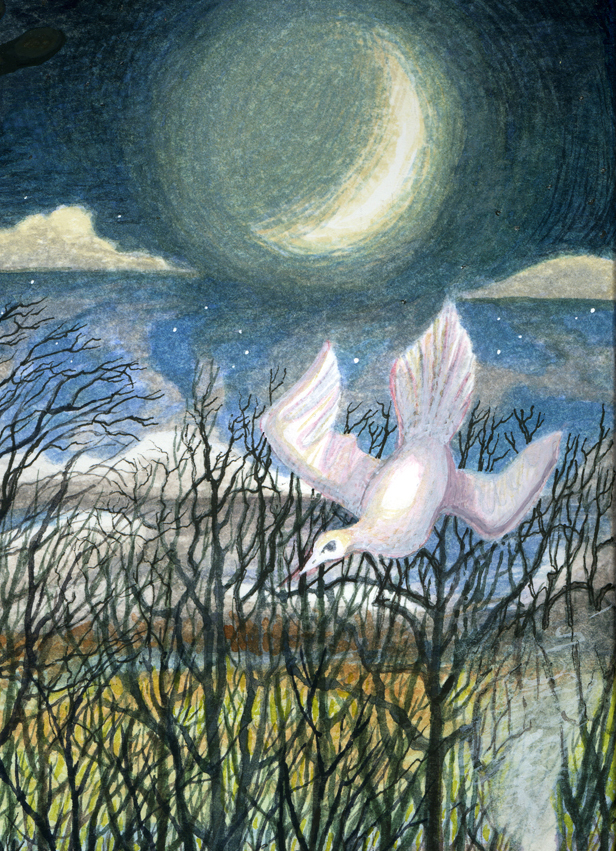
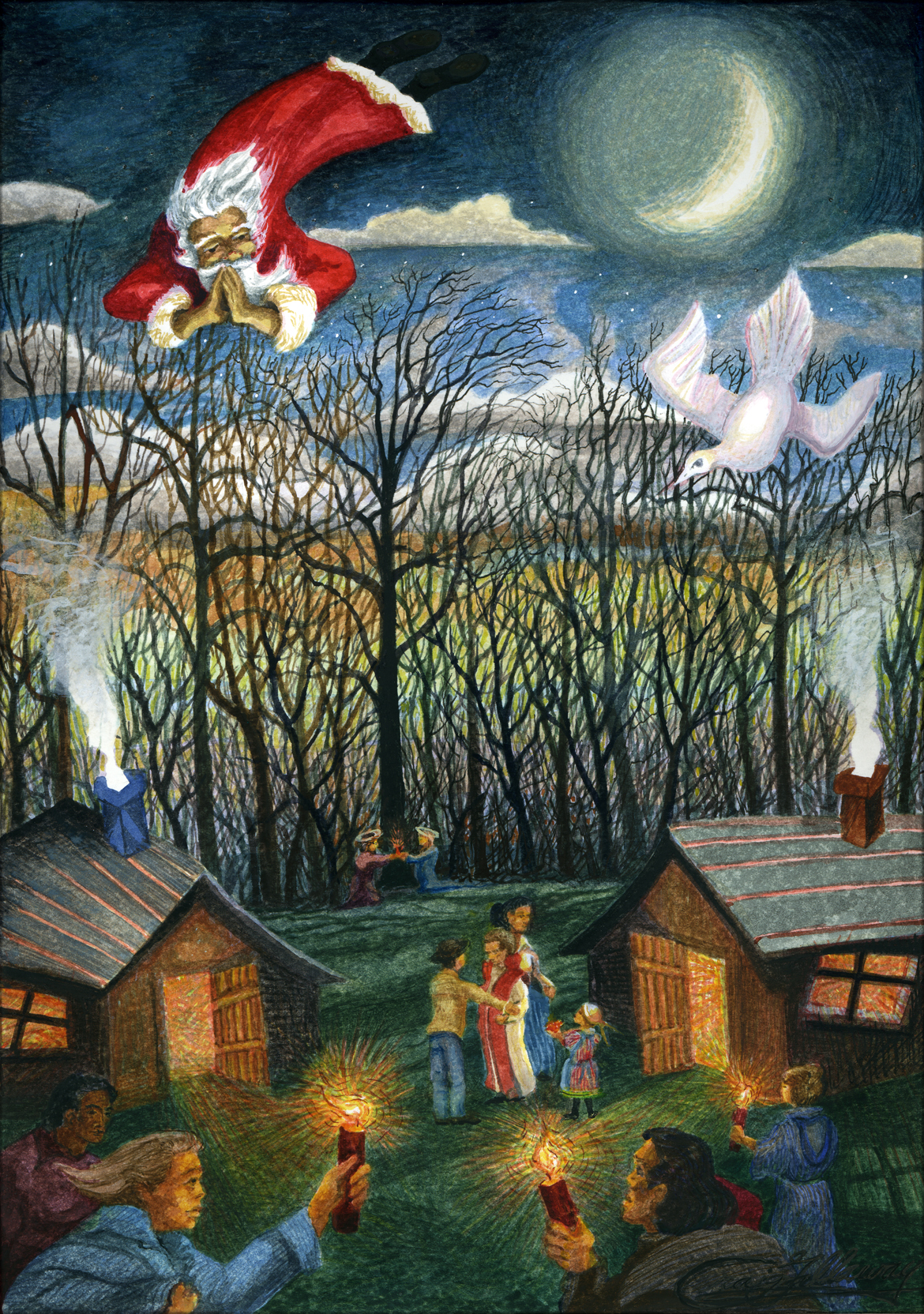
Saint Nicholas Praying for the Recovery of His Tradition, detail of the Spirit, watercolor by Craig Gallaway, Copyright 2005. From the time of Jesus’s baptism, the dove has been a reminder of the role of the Spirit and of the Father in all that Jesus accomplishes. He does not act on his own. He promises the Spirit will come to guide, befriend, comfort, and provide counsel. And he breathes the Spirit into his disciples after his resurrection, just as God breathed into Adam in the original creation.
“For freedom, you have set us free,” your servant Paul tells us (Galatians 5:1), and this means the freedom of life in your Spirit, the freedom to grow up in all of the fruits of your Spirit, to grow up in you:
To Love (agape) – because we are not focused only on our own needs or desires.
To know Joy – because we are no longer bound by the forces to which we once yielded power and control.
To experience Peace – because we are no longer pulled apart by rival “lords” and double-minded agendas.
To learn Patience – because we need to master smaller things before we are put in charge of larger.
To show Kindness and Gentleness – because we have moved beyond the doubts and defenses that once held us in check.
To practice Self-control – because we can do all things through Christ who strengthens us. Yes, in you, we are free.
And so, our fellow Advent pilgrims, Deb and I find ourselves with you at the close of another Advent and Christmas season, at the turning of the year toward a new year with our Lord’s Spirit and help, in the midst of His ongoing recovery and healing of the created order, on this road of New Creation. He has begun what is yet to be fulfilled. We have the first fruits of a great approaching harvest (Romans 8:23), and we must encourage each other not to grow weary “for our work is not in vain” (1 Corinthians 15:58).
Come, thou long-expected Jesus, born to set thy people free
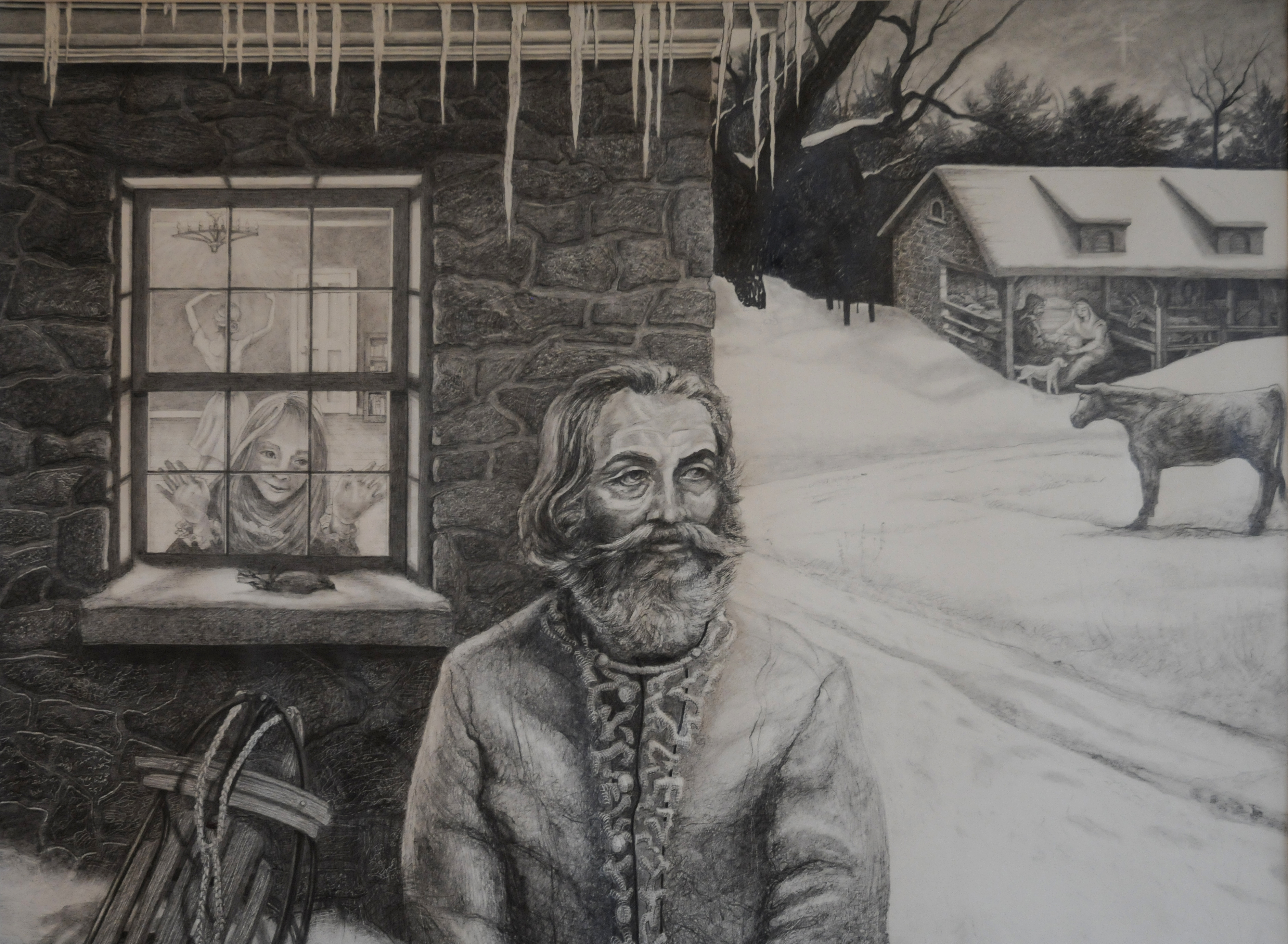
Saint Nicholas of the Dowry, Graphite drawing by Craig Gallaway, copyright 2011. Saint Nicholas is famous for his affirmation of marriage and for his support of young women who could not afford a dowry. In some cases, it seems, he was all that stood between them and a life on the streets.
Some might think it odd for Deb and me to choose an old Bob Dylan song, about the challenges of getting married, to celebrate the birth of our Lord and his purpose to restore the good order of creation. But then, in the Bible, there are few things that need restoration more than God’s good gifts of marriage and sexuality. And there is something in the very structure of Dylan’s song that echoes what the Bible has to say about this—how our incarnate Lord, born at Bethlehem to be both King and Bridegroom, wants to restore the order of marriage in his kingdom. [i]
We learn from the Apostle Paul and others that Jesus is the true bridegroom of his people, the church, and that he has suffered much to make the church his bride (Ephesians5:21-32). The epistle to the Hebrews tells us that, “He was tempted in every way as we are, yet without sin,” and this is why “he is able to sympathize with our weaknesses.” (Hebrews 4:15). Paul tells us that he was “obedient even unto death on a cross . . . and so God has highly exalted him and given him the name that is above every other name, Lord” (Philippians 2:8-11). And Hebrews again speaks of how “He endured the cross for the joy set before him, and then sat down by the throne of God,” (Hebrews 12:2) from whence he now reigns, “until God has put everything in order under his authority” (1 Corinthians 15:20-28).
This is the basic biblical narrative of the incarnate Son of God, from the time of his birth, through his faithful life and death, his resurrection and sending of his Spirit, and on now with his people, the church, toward the time when the great restoration will be fulfilled. And this is the narrative of our lives as well, if we have joined our lives to the living reality of his, by faith. For we are called to live our lives in him, and this means to follow him in the way of faithfulness and, yes, in the way of sacrifice. Paul puts it like this in Ephesians 5.
“Husbands love your wives, as Christ loved the church, and gave himself for it . . . so that it might be holy and without blame” (verses 25-27). “Wives, be subject to your own husbands as to the Lord” (verse 22).
In this way, Paul calls wives to exemplify what every Christian, including husbands and the unmarried, are called to do (cf., Romans 12:1-2). And he calls husbands to imitate the faithfulness of Christ, so that they may encourage and strengthen their wives in the pattern of life (in Christo) to which all people are called, again including the unmarried. We are all called to imitate the greatest Bridegroom of all, in the power of his Spirit, so that our lives may become whole and strong in him.
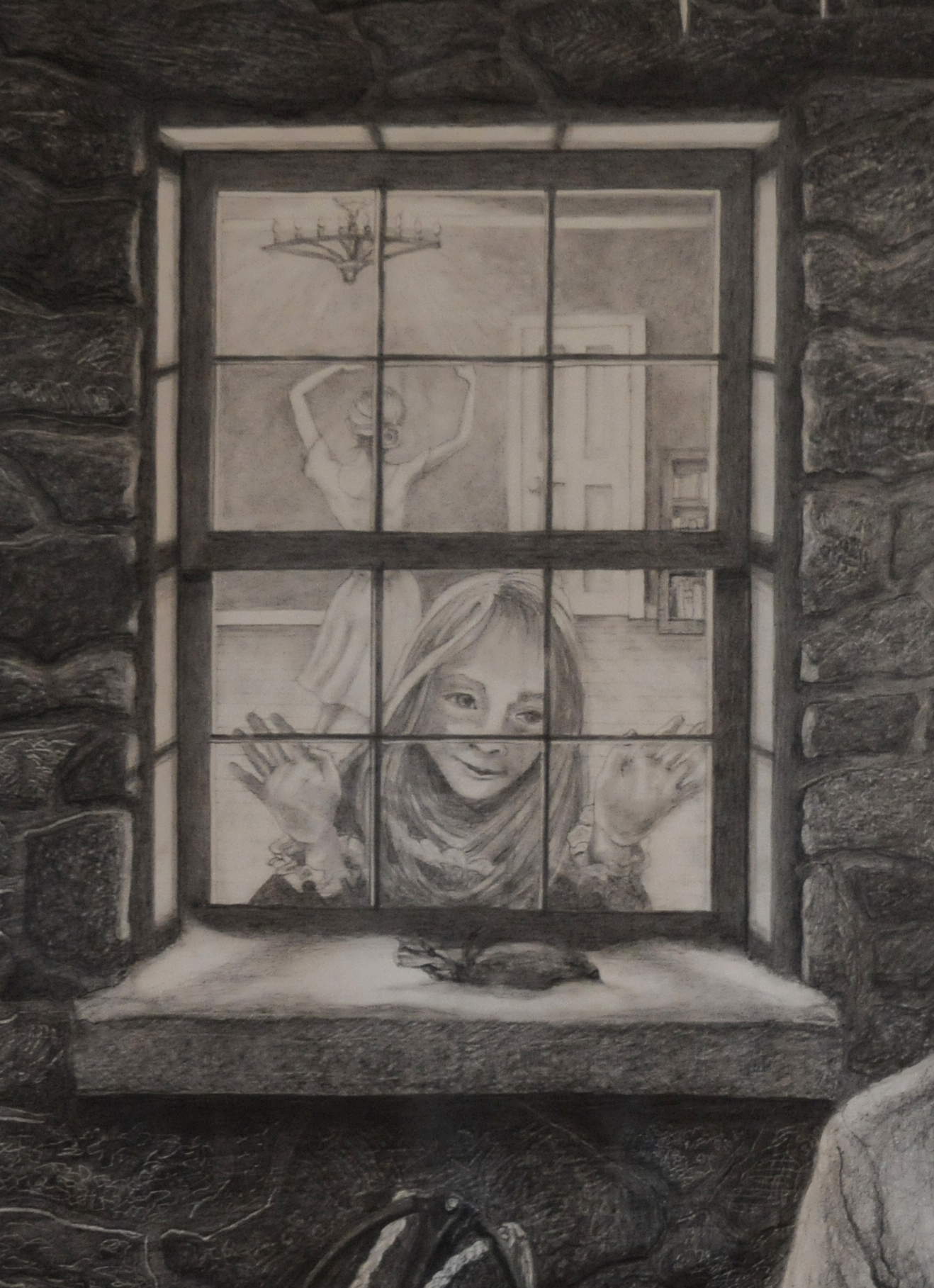
Saint Nicholas of the Dowry, detail, Graphite drawing by Craig Gallaway, copyright 2011. A younger sister looks out the window where Nicholas stands, having left a bag of gold on the windowsill. (In some early accounts, he would have dropped the gold down the chimney, or secretly left it inside the house.) Her older sister dances in the background because she has hope now to marry. My drawing no doubt makes their accommodations look more convenient than they would have been.
Of course, there are ramifications that ring out into our lives from this narrative. For example, we must not make an idol of sex–that is, to give it more power in our lives than it is due–unless we want to become confused about its real purpose. The degradations that result from idolatry are what Paul has in mind in Romans 1:18ff. Also, we should recognize that marriage has several purposes—mutual help, comfort, the procreation of life, and the preservation of chastity (Genesis 1-2, 1 Corinthians 7)—not all of which are focused on sex. If we are to follow our Lord, and live in his Spirit, we must be ready to take up the larger and wider callings that come with being good wives and husbands, as well as good neighbors and members of his bride, the church. Whether in our own personal lives, or in our corporate life together as his people, eros must be governed by agape. [ii]
But what, then, does all of this have to do with an old Bob Dylan song about a prospective bridegroom who is struggling to manage his inner fears, temptations, and doubts as he anticipates the arrival of his wedding day? Will he bolt and run, for fear of failure in the challenges of married life ahead? Or will he “get his mind off of wintertime” and rejoice in the arrival of his bride? Will he listen to the siren voices of romantic wanderlust, and travel to some distant place, or will he “pick up his money and pack up his tent” and look forward to the coming of his bride? What did Jesus do? What is he doing now?
By the third verse of Dylan’s song, we discover what our protagonist has decided to do. He will stay and embrace the covenant of marriage, with all that it entails. He plants his feet on solid ground and calls for the instruments of creativity and provision (perhaps also of procreativity): “Buy me a flute and a gun that shoots, I won’t accept no substitutes.” He intends now to honor his bride, like the Bridegroom is doing. He will fight for her against the enemy’s opposing forces, even if some of his own troops are weary or lagging. [iii] And he will “climb that hill no matter how steep,” so that he may rejoice in the joy set before him.
Thus, with the scriptural narrative ringing in our ears, we know what our Lord, our Bridegroom, has done (in his faithful life, death, and resurrection) and is doing (in the presence and power of his Spirit) in anticipation of the great day when his faithfulness will be fulfilled, when we too shall rise like him from the dead, and there shall be a new heaven and a new earth, and there shall also be a great wedding banquet for the Lamb and for us.
Can you hear, as Deb and I do, his voice echoing beyond our own as we sing about the place of our marriage in his New Creation purpose and care?
Ooo wee, ride me high, tomorrow’s the day my bride will arrive.
O Lord, are we gonna fly, down in that easy chair.
[i] Deb and I aren’t saying that Dylan intended or foresaw all of the biblical allusions that we see reflected in his imagery. But he did become a Christian later in life; and he was always deeply influenced by the Bible, as he once told Paul Stookey.
[ii] This seems to be the main point of C. S. Lewis’s reflections in The Screwtape Letters, regarding the demonic strategy that uses certain art forms to confuse people about the importance of “being in love,” that is of romantic or erotic passion, as if this were the foundation and purpose of marriage. If the demons win this battle, says Lewis, they also create an excuse for divorce when the level of excitement changes over time. But then, Lewis also portrays, in That Hideous Strength, how the affection of eros can be restored where husband and wife learn to embrace the larger pattern of servant love (agape) and obedience to God. Eros can return as a result of a more caring and wholesome way of life together, not as the goal or purpose of marriage itself.
[iii] Given the culture wars in America today, many of which turn on the definition of sex, gender, and marriage; and given the strong rhetoric of “hate speech” that has been cast against Christians for trying to uphold, much less to recommend the covenant of marriage as a source for sexual healing in our culture; Paul’s discussion of spiritual warfare (Ephesians 6) just after his instructions regarding marriage (Ephesians 5) does not seem at all accidental. In any event, to promote the Christian practice of marriage in our present culture will be a spiritual battle, to be sure; but one that the church must accept with a whole heart.
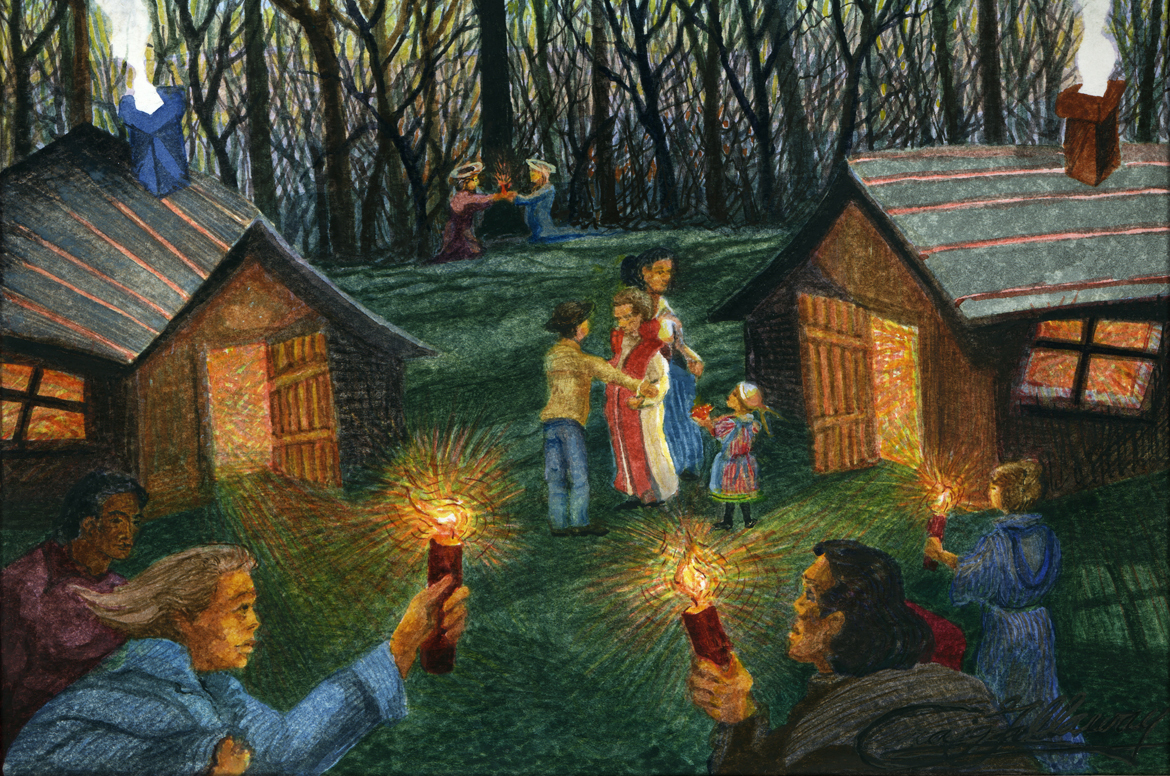
Saint Nicholas Praying for the Recovery of His Tradition, Watercolor by Craig Gallaway, copyright 2008. In this painting we see people of different races and ages seeking the light of Christ which brings them together as one family of faith. This also reflects the Apostle Paul’s vision of the Messiah’s single family.
In his letters to the Christians in Galatia and in Rome, the Apostle Paul explained with great energy why the coming of the Messiah into the world, “to give himself for our sins and to deliver us from the present evil age” (Galatians 1:4), leaves no room for ethnic divisions, jealousy, or strife within the single family of God’s people. Indeed, according to Paul, God’s purpose from the beginning, as in the covenant promise to Abraham, has been to make one family of his people across all national (that is, ethnic) and cultural boundaries. Jesus confirmed this promise in his “great commission” (Matthew 28:18-20). And so, Paul declares with great boldness:
“For you are all children of God, through faith, in the Messiah, Jesus. You see, every one of you who has been baptized into the Messiah has put on the Messiah. There is no longer Jew or Greek; there is no longer slave or free; there is no ‘male and female’; you are all one in the Messiah, Jesus. And if you belong to the Messiah, you are Abraham’s family. You stand to inherit the promise.” (Galatians 3:26-28)
This was radical stuff in the strictly stratified culture of ancient Rome. It is radical stuff today. The church so aligned with its Lord (then and now), like Jesus at the beginning of his ministry, rejects Satan’s temptation to seek power by exploiting the nations (the ethne, Matthew 4:8-11). And like a city set on a hill, the church thereby demonstrates the power of his resurrection, the beginning of the new creation, his victory at the cross over the fallen powers, including the power of race itself where this has become disordered and abused. But what then does it look like as we live this life of new creation in our risen Lord and in his Spirit–where he is putting everything back in order, where there is neither Jew nor Greek, where race itself literally does not divide us?
In our current culture wars in America today, there are primarily two opinions about how to deal with issues of race and ethnicity. In order to avoid using merely partisan tags and labels, we may think of these in terms of two major leaders who speak for these two views, Robert Woodson and Ibram Kendi.[i] In Kendi’s view, using the ideas of Critical Race Theory (CRT), the topic of raceitself must be the primary focus for improving race relations. We must, therefore, divide people into groups according to their skin color, and judge them as oppressors (if white) or as victims (if black or, perhaps, people of color). No room here for differences among individuals based on traits of character, moral choice, or personal behavior. Then, we should proceed by creating government programs that favor the black victims and restrict or penalize the white oppressors.
In other words, according to Kendi’s view, we must follow a strategy that is exactly opposite of Paul’s view, as well as being opposed to the practices of Martin Luther King, Jr., who called Americans to judge one another “not by the color of their skin, but by the content of their character.” Kendi, by contrast, regards the principle of “colorblindness” itself as a pillar of racism because it does not force the collective pre-judgement (what I would call the racial profiling!) demanded by CRT and the concept of “systemic racism.”
From the other side, Robert Woodson warns America that Kendi’s approach only creates division, envy, animosity, victim mentality, and lust for power. Indeed, Woodson regards CRT as a form of racism more insidious than the old-fashioned type of the KKK which was obvious on the face of it. Moreover, by focusing on race as an end in itself (as the CRT, DEI, ESG, and other government and corporate programs are now doing), we only make matters worse for the very people we say we are trying to help. The “race hustle,” as Woodson calls it, has a terrible history of failure. In the fifty years or so since the welfare state was created by LBJ’s “Great Society” programs, some 42 trillion dollars have been spent. Seventy percent of this went to operating costs for the government’s own overhead, not to recipients. And the inner cities have only gotten worse in every area of basic measurement (single-parent families, illegitimate birth rates [now 70%, up from 20% in the mid 1960s], educational outcomes, low income, neighborhood blight, violence, etc.).
Saint Nicholas Praying for the Recovery of His Tradition (Detail), watercolor by Craig Gallaway, copyright 2008. The title of this painting refers to the tradition (the “handing on”) of St. Nicholas. But Nicholas himself stood, as he knew, in the tradition of Jesus, born to Mary and Joseph, who kneel together in the background. And all of this reminds us that our Lord has chosen to mediate his new creation purpose through the ministry and participation of his pilgrim people, of which we too are a part.
By contrast, says Woodson, we should follow the guidance of Scripture, and focus instead on three basic things: 1. the grace of God extended to all people, all of whom are sinful, 2. the gifts and purpose that God has for every individual person, and 3. the goal of unity in a colorblind congregation, community, and society. Thus, Woodson champions leaders of every color, especially in the black community, who have become mentors for the people in their own neighborhoods. Such local, grass roots leaders demonstrate how to be responsible for one’s own life, and to succeed with discipline and dignity, even when there are still others around (including the CRT group and the white supremacists, strange bedfellows!) who insist on pre-judging people by the color of their skin. He calls these mentoring exemplars “Josephs,” for the role they play in leading the whole country toward healing, wholeness, and “a more perfect union.” As a result, the Woodson Center, in contrast to the welfare state, has a long history of major and sometimes miraculous success participating in the transformation of individuals, neighborhoods, and communities.[ii]
The difference between these two visions could not be more pronounced.[iii] One is highly idealistic, self-righteous, and brooks no dissent from its agenda, requiring a kind of “group think” from everyone, and ready to cancel or censor those who don’t toe the line. The other is realistic, recognizing that people are not perfect, that we are in fact sinful; but that we make progress by taking measured steps grounded in faith and moral tradition as we make our way toward “a more perfect union.” And only one of these visions is consistent with Paul’s vision of how the incarnate, crucified, and risen King, Jesus the Messiah, is restoring his people, even now, by the power of his Spirit, putting everything back into the proper order of creation, and building the new creation that is yet to be fulfilled.
The song that Deb and I are sharing this week, Some Children See Him, also follows Paul’s vision of the Messiah’s single family–making our way together in him on the road of new creation. Each verse of the song portrays children who imagine the baby Jesus as a member of their own ethnic group (though of course, historically, Jesus was not a member of any of the groups mentioned). Each verse shows, moreover, how our Lord’s life, his love, and his power, nonetheless, reach children (and people) in every group. And then, still ringing with Paul’s vision, the emphasis on groups stops, and we stand individually before Christ himself. In the light of his holy Light, we affirm our ethnic and racial heritages, to be sure; but we do not let them become an idol, separating us from him or from each other. Rather, we hear his own invitation through the music of jazz musician, Alfred Burt, and the words of Wihla Hutson:
[i] Robert Woodson is a veteran of the Civil Rights Movement, who pulled away from that movement when he saw it turning into what he came to call the “race hustle” of the welfare state. He saw black and white elites growing wealthy by creating expensive programs that signaled their own virtue but did little to change conditions for the people they were supposed to help. In this assessment, Woodson is the protégé of Thomas Sowell. For further reading, see Robert Woodson, The Triumphs of Joseph: How Todays Community Healers Are Reviving Our Streets and Neighborhoods. Ibram Kendi is one of the more prominent academic teachers of contemporary neo-Marxist ideas about race, based on the concept of “systemic racism” and the methods of Critical Race Theory. For further reading, see Ibram Kendi, How to Be an Antiracist, and Stamped: Racism, Antiracism, and You.
[ii] Woodson’s vision, following Paul and the Bible, does not ignore or demean our different ethnic heritages—the things that make us ethnically and culturally different from each other: for example, food, fashion, music, and even many of the elements that shape the way we worship God. But neither does he see why different groups should be forced by an academic or a government program to adopt the same cultural style, customs, congregation, or neighborhood. Rather, Woodson affirms the approach of Paul in Romans 14. We should leave room for our cultural differences (Paul’s word is adiaphora, that is, non-essentials). We should in fact honor these in our own and in each other’s lives. But we don’t have to force everyone into a single style. Thus, we may be different in our ethnic heritages without shame or guilt, and also united in our love for the living God who knows each of us from our mother’s womb and has a unique plan for each of us in his new creation.
[iii] The mention of two visions invites a further reference to the work of Thomas Sowell. Sowell has done as much as anyone on the planet to document with hard empirical evidence the ideas and actual results of the two visions we are examining. See Thomas Sowell, A Conflict of Visions: Ideological Origins of Political Struggles, and The Vision of the Anointed: Self-Congratulation as a Basis for Public Policy.
[iv] I take Hutson’s reference to “earthly things” here to mean precisely the ethnic and racial differences (adiaphora) that distinguish us culturally from one another in comparison to the unity that we have in Christ our Lord as fellow sinners made alive in the Spirit and making our way together with the single family of God toward the fulfillment of the new creation.










 Faith and the Arts