Within the space of two chapters (5 and 6) Mark Studdock goes through in microcosm and as an individual all four stages of the neo-Marxist “cultural revolution” described by Yuri Bezmenov. When this occurs at the societal and collective level it may also exhibit the characteristics of “mass formation” described by Matthias Desmet (see Introduction).
FOG
Overview Question
Another way to analyze the content of Chapters 5 and 6 is to evaluate what is happening to Mark as an individual within the framework of Yuri Bezmenov’s “Four Stages of Cultural Revolution” (as described in the Introduction). Given the four stages–1. Demoralization, 2. Destabilization, 3. Crisis, and 4. New Normal–how would you track Mark’s progress through these stages from his first interviews with Wither and Miss Hardcastle, to the job-insecurity that arises from Feverstone, to his frantic effort to regain solid footing with Curry, and finally to his capitulation to what he knows to be the nefarious yet required role of churning out propaganda for the NICE. This will reveal how the stages of Bezmenov’s model appear in the life of one individual; but the wider collective phenomenon will also appear in future parts of Lewis’s story. Overview Question:
Given the four stages of Bezmenov’s model, try to locate Mark’s “progress” as he makes his way through the difficulties that he faces in Chapters 5 and 6. For example, at what point does he become demoralized, and when does this shift to the more serious stage of being destabilized? At what point does Mark enter a condition of crisis? And when does he finally cave into what is, at least for a period of time, his new normal?
DEEPER-DIVE QUESTIONS
1.In Part 1, Wither continues to work on Mark with a style of communication that leaves Mark at sea about whether he has a job, or not. At the same time, Mark’s own self-absorbed motives, especially his ambition to be part of the inner circle, make him very vulnerable to this kind of manipulation. Describe the “fit” between Wither’s leadership style and Mark’s personality. What different character traits or virtues might have provided Mark with a means of resistance to Wither’s mechanizations?
2. Absent the needed character traits to resist, Mark finally caves in and begins to do the bidding of the NICE. He begins to work as a fake news “journalist,” providing the kind of cover, spin, and suppression that are needed to keep the NICE from taking responsibility for their own destructive actions. What parallels can you see between the kinds of problems that the NICE causes, the kinds of articles that Mark writes to cover them, and the events and media coverage that have shaped public opinion in America over the last 5 or 6 years? Try to be specific and think of at least three examples.
3. In Part 3 of Chapter 6, we meet again the Rev. Straik whose reflections on Jesus and the resurrection typify the role of religion in the modern worldview. What is that role, according to Straik, and where do you see a similar use of religion at work in the political and cultural battles of our time?
4. In part 5, Jane goes into Edgestow and runs into Professor Frost of Belbury, whom she has seen previously only in her dreams (see part 2). The nature of this man’s actions in her dreams, and the atmosphere of his person when she nearly touches him on the street, send a shock of repulsion through her. She hadn’t really wanted to go to St. Anne’s to see the Director, but now her desire to go is urgent. What do these hints suggest about what is happening in Jane’s inner life, quite apart from her initial or deliberative plans?
Once again, the pre-covid cast for the THS movie directed by Antione Fuqua included a promising actor, this time for the role of John Wither, that creepy embodiment of prevaricating obfuscation and manipulating control.
ELASTICITY
Overview Question
In Parts 1 and 2 of Chapter 5, Mark is drawn yet further into the manipulations of the lifeworld of Belbury. Deputy Director Wither continues to flatter Mark’s vanity while refusing to give him a clear job description or to make a solid job offer. Fairy Hardcastle warns Mark not to expect a clear job description from Wither; and then explains how, if only Mark will do as he is told, he can begin to rise as a kind of activist journalist swaying public opinion for the NICE. And then Mark learns that his position at Bracton College is in jeopardy because Lord Feverstone has informed them that Mark is joining the NICE. When confronted, Feverstone simply shrugs Mark off with a dismissive comment. All of these passages portray in some detail how the modern worldview operates at the level of personal and interpersonal relationships. And this leads to our Overview Question for the week:
How do the different actions of Wither, Fairy Hardcastle, and Lord Feverstone in relation to Mark’s own servile mentality illustrate the basic principles and practices of the modern worldview and lifeworld at Belbury?
For additional help in answering this question, remember the brief outline that I provided with the Chapter 3 Overview Question: Yoram Hazony’s analysis of the “practices” that characterize both the modern and the traditional worldviews. In particular, keep in mind how the modern worldview valorizes above all individual freedom and reason, and rejects the need for religious, moral, or even familial traditions of loyalty, honor, and acknowledged hierarchy to guide and shape the freedom or the reason of the individual.
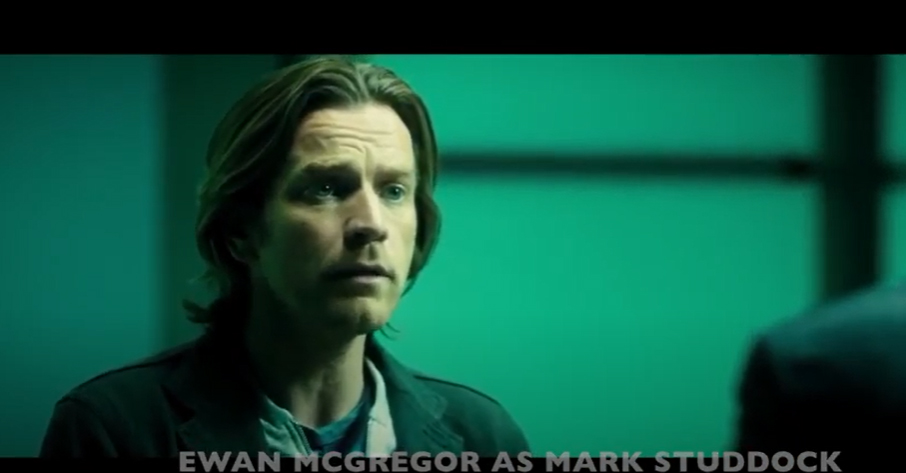
As artfully evoked in the expression of actor Ewan McGregor, Mark’s lack of a transcendent religious and moral point of reference, and his desire above all to be counted among the elite, leaves him imminently vulnerable to the manipulations of nearly everyone at Belbury.
DEEPER-DIVE QUESTIONS
1. In Part 3 of Chapter 5, Arthur and Camilla Denniston take Jane on a picnic, and treat her in a manner that is quite opposite of how Mark is treated at Belbury. They propose a specific role for Jane: namely, to consider her dreams as a special gift that can be of great help to the community at St. Anne’s. When Camilla begins to put pressure on Jane to decide right away, however, Arthur reminds her that the Director of their community would not want Jane to join them under that kind of pressure or coercion. In contrast to Mark’s interview, what interpersonal conditions are given priority in Jane’s interview, and how do these reflect the principles and practices of the traditional worldview? (see again Yoram Hazony)
2. How do the conditions of the two interviews reflect the customs and values of the two groups of people and the two worldviews that inform Lewis’s story, the modern worldview and the traditional worldview? In particular, what role do the values related to the family and religion at St. Anne’s play, in contrast to the emphasis at Belbury on the individual and his or her “freedom.”
3. Where, in our current cultural and political turmoil in 2022, do you see signs of the kind of individualism, disunity, coercion, cancellation, and manipulation of power that characterize Mark’s job interview at Belbury? Where are there signs of the open discussion, debate, transparency, and the freedom to deliberate and practice informed consent that are given to Jane?
Sub-Warden Curry and Rev. Busby look on as the NICE police watch while rioting workers destroy the grounds of Bragdon Wood and Bracton College. When these two college administrators first manipulated the faculty into selling Bragdon Wood at a profit, they hadn’t realized that the NICE would destroy the college grounds. Now they must try to put a good face on their own short-sighted leadership. Collusion with an authoritarian state can have hidden costs! (This is a screenshot from the pre-covid THS movie that has now, I believe, resumed production with a new cast.)
THE LIQUIDATION OF ANACHRONISMS
Overview Question
This chapter portrays a truly nightmarish attack by the NICE on the basic rights of the English people who live around Edgestow. The Dimbles lose their home in an abrupt and legally questionable cancellation of their lease. Bracton College loses its landscaped buffer zone (Bragdon Wood) and its historic stained-glass window as rioting workers run amok. And the village of Cure Hardy is scheduled to be razed by the NICE to make room for an “improved” state-run model village. Furthermore, all of these abuses of private property are accompanied by a psychological assault on the legal traditions and moral sensibilities of the people (all of which are seen as “anachronistic” by the NICE). The people can’t quite believe this is really happening. Overview Question:
Given what you already know about the “long march through the institutions” (from Chapter 2), what makes it possible for the NICE, with little if any resistance from public authorities, simply to ignore and run over the basic rights of the people? And what parallels can you see in America today for this kind of government action that routinely ignores and runs over the basic constitutional rights of the people?
Screenshot from pre-covid THS film. Are the NICE police trying to stop the rioting, or are they egging it on? No one will know for sure until the local papers, now controlled by the NICE, clarify the story. O, that story is already in print, and the riot would have been much worse except for the NICE intervention. O.K. got it.
To get at the heart of this problem in Lewis’s story, I suggest that you combine what you have learned about the “long march” in Chapter 2 with what we discussed in the Introduction concerning Yuri Bezmenov’s description of the stages of cultural revolution. In particular, the first two stages: 1. Demoralization, and 2. Destabilization. These should help you discover a very plausible interpretation for what takes place in Lewis’s story.
This may also be a good time to consider the larger shape of Lewis’s story as it spreads out before and behind us. A quick glance at the Table of Contents reveals a definite trajectory in Lewis’s plot. In general, the story moves from a.) the early chapters where the NICE at Belbury are expanding their reach and power over both people (including Mark) and institutions; to b.) the middle chapters where Mark and Jane are discovering the challenges of their “callings” at Belbury and St. Anne’s; and then c.) the final chapters where both Mark and Jane come to a crossroads as the spiritual battle is fully joined. The following diagram shows this dramatic sequence at a glance:
1. Sale of College Property
2. Dinner with Sub-Warden a. The Taking and Holding
3. Belbury and St. Anne’s of Territory
4. Liquidation of Anachronisms
5. Elasticity
6. Fog
_____________________________________________
7. The Pendragon
8. Moonlight at Belbury
9. The Saracen’s Head b. The Calling and Inward Battles
10. Conquered City of Mark and Jane
11. Battle Begun
12. Wet and Windy Night
______________________________________________
13. They Have Pulled Down Deep Heaven
14. Real Life Is Meeting c. The Road of New Creation
15. Descent of the Gods and the Way Ahead
16. Banquet at Belbury 17. Venus at St. Anne’s
A photograph of an English village by a river that looks a lot like the description of Lewis’s Cure Hardy. This is the kind of village, note well, that the NICE plan to relocate in the novel in order to reroute the river and make a new model village somewhere on the higher ground nearby. (Photo by Colin Braidford.)
DEEPER-DIVE QUESTIONS
1. In Part 1, the Dimbles lose their cottage. In Part 6, Mark works with the NICE to condemn the quaint village of Cure Hardy. And in Part 7, Bracton College loses its Wynd River, its land, and its famous stained-glass window. In the conversation between Mark and Cosser at Cure Hardy (Part 6), Lewis portrays the kind of thinking (the basic premises of the modern worldview) that warrant these actions. What are these premises, and where do you see them at work in American politics today? (The “Four Stages of Revolution” in the introduction should also help with this analysis.)
2. In Parts 2 and 5, we find Jane continuing to have dreams, and wishing that she could somehow just get rid of them altogether. At the same time, her experiences with Mother Dimble expose her to a worldview where prayer and a desire to grow in virtue demon-strate a kind of faith that Jane simply does not possess. How might Jane’s aversions to her dreams and her discomfort with Mother Dimble’s traditional faith be related?
3. In Part 3 of Chapter 4, Mark finds himself confronted with the religious views of the Rev. Straik, who serves as a kind of advisor for the NICE. How do Rev. Straik’s views on Christianity fulfill the requirements of the modern worldview and of the “long march” at NICE? (Consider your answers in the light of the “disestablishment” clause of the First Amendment to the US Constitution.)
4. In the Discarded Image, Lewis explains how, in the medieval worldview, everything is mediated in the relations between God and man. We see an example of this when, in the midst of his work with Cosser, Mark’s conscience is awakened to the beauties and virtues of Cure Hardy by memories from his past experience with family and friends. As a consequence of these “messages” mediated from the past, Mark’s conscience is awakened, and he almost turns against the mentality of the NICE. What are the thoughts, experiences, and memories that mediate this awakening, and why does Mark turn away from them?
Ewan McGregor was well chosen, in my opinion, as Mark Studdock in the pre-covid 19 cast for the THS film directed by Antoine Fuqua. MacGregor would have helped us see, I can well imagine, how the manipulative and unaccountable atmosphere of alleged “equality” at Belbury was perfectly suited to exploit Mark’s obsequious desire to please those in power.
BELBURY AND ST. ANNE’S ON THE HILL
Overview Question
In this chapter we encounter the very different social and interpersonal dynamics that characterize Belbury and St. Anne’s on the Hill. What is most striking is how nearly opposite these two groups of people are in terms of how they treat Mark and Jane. Indeed, the contrast is so sharp that it begs for some kind of explanation. And this provides the focus for our overview question this week:
Why do the people at Belbury (who hold the modern worldview, as we have seen) confound and manipulate Mark the way they do; while the people at St. Anne’s (who hold the traditional worldview) make every effort to behave with candor, transparency, and informed consent toward Jane?
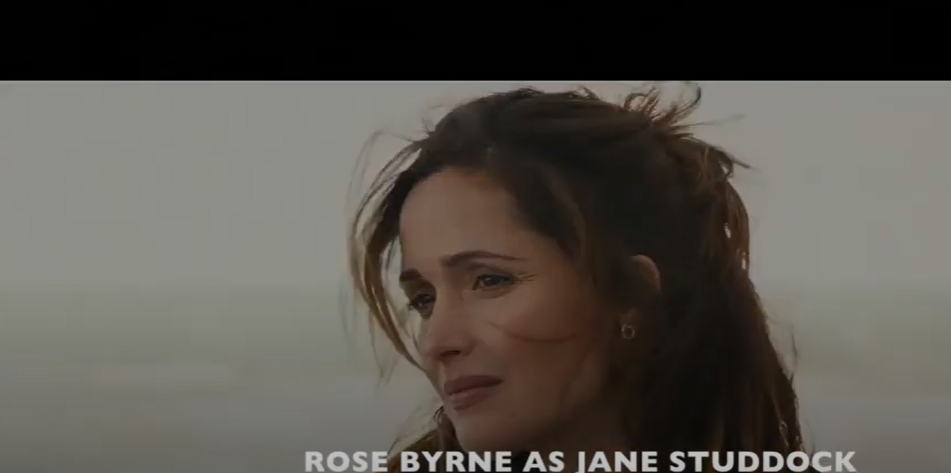
Rose Byrne, as Jane Studdock, has also been replaced in the post covid 19 cast for the new THS film. But these screen shots give us an opportunity to reflect on these characters, Mark and Jane, and how different they are from each other though both begin as holders of the modern worldview. And then how differently Jane is treated by Grace Ironwood and others at St. Anne’s in comparison to Mark’s entry into an arena where “every man for himself” is the unspoken rule.
Note well, I am asking you (with the overview question, above) to think about why each worldview–lifeworld seems to produce such starkly opposite results at the level of personal and interpersonal relationships. Of course, Lewis doesn’t do this analysis directly in the story itself; but his very consistent portrayal of both groups, which only gets sharper and clearer as the story proceeds, suggests a definite set of observations on his part. In order to clarify this contrast, let me recommend another interpretive tool that you may at your choosing find helpful: A brief sketch of Yoram Hazony’s analysis of worldview practices from Conservatism: A Rediscovery.
Hazony gives a remarkable history of what he calls the Anglo-American Conservative paradigm with its traditional worldview, on the one hand, and the Liberal Enlightenment paradigm with its modern worldview, on the other. Of particular interest in this regard are Hazony’s observations that the traditional worldview valorizes specific principles and practices such as loyalty, honor, family, hierarchy, religion, and empiricalknowledge (based on evidence); while the modern Enlightenment worldview valorizes the opposite: freedom and independence of the individual, the alleged “self-evident” truths of reason and nature, and the rationalistic approach to knowledge (based on a priori first principles rather than evidence). As such, the modern individualistic worldview rejects the need for religious or moral traditions and practices to guide or inform its use of reason; while this is precisely what the traditional or conservative point of view calls for. Are there clues here about the two opposing “styles” of Lewis’s two groups?
I think Hazony’s observations are in close alignment in many ways with what Lewis is trying to show us in his fictional portrayals of the very different worlds of Belbury and St. Anne’s on the Hill.
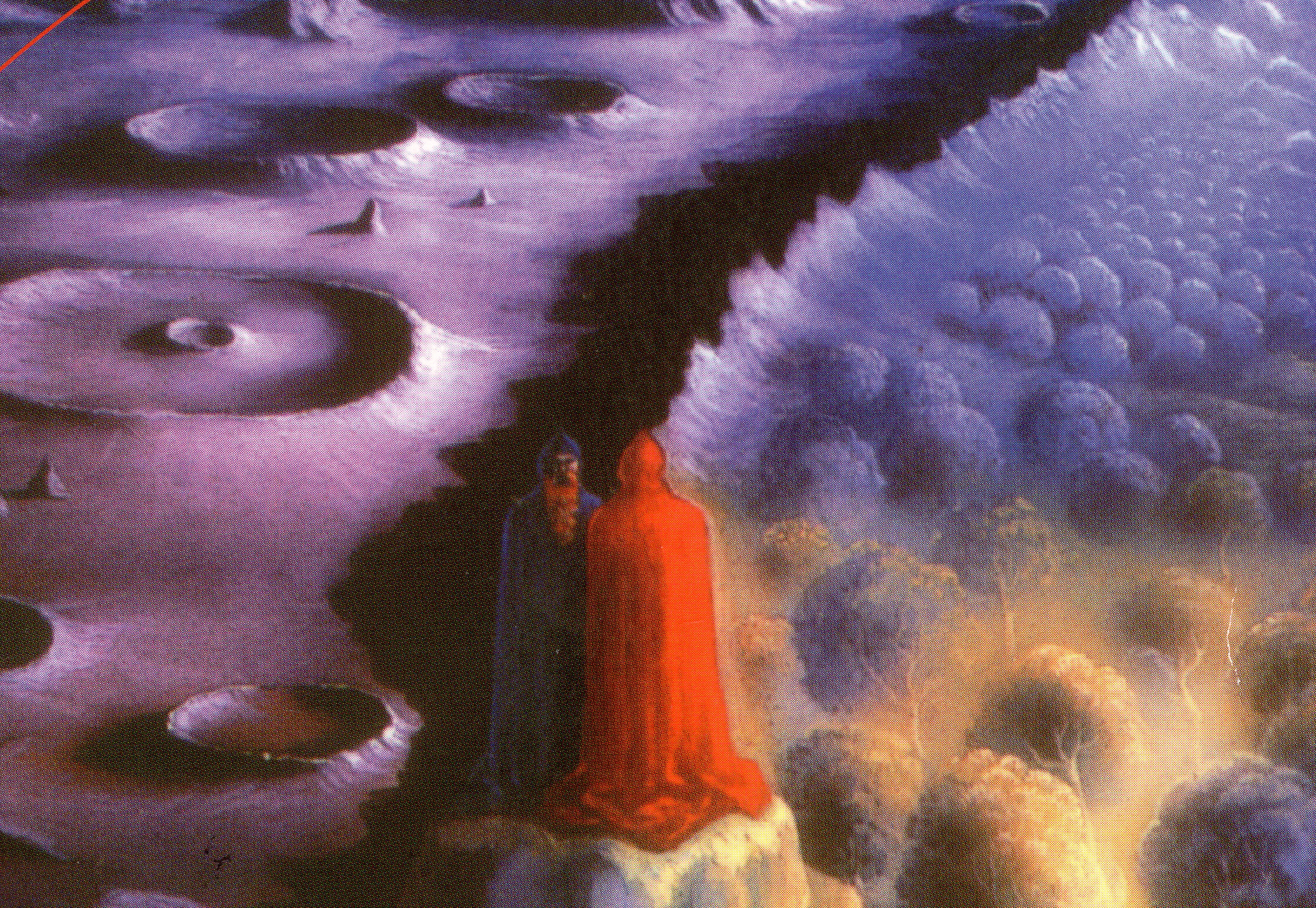
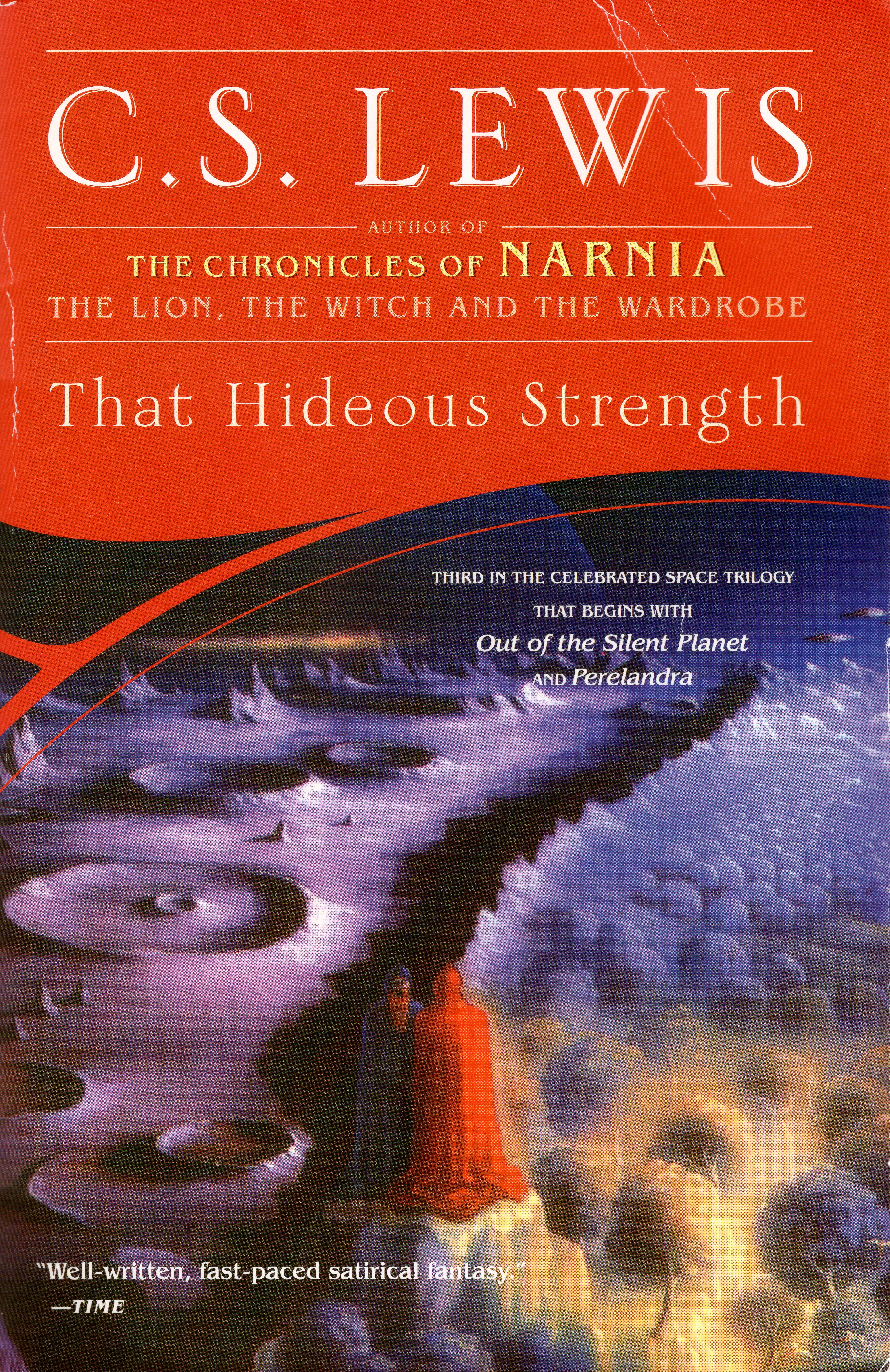
The cover illustration of Scribner’s 2003 edition of THS portrays the landscape of the moon with its dark cold side (pointing toward earth where the marriages are “barren and cold”) and its bright living side (pointing toward the joys and creativity of deep heaven) as Ransom describes this to Merlin later in the story. Are there hints here of the two very opposite ways of living–specifically in this case related to marriage and sexuality–that are reflected at Belbury and at St. Anne’s on the Hill?
DEEPER-DIVE QUESTIONS
1. In Part 1 of Chapter 3, Mark has a long conversation with John Wither about the possibility of taking a new job with NICE. How would you describe the “style of communication” that Wither uses with Mark? What seems to be Wither’s purpose for using this style? How does this style tie in with what you already know about the larger social vision, lifeworld and worldview at Belbury?
2. In Part 3 of Chapter 3, Jane tells Miss Ironwood about the strange dreams that she has been having. How would you describe Miss Ironwood’s style of communication with Jane? How does Miss Ironwood’s style and manner differ from that of Wither? What does Miss Ironwood’s different communication style suggest about the different values of the worldview embraced at St. Anne’s?
3. In Parts 2 and 4 of Chapter 3, we are introduced more fully to Professor Hingest (chemist at Bracton) and Fairy Hardcastle, head of the NICE institutional police. We learn that Hingest and the NICE hold nearly opposite views of what science is really all about. Why do the NICE regard Hingest as “the wrong sort of scientist” while he regards their work, including Mark’s sociology, as not really science at all? How are the two worldviews reflected in these different approaches to “science,” and how are the differences also reflected in the politicization of science in America today?
4. In Parts 3 and 5 of Chapter 3, Jane struggles through her interview with Miss Ironwood. Everything that happens–Jane’s wandering thoughts about Camilla’s beauty, her premonition of a passage on sex and sexual attraction in a book she picks up while waiting to see the Director, and Miss Ironwood’s unwelcome advice about her dreams—seems to go against how Jane wants to see herself. What pattern, if any, can you detect in what Jane wants for her own self-image, and what keeps happening to her to interfere with this?
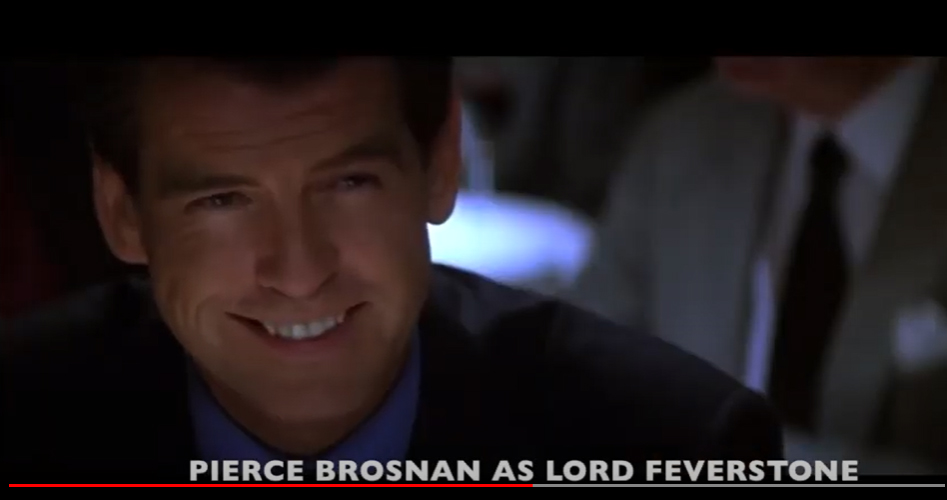
Screen shot of Pierce Brosnan as Lord Feverstone in the 2019 pre-covid cast for what was then planned as a new THS movie directed by Antoine Fuqua. In my view, Brosnan would have made a convincing, cold-blooded Lord Feverstone.1
DINNER WITH THE SUB-WARDEN
Overview Question
Having accepted Sub-Warden Curry’s invitation to dinner after the all-day faculty meeting (where Bragdon Wood was sold!) and hoping to strengthen his position in the “progressive element” at the college, Mark attends the gathering in Curry’s rooms with several elite college faculty and sponsors including Rev. Busby the bursar, Curry himself, and Lord Feverstone, the latter an important political figure with connections in London.2
As the evening progresses, it becomes clear that these men do not really know each other in a personal way, nor are they loyal to each other. Both Busby (as a representative of the college) and then Feverstone (as a representative of the NICE) expound their views on “man, nature, science, and society,” and then speak at length about how the elite leaders of the NICE will take over all of the major institutions of society. All of this echoes what we saw in the introduction (8/3/22) concerning the modern worldview with its administrative state and its neo-Marxist “long march through the institutions.” Meanwhile, Mark is watching every move to see where his best opportunity will arise to join the “inner ring,” if he can only figure out where the real “ring” is.
Question: As you read the speeches of Busby and Feverstone in Part 1, what specific cultural institutions do they name or allude to as they spin out their visions for the influence of the NICE in the college and in the wider world? How are these same institutions at play today in the culture wars of America?
Cover for the 1965 Simon & Schuster edition of THS illustrating the different levels of local, global, and spiritual forces at work in the story.3
DEEPER-DIVE QUESTIONS
1. At the faculty dinner, after Curry and Busby have left, Feverstone belittles them and declares them to be mere pawns in the grander scheme of the NICE, which is global in scope, not just local or academic. What parallels for this two-tiered struggle for power between the local (regional or national) focus, on one hand, and the global (or interplanetary!) focus, on the other, can you discern in the geo-politics of the world today? And why is it important (for us as for Lewis) to mark these levels?
2. Still in Part 1, Mark becomes flushed with excitement as Feverstone verbally runs down the college men and goes on to paint a picture of the administrative state in which “some men have got to take charge of the rest.” What does this scene tell us about the pattern of loyalty and honor that one may expect (not only between Mark and Feverstone) but also in an administrative state that is based strictly on natural reason and individual freedom, as opposed to the values of religion, family, congregation and community that guide the traditional lifeworld?
3. In Part 2, after lunch with the Dimbles, Jane hoped her anxieties about her dream would go away. But they didn’t. So, when Mark comes home from his dinner, he finds her in an unusually vulnerable mood. But then in Part 3, the next morning, Jane is angry and defensive about having let herself get upset in the first place. What do these layered reactions say about Jane’s struggle with her own personal formation? Are there hints about her own nature that she has a hard time accepting given her preferred self-image?
4. In the final Part of chapter 2, Jane and Mark are moving in opposite directions, one by fast sports car to Belbury, the other by slow train to St. Anne’s. How do the details of Lewis’s descriptions reveal not only the two very different geographic destinations, but also the two opposing worldviews (modern and traditional) that are, so to speak, hidden in the landscape?
A train trailing smoke through the English countryside may help to remind us of the kinds of beautiful, agrarian places Jane would have seen on the way from Edgestow to St. Anne’s on the Hill. Photo from stock images online at Flickr and Pinterest.
A new cast has recently been announced for this movie version of THS which will, at the time of this writing, feature Hugh Grant as Feverstone. Other new cast members include: Daniel Day-Lewis as Ransom, Emily Blunt as Jane Studdock, Emma Thompson as Grace Ironwood, and Jeremy Irons as Frost, plus a host of other great picks. Should be a worthy effort if our government, in contrast to Feverstone’s vision for 1940s England, can wean itself from further lockdown and emergency powers.
Lord Feverstone is also the Richard Devine of Out of the Silent Planet, the first volume of the space trilogy. Devine/Feverstone is an old classmate and enemy of Dr. Ransom, the Director at St. Anne’s. In the first book, Devine and his partner Edward Weston kidnap Ransom and try to use him to gain control of the creatures on the planet of Malacandra (Mars). But Ransom fights back and makes some surprising discoveries about interplanetary spiritual powers. The portrayal of good and evil in the first two books will add much to the understanding of these themes in THS; but as Lewis himself says in his Preface, though the stories form a sequence, each “can be read on its own.”
The illustration for this 1965 Simon & Schuster cover with its picture of a) the college, b) the chess game pieces, c) an interplanetary map, and d) a symbol of mysterious power floating overall, suggests the various “levels” of interest and engagement for the different kinds of actors who support the NICE (in keeping with Lord Feverstone’s own description in Chapter 2). At one level, there are those, like the college faculty, who support the NICE simply because it promises to increase their salary. And then there are those somewhat higher up, like the administration of the college or Mark himself, who see an opportunity to rise within the frame of regional politics. And then, yet higher (or spiritually lower as the case may be), there are those like Lord Feverstone and the leaders at Belbury who represent forces that want to use the NICE to dominate and control the whole world or even the universe. One reason it is important to mark these levels is that, as in Dante’s Inferno, they reveal different motivations and degrees of evil that betray people at each level. This is also relevant as we try to take stock of the spiritual forces at work in the geo-politics of our own time. Some people at the lower levels of involvement are what the Marxists have called “useful idiots,” for they do the regime’s dirty work and are later dispensed with. One such group was the Red Guard in Mao’s China who were banished to the wilderness after helping to oppress the general population into subservience. Lewis was clearly aware of these different levels in the culture war of his time. And he explores this issue in greater detail as the story proceeds.
Mark and Jane Studdock are in many ways a typical young modern couple: college educated, with professional aspirations. One might look at them, whether as characters in Lewis’s 1940s story or as people we meet on the street today and conclude that they have everything going for them. What more could they ask? Given this, who would think that Jane’s feminism, or Mark’s professional ambition, could lead either of them into any serious trouble? And yet, spoiler alert, that is what happens.
Likewise, who would think that the long description of Bragdon Wood and Merlin’s Well in Chapter 1, or the account of the Wood’s devaluation by Mark and the “progressive” element at the college, could have any special import for our story as a whole? But what if the Wood represents that whole sense of sacramental and mediated life in creation which we find both in the Bible and in the Middle Ages—including the importance of obedience to God, submission in marriage, humility toward creation, and the disciplined practice of the virtues and affections of the Christian community? For that is what the Wood does symbolize already at this early stage in the story.
Question: What conflicts can you see brewing between the worldview/lifeworld of Jane and Mark, as well as the “progressive” element at Bracton College, on the one hand, and the values and traditions represented by the history of Bragdon Wood, on the other?
DEEPER-DIVE QUESTIONS
From the beginning of the story, how does Jane view marriage and family life? How does she see these traditions fitting into her larger plan for her own life?
What seems to be Mark’s strongest motivation in life? How does this affect his relationships with other faculty at Bracton? With Jane? (For a major clue into Mark, if you are able, look up Lewis’s short essay “The Inner Ring” in The Weight of Glory.)
Given what you already know about Jane, why do you think she becomes so troubled by: a.) her dream, and b.) Mrs. Dimble’s womanly attentions? Do these somehow interfere with or “trigger” her desired self-image and life-world?
What impressions of Arthur and Merlin do you get from Dr. Dimble’s descriptions, and how is this reinforced by the narrator’s sketch of Bragdon Wood and Merlin’s well?
What signs of the opposition between the modern and the traditional worldviews can you identify in the story so far?
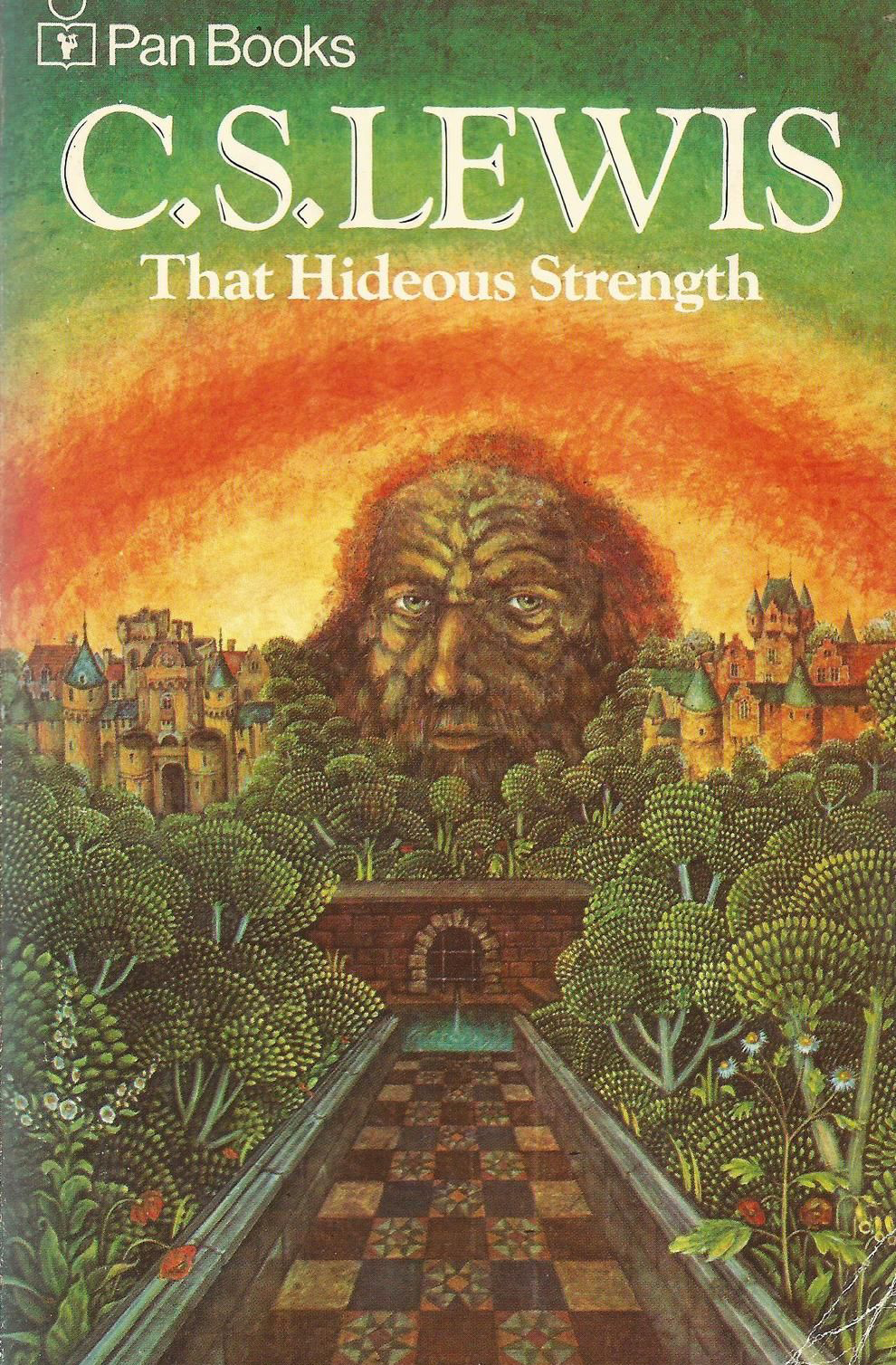
The illustration (above) of Bragdon Wood and Merlin’s well, with the college and Merlin’s visage rising on the horizon, was the cover for the 1983 Pan Books edition of THS.
That Hideous Strength (THS) by C.S. Lewis (1945), is an amazing and multilayered story about spiritual and cultural warfare in the modern world.1 Set in the fictional college town of Edgestow in mid-twentieth-century England, the story portrays events that presage the troubles and traumas of American society today. Anyone reading the story in the United States today will surely discover many alarming and revealing parallels. This should not surprise us, however, for the forces that are at war in America today have their roots in movements that have been trying to reshape both England and America since at least the early twentieth century.2 Lewis was aware of these forces.
The “Big Picture.”
In his preface to THS, Lewis says that his book is a “fairy-tale” with a “serious point,” a point that he has tried to make elsewhere in The Abolition of Man (TAM). In TAM, Lewis also describes a cultural war: a war between the modern post-enlightenment worldview (or life-world), with its exaltation of so-called “objective” or “scientific” knowledge, and the traditional worldview (or life-world) that reaches back through the Middle Ages to the Bible, with its emphasis on spiritual values and virtues that shape every part of human life in obedience to God.3 According to Lewis, the shift toward the modern life-world, especially in the institutions of modern British education, has resulted in “men without chests,” that is, people without training in the kinds of virtues and values that build strong families, congregations, communities, nations, and a healthy interaction with nature. These are, indeed, the themes of THS as well, though in THS they appear in a fictional story of dramatic detail with an unfolding narrative of personal struggle.
Thus, the conflict between the modern worldview and that of the biblical tradition through the Middle Ages is the “big picture” within which the story of THS is set. In a way, it is a story about the conflict between two big pictures, two life-worlds.
Major Corporate Characters of THS: The NICE at Belbury and St. Anne’s on the Hill
There are two primary institutional “characters” in THS, and each represents one of the life-worlds in question. At Belbury, we find the organization known as the N.I.C.E. (the National Institute for Co-ordinated Experiments). This group promotes the modern worldview, where all moral and religious values are considered subjective and relative, and where the primary goal is to create an administrative state, led by scientific elites who will manage and control the lives, the work, the futures, and even the sexuality of the common people. Sound familiar?
In this way, the NICE embrace, in a fairly straightforward manner, the modern post-enlightenment worldview. It is a world in which “nature” includes everything in the universe in a vast cause-and-effect system; and man is free to experiment on nature guided only by his own reason. As such, the NICE are also in league with what is called in THS the “progressive” element at the local Bracton College where, once again, the goal is to move the college away from its older scholars who represent the traditions of classical learning (Prof. Jewell) and even away from basic, “hard,” laboratory science (Prof. Hingest).
On the other side of this spiritual and cultural battle, we have the group that lives together at St. Anne’s on the Hill. This group, which is really more of a community—with marriages and families, gardens and animals—is led by Dr. Ransom, who is also variously called the “Director” and the “Pendragon” (the latter is a link to the medieval Arthurian legend).4 The plot thickens at this point, note well, for where the NICE are in league with the progressive element at Bracton, the community at St. Anne’s is in communication through Ransom with a group of “angelic” beings known as the Eldil. These angelic messengers, or Eldils, are guiding the people at St. Anne’s in their efforts to defeat the demoralizing influence of the NICE and to restore what is truly good, natural, and normal to the people of England.5
In this way, the life-world at St. Anne’s is open to many things that are simply unthinkable at Belbury. For at St. Anne’s, nature is not a vast cause-effect machine, ruled only by human reason. Rather, it is a living organon in which the power of God and of other spiritual forces are at work. Within this world, moreover, and shaped as it is in Lewis’s story by the medieval tradition, human beings are guided above all by their obedience to God and their submission to the living order of creation itself which God sustains. Their practices of marriage, prayer, and care for creation, for example, are inherent in how they view and value the world.
Major Individual Characters: Jane and Mark Studdock, and Merlin
Among all of the characters in THS, both at Belbury and at St. Anne’s—all of whom carry in some way the weight of their group and its life-world—there are three characters whose roles deserve special attention now. The first two are married to each other, Mark and Jane Studdock. They are a young professional couple. She is a feminist who wants an academic career rather than a family. He is an ambitious young professor who wants, above all, to climb the ladder of success. One might look at them in the story or in a real-life situation and say, “My, what a fine young couple.” But Mark’s and Jane’s marriage is in trouble. She wonders if she has made a mistake. They do not share deeply with each other about anything.
As the story progresses, furthermore, Mark and Jane move in opposite directions; one toward Belbury, and the other toward St. Anne’s. But in neither case are their movements streamlined or seamless. Both wrestle a lot with how to understand themselves, and with how to understand what is happening to them in these very different settings. Indeed, with Mark and Jane, we are given a personal life, two lives in a personal relationship with each other, as the canvas upon which to discover what is really at stake in the life-worlds and the worldviews that they (and we) embrace.
And then there is Merlin. Part of the medieval worldview that Lewis loved was the Arthurian legend. In THS, in this regard, both Dr. Dimble and Dr. Ransom are character types of Lewis himself. Both are Arthurian scholars, and both are aware that the NICE are trying to unearth the legendary grave of Merlin at Bragdon Wood. As a result, Dimble and Ransom are concerned about what this blending of modern atheistic science with ancient “magic” may portend for the spiritual battle ahead. In the end, Merlin—back from the dead after 1,500 years—plays a critical role in the defeat of the dark powers at Belbury. But he also presents one of the greatest challenges for us in trying to figure out how the fictional battle of THS may also apply to our own situation in America today.
Some Contemporary Concepts to Keep in Mind
As we work through the story, reading about both the individual characters and the corporate ones, each of us will, I believe, notice parallels, analogies, and echoes between what is going on in the story and what seems to be going on in America today. I want to encourage you to take note of these parallels and, indeed, some of my questions will ask you to name and list the parallels that you discover. In addition, I want to offer three major conceptual tools that I believe will help you to interpret what these parallels signify, both in our time and at the time of Lewis’s story. Keeping these in mind as you read may help you to make sense of the sometimes-chaotic strands of Lewis’s story, a kind of chaos that I believe we also encounter as we try to understand the strange and nonsensical things that are taking place today.
The Four Stages of Cultural Revolution – As described by former KGB agent Yuri Bezmenov in the 1970s, these are the stages by which Russian agents worked to infiltrate and undermine America and other western societies. 1. Demoralization – using pornography and other methods through media, entertainment, education, etc., to break down the moral courage of the people. 2. Destabilization – By undermining police, courts, borders, etc., to overwhelm public safety and further demoralize the people. 3. Crisis – Build 1 and 2 to the point of a crisis where people resort to rioting or to civil war. 4. New Normal – Declare emergency powers and install the administrative state as a solution for all of the problems which the revolutionary forces have themselves caused.6
The Long March through the Institutions – This is a central concept of cultural Marxism, (see endnote 2). It concerns the strategy of neo-Marxists in America and in other Western societies to overcome the resistance of successful middle-class cultures to the Marxist rhetoric of revolution. Middle-class people tend to be somewhat satisfied with their lives and tolerant of income differences with others. Cultural Marxists therefore target all of the institutions of middle-class society—church, family, public education, media, the press, entertainment, business, academia, science, law, etc.—in order to create the problems and crises that lead to the imposition of emergency powers and the administrative state.
Mass Formation – This is an academic concept that has been used for many years to try to understand the mass psychology that appears to be at work in societies like Bolshevik Russia, Nazi Germany, and Mao’s China, where thousands of ordinary citizens either turned a blind eye to the suffering of their fellow citizens or, in some cases, joined the forces that shamed and tortured them. The process is based on fear and the desire to survive or escape the threat of suffering. Under these conditions, “normal” people may become callous to the suffering of others. They “go along to get along.” But the result is a complete collapse of genuine religious and moral civilization.7
A Coherent Picture?
Using these conceptual tools, and others that come in along the way, I believe our reading of That Hideous Strength will provide numerous insights into the troubles—cultural, political, and spiritual—that we are facing in America today. And, since the conclusion of Lewis’s story involves a time of reflection by the people of St. Anne’s on what has happened and what may be expected to happen in their future, the story also gives us an opportunity to consider what kind of strategy and what view of our future we should take if we are to embrace the traditional worldview, at least as C. S. Lewis understood it. My hope is that our reading of THS will enable us to make a more informed response to these kinds of issues for the sake of our own time, for the sake of our own country, for the sake of our own “great heartedness.”
1. That Hideous Strength (1945) is the third volume in Lewis’s famous space trilogy. The first two volumes are Out of the Silent Planet (1938) and Perelandra (1944). All three are connected by their main character, Dr. Elwin Ransom, Cambridge philologist and space traveler. But each can be read separately as a story in itself.
2. I am thinking of the movement known as “cultural Marxism” or “Neo-Marxism” which began in Europe in the 1920s when Antonio Gramsci and the early members of the Frankfurt School of Critical Theory in Germany launched their plan to revitalize the forces of Russian Marxism in America and in Europe by engaging in what they called “the long march through the institutions.” This involved infiltrating and undermining the traditional institutions of Western culture—such as the church, the family, education, the media, entertainment, the courts and police, etc.—in order to create an administrative state by which to manage and control society. See, for example, Roger Kimball, The Long March: How the Cultural Revolution of the 1960s Changed America.
3. As this paragraph already suggests, and as the story of THS shows, a worldview is more than simply a set of beliefs, ideas, or first principles. It is also a way of life that people live out in various ways because they look at the world the way they do. For example, we only pray in a world where we believe God listens. For this reason, I will also use the term “life-world” interchangeably with “worldview” to indicate the kind of consequential process that I believe Lewis himself has in mind.
4. In the Arthurian legendarium, King Arthur’s father was Uther Pendragon, and “Pendragon” became one of the names for the line of kings that later descended from Arthur himself. Thus, Ransom is identified as one of these descendants.
5. The traditional worldview, as I am using this term, includes both the biblical worldview and that of the Middle Ages as both of these influence Lewis’s story. His portrayal in THS of the angelic eldil, in relation to the planets, for example, is borrowed from the medieval tradition. In this regard, Lewis brings into his story not only the biblical references to angels, powers, and principalities, and the like (Col. 1:16; Eph. 6:12); he also articulates this in terms of the medieval analysis of the major virtues (angels) and vices (fallen angels) that were metaphorically associated with the planets. Thus, the power of love, Venus, can become the fallen power of unbridled passion. And the power of courage, Mars, can become the fallen power of coercion, the bully. Or, yet again, the power of language and intelligence, Mercury, when it is warped by fallen power becomes the confusion of Babble. Lewis gives an extended description of the medieval worldview in his book, The Discarded Image.
6. You can still find videos online of Yuri Bezmenov giving lectures to Canadian and American audiences on these topics. He often remarks how easy it was to influence the American public by these methods.
7. See Matthias Desmet, The Psychology of Totalitarianism. According to Desmet, in a totalitarian society, three groups emerge: 1. Those who support the totalitarian power, usually a minority. 2. Those who resist it. Also, a minority. And 3. Those in the middle who swing toward whichever side seems to offer safety and security, usually a majority. Against this backdrop, one can see why the great freedom fighters of history, like Alexander Solzhenitsyn, speak of the importance of faith in God in order to follow conscience and “live not by lies.” Desmet himself appears to hope for a resolution based on human reason alone (the modern worldview). So, though his analysis of the problem is helpful as far as it goes, he doesn’t seem to understand the spiritual depths of the problem of evil or its resolution in obedience to God’s guidance and power as portrayed in THS.
Canyon, Watercolor, copyright 2007 by Craig Gallaway
According to the Apostle Paul, Jesus our King (the “Messiah” of Israel) has risen from the dead and is, even now, praying for us as we walk in his Spirit on the road of new creation (Romans 8:34). And as he prays, again according to Paul, he is also working through his Spirit to extend his reign over every enemy that opposes the godly order of creation, including the final enemy, death (1 Corinthians 15:25-26). His goal in all of this is to restore the order of Creation throughout the world, corrupted and misshapen as it is since the fall of Adam (Romans 1:18-32), and in particular to restore the order of our Maker’s own creative, strong, and loving image in us human beings (Romans 8:18-29). This is all in fulfillment of the Creator’s promise to Abraham, described in the book of Genesis, that Abraham’s descendent (his seed) would be the means by which the Maker would restore the fallen world (Genesis 12:1-3). According to Paul again, this promise to Abraham, and this restoration of the fallen world, is what King Jesus came into the world to accomplish through his victory over sin, death, and the fallen powers in his cross, his resurrection, and the sending of his Spirit (Romans 4:13-5:21; 8:1-17). That is, in his own body—his faithful life and death, and then through his victorious resurrection and the sending of His Spirit—he is even now at work in those who put their lives into his hands by faith. He is transforming and restoring us and the whole created order with us (Romans 5:12-21; 6:6-14; 12:1-2; 1 Corinthians 15:20-22).
This story of Jesus’s victory over sin and death and his reign as the risen Lord through his Spirit is, Deb and I believe, what Paul means by the word “gospel” as in Romans 1:16. If we want to know what Easter is really about, what Christmas is about, and what God’s purpose for the world is all about, this is the story. There are, of course, various opinions and theories[2] in the history of Christian thought which attempt to interpret some part or facet of these bedrock Scriptural events; but the good news embodied in the events themselves is the main path of Scripture. Jesus was faithfully obedient even unto death on the cross (Philippians 2:6-8). He died to sin once and only once, so death no longer has any authority over him (Romans 6:10-11). Therefore, God has raised him from the dead and made him Lord and King over all (Philippians 2:9-11). So now, by his Spirit, he is guiding, strengthening, and leading us toward the great day of our own resurrection, judgement, and the new heaven and earth, of which we now have the first fruits (Romans 8:18-39). With this scriptural account of Jesus’s victory over sin, death, and the devil in his own body, and his continuing work as our risen Lord by the presence and power of his Spirit to restore the fallen world, we find ourselves, if we put our faith in him, on the main path of Scripture moving toward the fulfillment of the promise of new creation (Romans 8:18-39).[3]
With this journey of faith in Christ on the road of new creation in mind, and mindful also of the suffering and spiritual warfare of the current time in our culture, Deb and I offer the attached song as a kind of theme “music for the road,” expressing at least part of the emotional range of the daily path and battle as we know it. The title of the tune is “Craigieburn” which ties Craig’s own name to its Scottish origins, and means “rocky stream.”[4] We hear this music as an “echo from the far country,” a kind of longing for and foretaste of the beauties of the world fully restored. And yet it also has something in it of the groaning that Paul acknowledges for those who are on this new creation path with our Lord (Romans 8:18-26). And isn’t this why the Apostle exhorted the believers at Philippi to put their minds on certain kinds of things: “Whatsoever things are true, noble, just, pure, beautiful, admirable, virtuous, and worthy of praise, think on these things” (Philippians 4:8-9). We are called to be cheerful in a still fallen, dangerous, and disordered world. Jesus also spoke of this when he encouraged his first disciples, “In this world you will have much suffering, but be of good cheer, for I have overcome the world” (John 16:33). And, for a more recent witness, we can recall C. S. Lewis’s thoughts about the Christian doctrine of suffering and how our Lord encourages us to live a life of cheerful insecurity:
The Christian doctrine of suffering explains, I believe, a very curious fact about the world we live in. The settled happiness and security which we all desire, God withholds from us by the very nature of the world: but joy, pleasure, and merriment He has scattered broadcast. We are never safe, but we have plenty of fun, and some ecstasy. It is not hard to see why. The security we crave would teach us to rest our hearts in this [present] world and oppose an obstacle to our return to God: a few moments of happy love, a landscape, a symphony, a merry meeting with our friends, a bathe [swim] or a football match, have no such tendency. Our Father refreshes us on our journey with some very pleasant inns, but will not encourage us to mistake them for home.[5]
Craigieburn Wood, arranged by William Coulter, played by Craig and Deborah Gallaway
And so, Deb and I offer this music as an inn along the way, echoing with strains of the good, the true, and the beautiful from the far country of the restored and reordered world. And as we continue on our journey, we are convinced—despite all of the troubles that we are surely facing—that nothing can separate us from the promise of this homecoming. The Lord is risen. He is risen indeed.
[1] “Ordinary Time” refers to those stretches in the calendar of the Christian year when the great festivals of Advent-Christmas and Lent-Easter are not in action; when the days and weeks are simply numbered with the numbering system known as the “ordinals,” such as the first Sunday in Pentecost, or the second Sunday in Kingdomtide. Thus, the word ordinary doesn’t really imply that nothing special or “extraordinary” ever happens during these periods; yet it does, in a different sense, remind us that there are times in our daily Christian lives when we have simply to practice with patience the regular disciplines of our faith. And one of those disciplines is surely to remember well the basic story of the gospel and the Scripture which brings order to all of our lives.
[2] For example, the various “theories of atonement” such as the moral influence theory, the penalty substitution theory, and so forth; but none of these hold together the full range and depth of our Lord’s new creation purpose which animates and integrates the narrative of Paul’s faith and world view.
[3] For additional help in tracking this Scriptural story of salvation, see for example: Athanasius, On the Incarnation; John Wesley, “The Scripture Way of Salvation;” Craig Gallaway, The Presence of Christ with the Worshipping Community; and N. T. Wright, How God Became King.
[4] We first heard this lovely melody and the basic arrangement that we are using, on a CD by the guitarist William Coulter titled “The Crooked Road.” The title of the original tune is “Craigieburn Wood,” which comes from a poem by Robert Burns (1759-1796). The compound word “Craigieburn” in the Scottish dialect refers to a rocky or stony stream (a “craggy burn”). The connection with Craig’s own name has given him a chance to reflect on the parallels between his journey, with its many ups and downs and twists and turns, and that of the Apostle Peter (Petros, “rock”) as well as the description of our shared and sometimes-rocky Christian journey to new creation given in Romans 8. All of these journeys evoke the attitude of patient faith and hope that is the way of new creation, of life in the Spirit, as we journey toward the great day of fulfillment and banqueting, when “the knowledge of the glory of the Lord shall cover the earth as the waters cover the sea” (Isaiah 11:9; Habakkuk 2:14; Revelation 21:1-4).
[5] C. S. Lewis, The Problem of Pain (Macmillan, 1966) p. 115.
Arise My Love, by Craig Gallaway. Pen and ink, copyright 1976 by Gallaway Art. A marriage invitation made by the artist for his friends many years ago.
The Biblical Affirmation of Marriage and Sexuality
From its opening story about creation, the Bible affirms the institution of marriage and the joy of human sexuality. The Creator commands the first human beings, Adam and Eve, to “be fruitful and multiply and fill the earth” (Genesis 1:28). And he regards their creation not only as “good,” along with all of the other creatures, but as “very good”—a kind of crowning achievement. And then, in the special story about how and why Eve was created from Adam’s rib, the institution of marriage is confirmed. “For this reason, a man leaves his father and his mother and is joined to his wife, and the two become one flesh” (Genesis 2:24). These words, moreover, are taken up by both Jesus (Matthew 19:5) and the Apostle Paul (Ephesians 5:31) in order to affirm the special role that marriage has within the biblical worldview as a symbol of the Creator’s own love for human beings. In this light, the affirmation of romantic love that we find in The Song of Solomon, as echoed in the title of this article (Song of Solomon 2:10), is a most natural and congenial expression.
And yet, all was not well in the garden of Eden. Adam and Eve fell from their high station in God’s love through pride and vanity. Envy and jealousy spread to their children. Greed and lust darkened the world by the time of Noah. And God promised Abraham that his descendant, his “seed,” would lead the whole world forward to its restoration. Thus, when Jesus came preaching the Kingdom of God, he gave a new, yet also an ancient standard for what would characterize the recovery of faithful marriage in the restored world.
“You have heard it said, ‘You shall not commit adultery.’ But I say to you that everyone who looks at a woman with lust has already committed adultery with her in his heart. If your right eye causes you to sin, tear it out and throw it away; it is better for you to lose one of your members than for your whole body to be thrown into hell.” (Matthew 5:27-29)
So, Jesus set forth the call to single-minded faithfulness in marriage, including purity of thought and imagination, as the standard for the Kingdom of God which he was inaugurating. But how prepared are we today to follow Jesus along this way of imaginative purity and moral restoration? What would it mean to do so?
The Current Demoralization of American Culture
If we take Jesus’s standard of purity of thought and imagination as our guide, I think we will have to conclude that our culture in America today is thoroughly demoralized. Our movies, our television shows, our advertising and sporting events, and many other cultural venues are thoroughly riddled with stories and images that invite sexual fantasy, sexual adventurism, sexual self-invention, and promiscuity—a kind of roving sexual imagination rather than the disciplined and faithful one that Jesus calls us to embrace. But we are also like the proverbial frog sitting in a pan of water that has been slowly brought to boil. We are so inundated with sexual impurity and fragmentation, that we have grown used to it. We hardly notice it anymore.
For example, Deb and I were recently encouraged by some young Christian friends to watch the movie Game Night. Based on their recommendation, we were hoping for a good laugh and a witty plot. But then we found that a good deal of the humor in the movie depended on jokes about the earlier promiscuities and infidelities of the young married couples who people the story. For us, it really wasn’t funny at all, but a sad commentary on the demoralization of even the lighter fare in our culture’s cinematic offerings. Our young friends evidently had not noticed this when they recommended the movie to us. Had we also not noticed the crudity of the humor we would, I suppose, have sat for over an hour simply soaking in a screenwriter’s mindset that sees multiple sexual partners before marriage as nothing more than a good laugh.
As members of the fallen human race, however, who have our own personal histories of sin and failure to account for, Deb and I don’t really believe that that is true. How much better might it be for young couples to marry each other out of a history of faithful purity, rather than thinking that it is only normal to take a detour through the self-indulgence and dissipation of promiscuity? Only the person who actually wears that shoe can tell us how it fits. Yet, we give thanks that, in Christ, we may also take back up his call to faithfulness in marriage and begin where we are to discover why he calls us to this kind of faithfulness, this purity of imagination.
The Remoralization of Our Lives
If we are to recover the goal of fidelity in marriage as Jesus described it, including the experience of purity of imagination, what will be required of us? No doubt there are many ways to respond to this challenge that could be helpful. Any effort would be better than none, better than simply remaining numb and vulnerable to the simmering pot of our demoralized culture as it is. But let me make a more proactive effort by suggesting what I believe is a pivotal focus for this exercise: We need to develop criteria for the “worldview-criticism” of media, and thus for the personal selection of the movies, television shows, advertising, and other entertainment resources that we watch. In other words, on what basis can we evaluate the moral content of the media we watch? What will we allow ourselves to watch? What will we turn off at once as soon as we discern its demoralized condition?
One way to do this, I hope without becoming rulish or legalistic, is to use the analysis of worldviews. There are many ways of viewing the world, with many different and even contradictory implications. There is the biblical worldview, for example, which we saw in outline in the opening paragraphs of this essay. And then there is the modern deistic or “Epicurean” worldview, which is widely prevalent in our culture and media, and typically diverges from the biblical worldview at nearly every point. For purposes of comparison, according to Professor N. T. Wright, all worldviews can be analyzed in terms of how they answer five basic questions.[1]
Where are we?
Who are we?
What is wrong?
What is the solution?
What time is it?
For the biblical worldview, the answers are full of hope. We are 1) in God’s good creation, and we are 2) designed to embody the goodness of life (including marriage and sexuality), but 3) we have fallen into patterns of brokenness, idolatry, and rebellion that lead to harm and death (again, including in our sexual lives). So, 4) our Maker has not abandoned us, but sent his Son and Spirit to reset the pattern and foundation for faithful human life (including, again, our sexual life); and now, 5) we are in the midst of this restorative process, if we place our lives in the care of the risen Christ and his Spirit. In the Spirit and power of his faithful life, his defeat of sin and death in his own body, we are on our way to our own resurrection and to the restoration of creation itself. That, in outline, is the biblical worldview.
But now, let us look at what I have called the “Epicurean” worldview, which is, I believe, one of the most prominent worldviews that we encounter in a great part of our contemporary media and entertainment. And please note, as we move through this brief analysis, we are engaging in the kind of worldview-criticism that can be applied to all other movies and media, whatever worldview they express.
For the Epicurean (or deistic) worldview, if there is a god or gods, he or they are not interested in or engaged in the events of our world. So, the world itself is 1) simply a flux of changing conditions and “atoms” in which 2) we humans exist merely as blips of consciousness with no future or purpose to reach beyond our immediate existence. In this kind of world, 3) there really is no problem that must be solved, unless it is simply to avoid any excess that might lead to pain; and 4) the solution is simply to maximize pleasure and avoid pain. Moreover, 5) since there is no life beyond death, no restoration of the world or the self to aspire to, we simply live in such a world for the present.
Let me ask you to try an experiment. The next movie or TV show you watch, try to observe the plot, the characters, and the storyline; and try to discern what kinds of answers to the five questions are either implied or made explicit in the story itself. How do the characters interact? What motives, aims, or goals do they have, if any? Is God, or prayer, or religious activity involved anywhere in their story? And what seems to be the underlying theme that the script brings into focus? Are the answers those of the biblical worldview? Is that the world in which the characters in the movie are living? Or are the answers more like the Epicurean, the deistic worldview? A world where all is in flux, where transcendent values are not even on the radar, and where one may as well follow the pleasure principle to get along in life as best one can, wherever that may lead?
My own experience with this kind of worldview analysis and criticism has been that a great portion of the movies and TV shows and other media that are released by our entertainment industry today embody and express, at best, the Epicurean worldview. This is not even to mention other worldviews that take a more Stoic or Eastern Buddhist approach, or still others in our post-modern context that become completely cynical, crass, and pornographic in their dystopian and hedonistic portrayal of what the world is really all about.
Applying these basic tools to the movie Game Night, in my estimation, it settles down comfortably within the demoralized simmer of the Epicurean worldview. It makes no effort to see the humor that could arise if the plot also included an awareness of higher values or the possibility of human redemption and restored life. Of course, these suggestions raise other questions that cannot be dealt with here. For example, what kind of humor, even bawdy humor, would still be at home within the biblical worldview? Also, how can a movie deal with sin and failure in a way that doesn’t trivialize it but rather shows the harm that comes to human life from unfaithfulness? I think the movie Doctor Zhivago achieves something along these lines in its portrayal of the heartache that comes to Zhivago and Lara, and others, as a result of their infidelity. The point here, however, is not to insist on my worldview analysis of selected films, but rather to suggest a method by which anyone can evaluate a wide range of media in order to engage more hopefully in the remoralization of our culture and of our own lives.
The Wider Cultural and Political Context
The importance of this effort toward the remoralization of faithful marriage and romance in our culture is not only about personal ethics. It is also about the recovery of moral conviction in the wider spheres of culture and politics. The forces of cultural revolution in America since at least the 1960s have been consistently committed to destroy the fabric of Christian marriage and personal morality in order to promote their own desired brands of social activism and revolution.[2] Consider, for example, the following litany, recorded at a gathering of radical feminists in the late 1960s.
“Why are we here today?” she asked.
“To make revolution,” they answered.
“What kind of revolution?” she replied.
“The Cultural Revolution,” they chanted.
“And how do we make Cultural Revolution?” she demanded.
“By destroying the American family!” they answered.
“How do we destroy the family?” she came back.
“By destroying the American Patriarch,” they cried exuberantly.
“And how do we destroy the American Patriarch?” she replied.
“By taking away his power!”
“How do we do that?”
“By destroying monogamy!” they shouted.
“How can we destroy monogamy?” . . .
“By promoting promiscuity, eroticism, prostitution and homosexuality!” they shouted.[3]
The demoralization of marriage and sexuality that we find in popular movies and in other media today is not usually so brazen and antagonistic as this litany. If the heat were turned up that high all of the time, the frog would surely leap from the pan. But the simmering dilution of moral vision and conviction that slowly drains away our commitment to faithful marriage and purity of imagination is nonetheless pervasive in our mainstream media and entertainment.
Indeed, in my estimation, almost all of what now appears on mainstream TV or in the theaters is riddled with voyeurism and images of sexual adventurism. We must become sensitized once again to the difference between wholesome, beautiful, and healthy stories of romance and marriage, on the one hand, and the tawdry images of sexual confusion and harm that are spawned upon us in nearly everything that comes out of Hollywood or through the TV. As Christians interested in Jesus’s standard of imaginative purity, we should ask the Holy Spirit to sharpen our skills for sorting out the difference between the garbage of casual sexual adventurism and the high goal and calling of faithfulness in Christian marriage.
Jesus’s Standard Revisited
In this light, Jesus’s call to faithfulness in marriage, including purity of imagination, is not at all, as some today are proposing, a harmful relic of ancient religious tradition. Rather, Jesus’s standard for his Kingdom people is really about how we are made as human beings, and how we can be fulfilled in our sexual experience, rather than hopelessly isolated and at odds with each other. Indeed, when we bring Jesus’s standard together with what the Apostle Paul says about the meaning and practice of Christian marriage, we find that marriage itself is a symbol of God’s own servant love in Christ (Ephesians 5:21-33) and that husbands and wives fulfill this symbol by being good stewards both of their own minds and hearts as well as those of their spouses (1 Corinthians 7:1-6).
Might we hear the title of this essay, then, not only as a celebration of human love and marriage; but also as an echo of our Maker’s call to us where he has found us in the far country. And the remoralization of our personal lives and relationships will pay dividends not only within our families, but also within the wider cultural, political, and spiritual battle that is currently shaking the foundations of our country. “Arise my love, my fair one, and come away.”
[1] N. T. Wright, The New Testament and the People of God (Fortress Press: Minneapolis, 1992) pp. 122-133. See also, by the same author, Jesus and the Victory of God (Fortress Press, Minneapolis, 1996) pp. 443-474.
[2] Yuri Bezmenov, former KGB agent who defected in the 1970s to Canada, gave public lectures in Canada and the U.S. on the communist strategy to overthrow the American government and society. The strategy consisted in four stages: 1.) demoralization (through such things as encouraging sexual decadence and undermining the rule of law), 2.) destabilization (through such things as stirring up strife and animosity between racial, gender, and other “factional” groups), 3.) Violent Revolution (by means of civil strife in the streets, riots, looting, and other criminal behavior) and 4.) Normalization (where the administrative state steps in to adopt “emergency” powers in order to quell the violence they have created). In this way, if all went according to plan, authoritarian power would be normalized.
[3] Paul Kengor, The Devil and Karl Marx (Tan Books: Gastonia, North Carolina, 2020) p. 366. This is taken from an interview with Mallory Millet, sister of Kate Millet who authored the book, Sexual Politics. Mallory was present in 1969 at Kate’s apartment for the performance of this litany.
My father’s pocket watch with the case open, from the front.
“O my, what a time that was.” We say this about an event when we have experienced something truly remarkable. The event may have been something wonderful, like a magical vacation at the beach. Or it may have been something terrible, like the loss of a loved one in an accident, or a time of awful breakdown in society. In either case, the event in view, and the time while it lasted, was full of meaning for us; and even now, when we remember it, our time is once again filled with the meaning of sorrow or hope, or both, with which that time was full.
This sense of time is roughly equivalent to what the New Testament means with the Greek word kairos, that is, time filled with meaning. Only, in the New Testament, the meaning in question is focused on what God has done and is doing in time–that is, in the events through which we live our lives in history. So, for example, Ephesians 1:10 speaks of what God has done in Jesus, when the time (kairos) was ripe, “to sum up the whole cosmos in the King (Jesus)—yes, everything in heaven and earth, in him.” Have you ever thought of the meaning of your life in the light of what Jesus did in his life and death, and what he continues to do today because of his resurrection and his Spirit? When we are able to see our lives in this way, we realize that we are truly living in a remarkable time, filled with meaning!
My father’s pocket watch with the case open, from the back.
There is another Greek word for time that is used in the New Testament, chronos. Chronos refers to time as we count and measure it. It is the root word from which we get our English words such as chronological, and chronometer. It is what we might think of as “clock time”—hours and minutes and seconds, days and weeks, months and years. Such time may simply pass from one second to the next. It need not be filled with any special meaning at all. In fact, if we try to isolate such time in the present moment, without any reference to some other meaning, we find that it is vaporous and vanishing—what some have called the specious present. It is this kind of time that Jesus seems to have had in mind when he chided Phillip (Luke 14:9) for not paying more attention to what was really going on: “Have I been with you for such a long time (chronos), and still you don’t know me?”
Try an experiment for yourself: Try to focus on the present instant of time. Where is it? When is it? Where does it go? How long does it last? As soon as you think about this instant, it is already past and gone; and another instant has taken its place, each empty of meaning unless supplied from something outside of the instant itself. Some people spend a long time (chronos) living their lives, like Phillip, without ever understanding the meaning of the time (kairos) in which they live.
So how can we discover kairos in the midst of chronos if we want our time to have meaning beyond the mere passage of seconds and minutes? I’ll bet you can answer this question for yourself, using nothing more than the definitions already provided. Here is my answer: We must learn to remember the larger story within which we live our lives. And this means not only the larger story of our own lives, both the good times and the bad times and the long difficult stretches, but also the larger Story, according to the Bible, of what God himself is doing through time to reconcile everything in Christ.
And so, note well, we need to remember the whole of the biblical story—its long past in the history of creation and Israel, its climax in the events of Jesus death and resurrection and the sending of his Spirit, and its still unfolding future in the promise of New Creation, toward which “everything in heaven and earth” is moving. Yes, we need to remember not only the biblical past, but also the promised future as well!
And we need to remember (“re-member”) that is to bring back together everything in our own lives in the light provided by the biblical story. Someone might worry at this point that this makes the biblical story too intrusive. But the biblical story does not diminish our personal story or make it small or insignificant in some way. For God has made no two snowflakes or leaves or people alike in all the long history of the world. And, as Jesus said, he knows every hair on each of our heads. And he knows when every sparrow falls. No, the biblical story does not make our personal story small so much as it shows how our story is woven into the great story of which we are a part, and in which we have our own unique part to play.
The Celtic cross on the cover of my father’s pocket watch.
In my father’s belongings, after he died, I found a lovely small silver pocket watch and chain. The watch has a case that opens both on the front and at the back. Inside, from both sides, you can see the clock’s works, the spinning wheels and golden gears that enable the watch to keep time (chronos). But the watch has one fault in this regard. It has to be wound about every four hours in order to keep marking the passage of chronos.
At the same time, the watch has another feature. On its cover is an engraving of a Celtic cross. Each limb of the cross ends in a design that looks like a blossoming flower, and the whole design is woven into a pattern of leaves and growing plants. This familiar pattern of Celtic crosses reminds us that Jesus’s life and achievement, did not end with his death on the cross. Jesus went through death and out the other side to the new life of his resurrection which he now makes available to us. And this is the pattern also of our lives when we place our lives in his care. We experience death to all that has misshapen and distorted our humanity made in God’s image, and we begin to experience the “first fruits” of the resurrection now, as we live our lives in His Spirit, and look forward to the Day of actual physical resurrection when our Maker brings the whole creation to the long-awaited fulfillment. Thus, is biblical time filled with meaning.
I don’t imagine my father worried too much about keeping this watch wound up all the time in order to keep track of chronos. He had other, more efficient chronometers for that purpose. But I know he kept his mind and heart centered on the story symbolized on the cover of this watch so that he could face with faith, hope, love, and courage whatever he met in the course of his own life and death. I know for a fact, that the hope of the resurrection filled his mind and heart with the fullness of kairos during the last hours of his life in this age of the world. And I am sure that he would want me, and you, especially at this time of the changing year, to remember our lives as well (past, present, and future) within the great story of redemption and restoration that gives our lives their deepest and fullest meaning—not so much the story that we tell, as the Story that tells us.













 Faith and the Arts