All Hallows Eve with Christ: For Our Grandchildren, Part 2

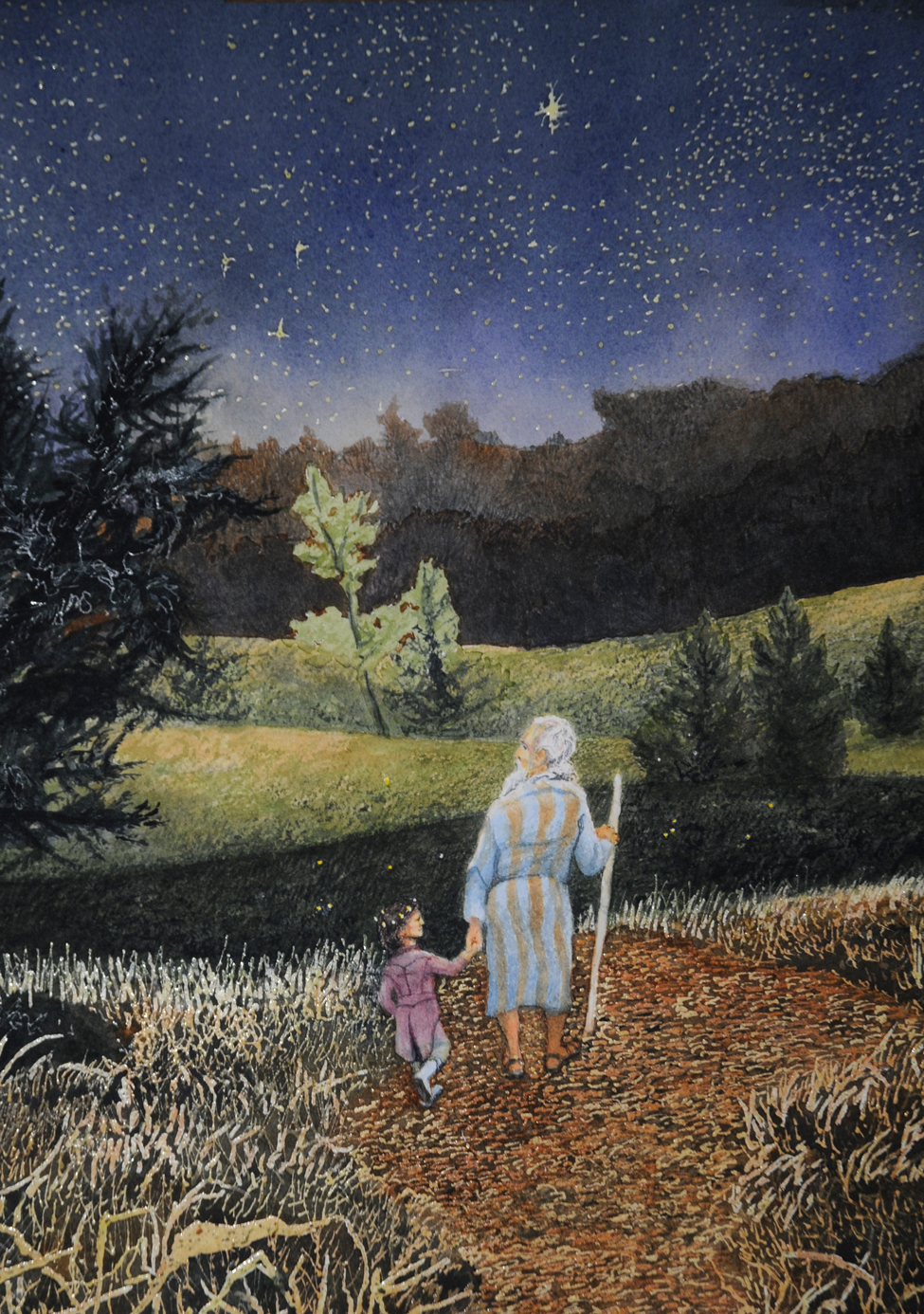
All Hallows Eve, by Craig Gallaway, 2021 (scratchboard)
© 2021 by Gallaway Art

One of the first things that Jesus did after he rose from the dead was to fix a breakfast of fish for his disciples by the sea of Galilea. His camp fire effort is a sign of the kind of holy life that we believe we too shall have when we rise on the Day of New Creation. But who are the other two people in the picture? They could be some of the people whose stories we tell in this album. They could also be us, Grandpa and Grandma Gallaway, once we leave this present life, and make our journey to be with Christ in paradise until the new Day comes. You see, we too have loved to share music, and to make delicious food for you and others. What is more, we believe that we shall enjoy these gifts again, just like Jesus did by the sea, when we gather around the fire with him. That’s why our picture also has mountains and cold and snow. Life with Jesus was never meant to be a life with no weather or work, no challenges or faith, no courage or hope. The Hallows know this better than anyone.

_______________________________________________


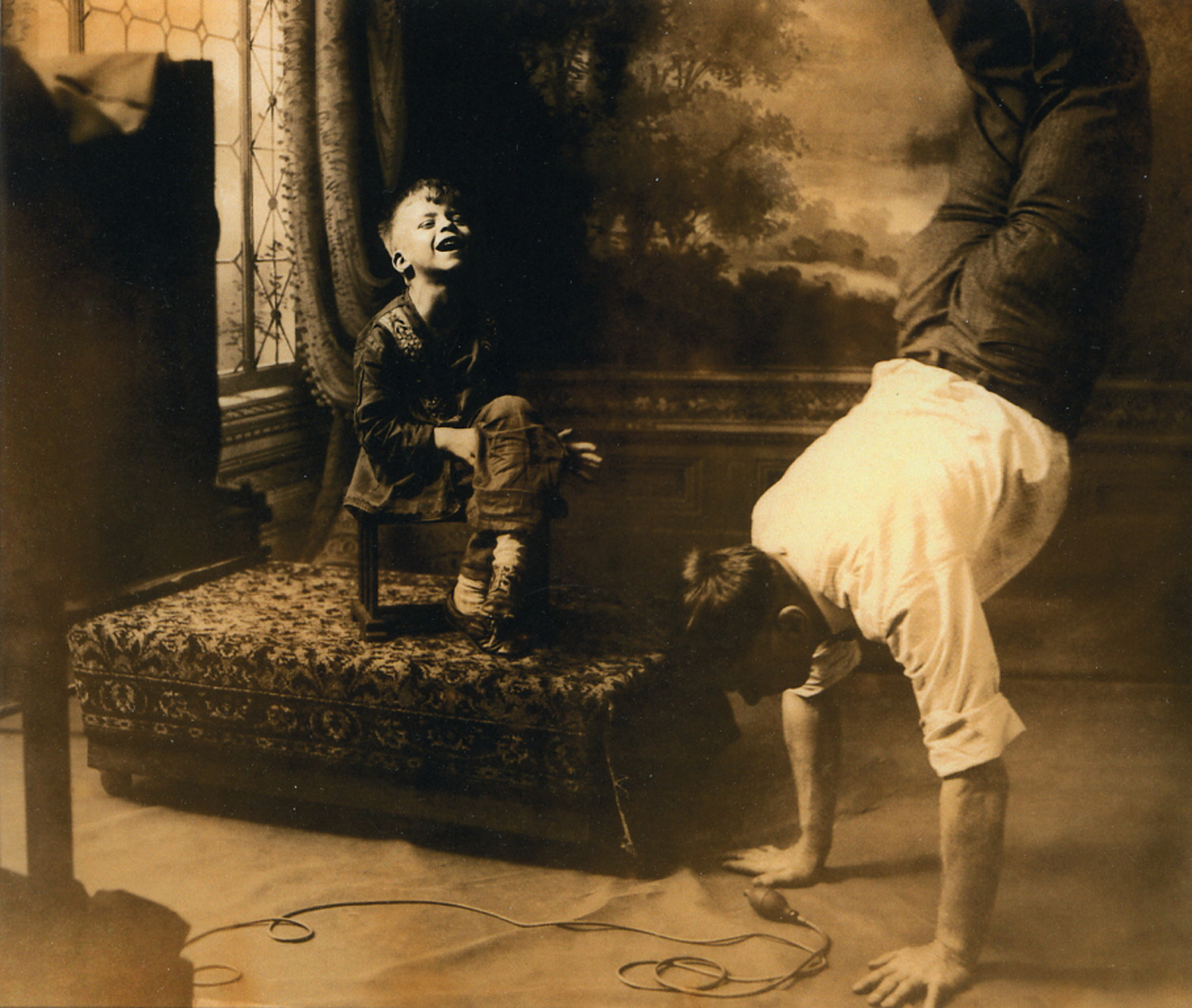
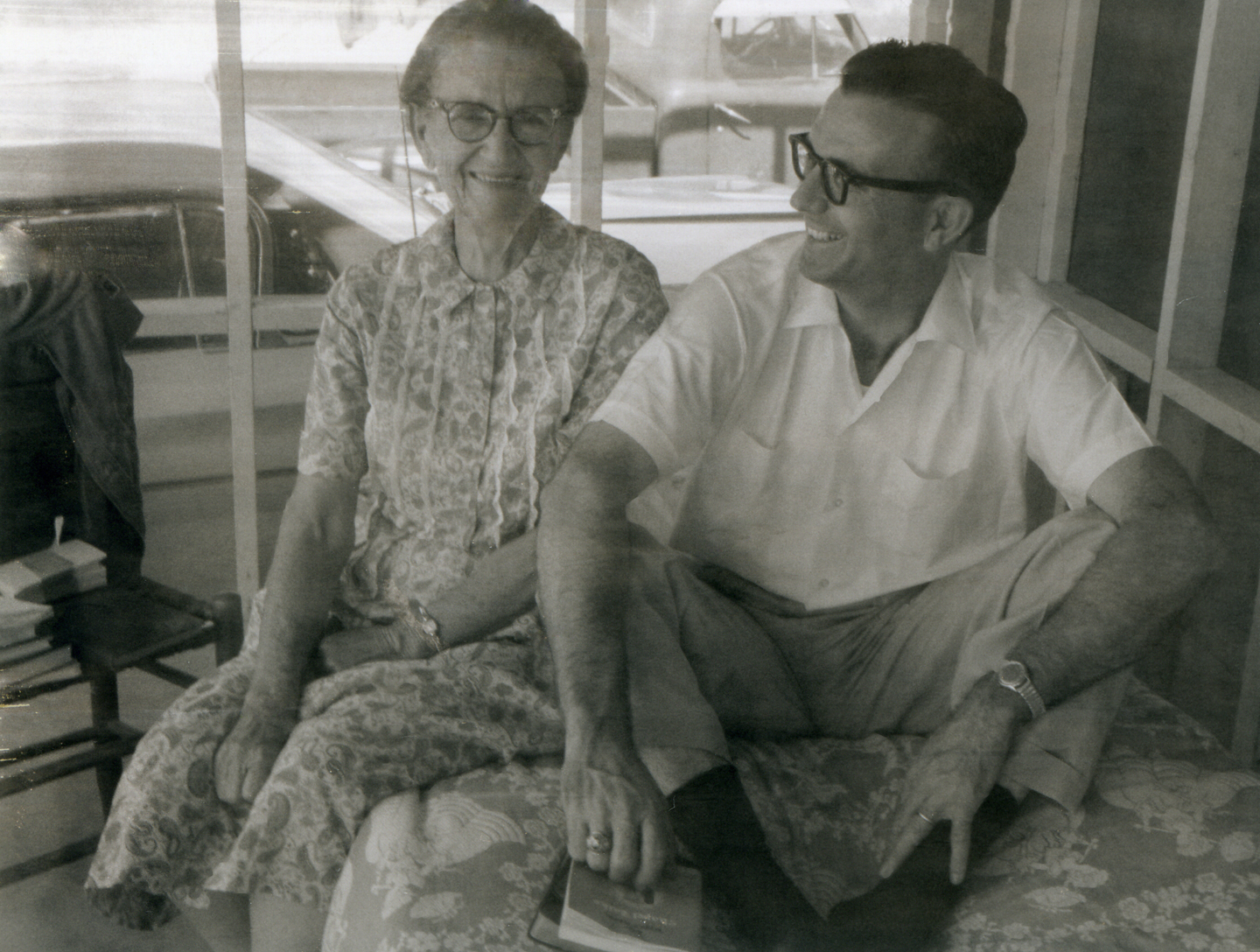
Great Granddad Luder with his father, about 1925

Carl Raymond Luder, 1921-2007

Your Great Grandfather on Your Father’s Side

Great-Grandpa Luder grew up in Washington, Indiana, a small town where his father was a photographer. That’s grandpa Luder, when he was a boy, playing with his father in the studio. But Grandpa Luder’s life wasn’t always easy and fun. Like many in his generation he served in World War II and in Korea. He met your great-grandmother, Marylouise, in Hawaii at the time of Pearl Harbor. 


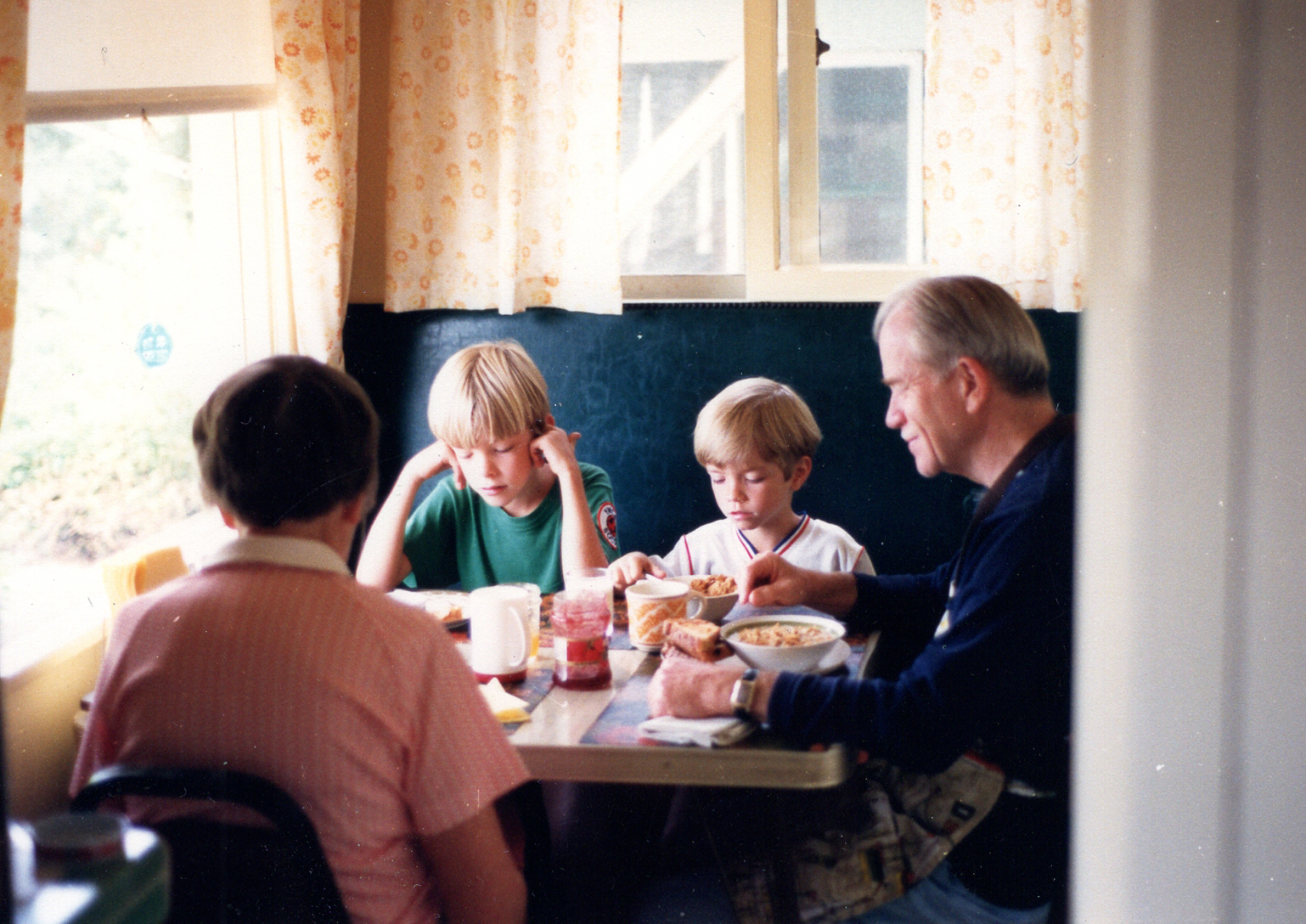
Carl and Louise with Ben and Chris, 1988

Later in life, Grandpa Luder enjoyed planting a vegetable garden each summer. He was a gentle man who always told the truth. He and Marylouise sang a prayer to start the day: 

Good morning, Lord–It’s great to see the sun again! 

Good morning, Lord—It’s great to talk to You again. 

This day’s a flower and as it blooms, I’ll trust its care to You. 

That’s why I say, as it begins, “Good morning, Lord!”

  “This is the day that the Lord hath made; we will rejoice and be glad in it.”

Psalm 118:24

_________________________________________________


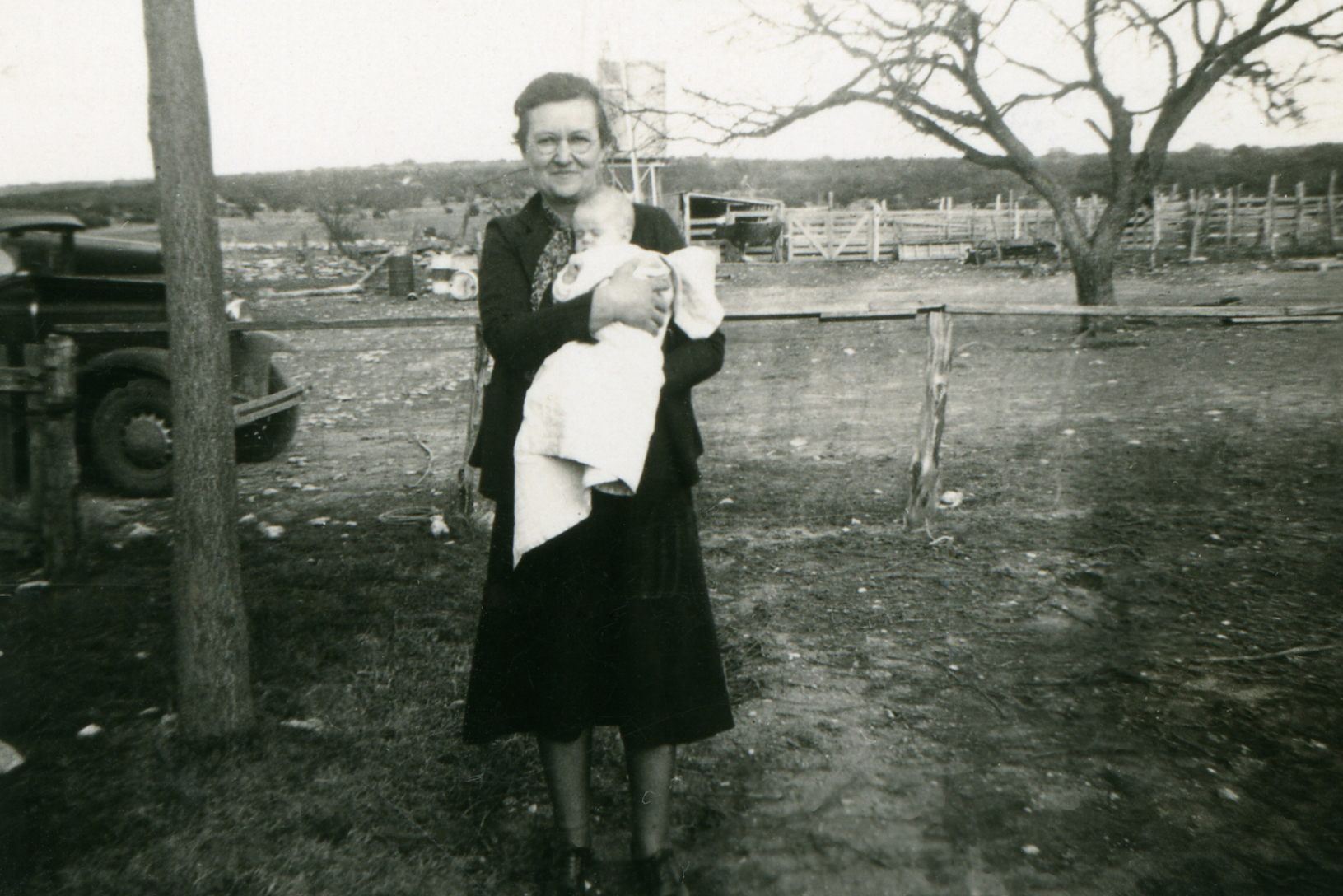
Mama Gallaway with baby Ira, about 1925

Julia Estelle Taylor Gallaway, 1894-1968

Your 2nd Great Grandmother, Your Father’s Side

“Mama” Gallaway, as she was known not only to her family but to everyone in the countryside around Glen Cove, Texas, was a wonderful woman. She came of age in the 1920s, and raised her family during the hard Depression years. That’s her, holding baby Ira, in about 1924-25 at the old Burton Place.  Mama grew big gardens, and put up hundreds of jars of fruit and vegetables so her five sons could eat during the winter. 


Mama with Great Granddad Ira on her front porch about 1956

Mama was kind. She always reached out to you and offered something. I (Grandpa Gallaway) used to come begging a pinch of dough when she was making bread. “Why Craig, that’ll give you a belly-ache.” “But Mama, I just want a little piece.” “Well, alright then; but not any more!” This happened pretty much daily. Despite the many hardships of her life, Mama was a grateful and a happy person. How good it will be to see her again.

Ephesians 4:32 – “And be ye kind to one another, tender-hearted, forgiving one another, even as God for Christ’s sake hath forgiven you.”

___________________________________________________  

All Hallows Eve with Christ: For Our Grandchildren

All Hallows Eve, by Craig Gallaway

Dear Colin and Rose,

All Hallows Eve, or “Halloween,” is a special day, once a year on October 31, when Christians remember and celebrate those who have gone before us in the life of faith; those who have already died and are now with our Lord in the place that Jesus called “paradise” (Luke 23:43). These people include our friends and family members who have died in the faith, and many others we have never known, all of whom believed in Christ, and all of whom are now with Christ in paradise waiting for the great and final day of the Lord’s judgement and the resurrection. They are “resting,” or “asleep” as the Scriptures say, until the Day of the Lord (Revelation 6:9-11).

In this photo album, we are gathering pictures and short stories about the members of our family who have already made this journey, men and women, maybe sometimes boys and girls, who lived with faith in Christ and His Spirit, who grew in that faith for the time allotted to them, and who then died and now wait (even as we wait) for the renewal of life-in-the-body that will come with the resurrection from the dead  (1 Cor. 15:12-26).

The people in this album were not perfect. They had their own flaws and failures. They struggled with temptations and difficulties. But because they believed in Christ and His Spirit, they did not face those troubles alone. They faced them with His help and guidance. And so, they became what the Scriptures call “saints,” that is, people who, despite their flaws, are being made holy by Christ and His Spirit. The stories we tell about them will include some of their struggles and how God helped them.

Our goal, each Halloween, will be to add to this album so that you, our grandchildren, can remember these examples of faith and holiness in your own family as you face your own struggles and temptations. This is the “communion of the saints,” saints above with saints below, and it is what “all hallows eve” is all about. 

Of course, there are other customs at Halloween, like “trick or treat” and dressing up in costumes, that are fun. And there are some old traditions in other religions, like Samhain, that sometimes are not like Christ at all. But we want you to know how to celebrate Halloween in Christ.

2 Corinthians 10:5 – “Take every thought captive for Christ.” 

_______________________________________________________________

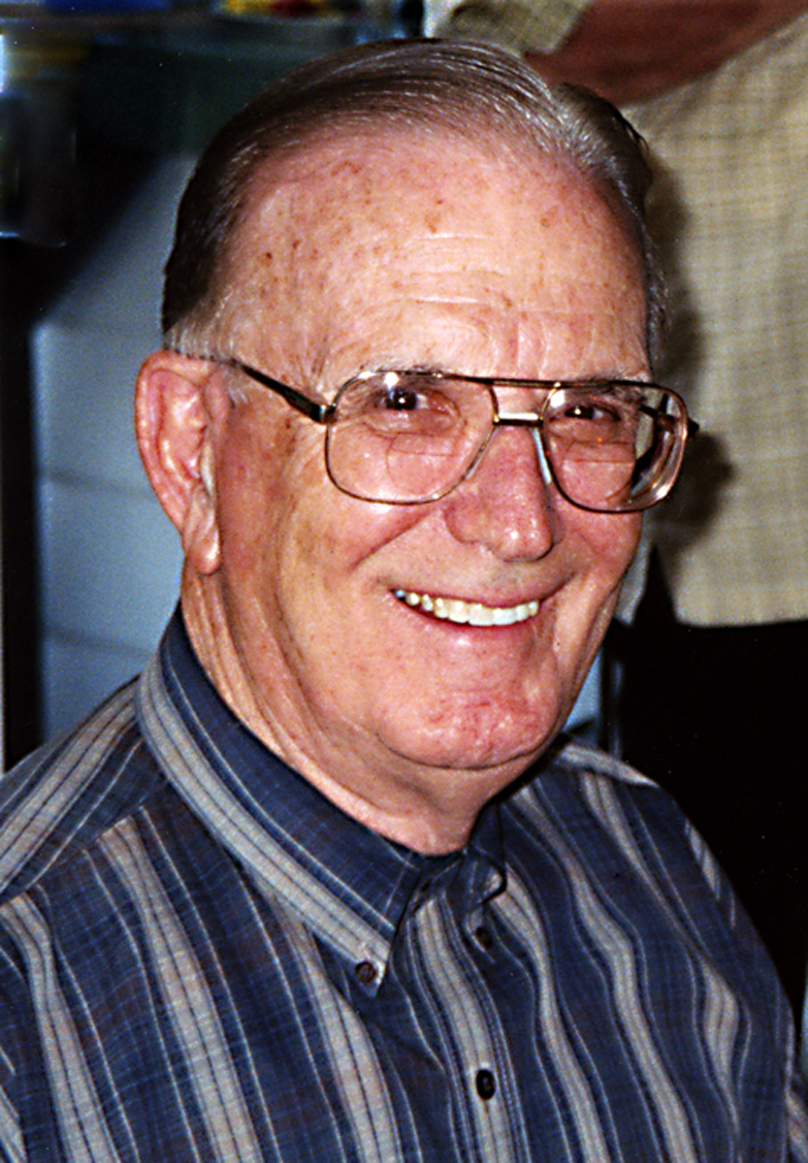
Ira Leon Gallaway at 6 years old

Ira Leon Gallaway,  1924 – 2015

Your Great Grandfather on your father’s side

Granddad Ira grew up and went to school at Glen Cove, Texas. When he was still little, there was a bully at school that used to pick on him. Every day he came home crying and complaining about this bully; until one day his older brother, Presley, said, “If you come home one more day complaining about that bully, I’m gonna whip you too.” Press knew that Granddad needed to learn to stand up for himself. And Granddad was more afraid of Press than of the bully. So, the next day, Granddad beat up the bully; and that put a stop to that.

Ira Leon Gallaway at 79 years old

Later in life, Granddad became a very brave and courageous man. He would often stand up for what was right when other people were afraid. Maybe that’s why his parents gave him the middle name, Leon, which means “lion.”

Philippians 4:13 – “I can do all things through Christ who strengthens me.”

________________________________________________________________

Great Grandma Luder with Ben and Chris, 1990

Marylouise Wellensgard Luder, 1913-2004

Your Great Grandmother on Your Father’s Side

Great-Grandma Luder lived most of her life in Santa Barbara, California. Your Grandma Gallaway is her daughter. When your dad and his brothers Ben and Zach were little boys, they would go to Santa Barbara to visit Grandma Luder. She loved having her grandchildren come to visit. She would fix their favorite foods. She made delicious pies.

Grandma Luder with Spenser, 2000

Great-Grandma Luder also loved animals—very much! The Luder household always had several furry occupants. But the thing people remember most about your Great-Grandma Luder is that she was a very, very good friend. She was a true friend to people who needed a friend—the sick, the sad, and the lonely. She loved Jesus, and she wanted very much to be just like Him.

John 15:13 – “There is no greater love than this, to lay down your life for your friends.”

___________________________________________________________

Well, Colin and Rose, we may send one or two more hallows stories to you this year, before October 31, if we can get to it; but we will certainly send more next year, providing neither of us have made the journey to paradise ourselves. In any event, we want you to know that we love you and, with all the saints, we will always rejoice with you in the goodness of our Creator and Redeemer.

On this road of New Creation,

Grandpa and Grandma Gallaway

The March of the Ents? A Metaphor

Study of Tree, by Craig Gallaway, 1973, pen and ink.

In the Lord of the Rings Trilogy, Merry and Pippin finally get Treebeard, the Leader of the Ents, to rise up against Saruman and Isengard, by showing him the raw destruction that Saruman and his orcs have caused. The Ents had met with Treebeard at an Entmoot (a council) for several days trying to decide if they should get involved in the war between Sauron, Saruman, and the free peoples. They had taken the long view and decided to stay out of the ruckus, that is until Merry and Pippin finagled Treebeard onto a part of the landscape where he would have to see the raw destruction, the clear-cut and burned-over damage. And then Treebeard comes alive, roaring for the other Ents, and marching against Isengard to bring it and its master down.

One wonders as we watch Joe Biden and his henchmen, Chuck Schumer (a ringer for Saruman) and Nancy Pelosi (a ringer for the character of Dolores Umbridge in a different modern fairytale)—signing executive orders for illegal immigration and a minimum wage that will destroy entry level jobs for lower income Americans, advocating another government money pit for environmental innovation (that always works!), welcoming the destruction of unborn children, seeking liaisons with enemy states, and encouraging racist animosity and sexual confusion among the young, all in the name of a so-called progressive agenda—who and where are our Ents today, and what would they have to see in order to rise up and overwhelm the evil infecting our land?

Tree and Fence detail

As Deb and I walked this morning and wondered aloud about these things, it struck us. Perhaps our Ents are the States, the individual States that we already see rising up, right now one at a time (like Texas, Florida, and South Dakota); but maybe soon many together, to throw off the yoke of bureaucratic coercion and ideological control pressing down on the people from this vicious administrative state. The Ents at Isengard unleashed the waters of a great river to wash away the filth of Saruman. Perhaps our States and their leaders will see the damage that Biden and democrat governors are doing, and the willful destruction of our Constitution and laws in the current sham of impeachment, and bring a flood of legitimate lawsuits that speak with one great and powerful voice, “No, you cannot take away our Constitutional rights and freedoms in the name of your elitist claims for power and control.” It takes a long time for the Ents to act, but when they do, watch out.   

Confessions of a Hymnal Revisionist, Regarding Inclusive Language

Precis: This brief “confessional” is not intended as a public display of self-ridicule for past mistakes, nor as a self-congratulatory show of recent discoveries. Rather, it is intended as an example of how a modestly well-intentioned person, working within the ideological and political premises provided by the surrounding culture at a given moment in history, can make honest but serious mistakes that have consequences far beyond anything that he or she foresaw or intended. It is, therefore, a call to serious self-examination in the midst of the forces that are currently shaping the future of our country; the future, that is, in which our children and grandchildren will have to live. Do we really want them to feel that it is a good thing to replace all references to “mother” or “father” with a neutered term like “parent,” in order to align themselves with the political demands of one ideology?

In the fall of 1987, as I was finishing up my dissertation on the theology of the hymns of John and Charles Wesley,[i] I was asked by Carlton Young to address the members of the newly formed Hymnal Revision Committee (HRC) of the United Methodist Church, on the topic of how to organize the new hymnal.[ii] As part of my role with the committee, over the course of several meetings during the next year or so, Dr. Young also asked me to make suggestions regarding “gender inclusive language.”  That is, to suggest where I thought the Wesley hymns might be altered, if at all, in order to keep pace with the growing pressure at that time in all things theological, especially worship resources, to use the rapidly developing standards of inclusive language.

The ostensible purpose of using gender inclusive language was to make both women and men, male and female, feel included in the ways we address God, and each other, in the course of singing hymns or saying prayers, etc..[iii] In my mind, at the time, I thought of this part of my task as a somewhat mixed assignment: on the one hand, perhaps, a matter of showing compassion toward those who might feel excluded; and, on the other, a matter of trying to avoid an all-out donnybrook over pronouns, and the like, that could threaten to overshadow the deeper and grander contribution of the Wesleys to Methodist worship, not to mention world hymnody.

And so, I made suggestions to the HRC about inclusive language: where, and in what cases, I thought pronouns, or other words, might be changed without disturbing too much the rhythm, beauty, and sense of the original Wesley hymns. Some of the suggestions I made were accepted and approved. Others were debated, rejected, or over-ridden in favor of sharper, more radical changes. In all of this process, many individual hymns were affected, often in ways that an average worshipper might not notice.[iv] I told myself, at the time, that it was more important to get these great hymns into the hymnbook, and to influence the larger organization of the hymnbook as a whole, than to lose individual hymns or the larger theological structure because a word or a pronoun here or there gave offense to the ears of some listeners, whether male or female or both.[v]

I think, now, that I chose the wrong course. I should have argued more clearly and forcefully for the appropriateness of traditional poetic language in the Wesley hymns, and against what has proven, in my estimation, to be in many cases an overly-sensitized reaction to a politically skewed issue, made all the more acute by regular complaint and appeasement.[vi]

The issue of language and poetry really shouldn’t have become so embattled. What may have begun as a matter of compassion, has become a matter of politically partisan war and control. In the worst cases, such as the recent push by Nancy Pelosi to require neutered pronouns and terms for all familial references (e.g., “parent” for “mother” or “father”) in the US House of Representatives, inclusive language, like other areas of identity politics today (race, gender, class), has devolved into a raw struggle of one party for power. It is no longer, if it ever truly was, about language or compassion at all. It is about power for a left-wing agenda.     


[i] The Presence of Christ with the Worshipping Community: A Study in the Hymns of John and Charles Wesley, Emory University, 1988.

[ii] Carlton Young was the editor of the hymnal and also a faculty member at Emory. The outline of my comments to the committee was published as “Patterns of Worship in Early Methodist Hymnody, and the Task of Hymnal Revision,” Quarterly Review, Fall 1987, Vol. 7, No. 3, pp. 14-29.

[iii] My focus in this brief comment is on the use of gender inclusive language, though even then, in the late 1980s, and certainly since, other groups have also become sensitized about their inclusion.   

[iv] This is, of course, a subjective judgement. Because for anyone, such as myself, who was raised in the Methodist Church (or in any other tradition for that matter) who has memorized the widely loved Wesley hymns over many years of experience, the changes would be more jarring and obvious. Here is an example of a change that might or might not slip by, from the opening line of the hymn, “Christ the Lord is Risen Today.” Note that the solution for inclusivity in this case, involved repeating the last line of a stanza from the original in the second line of the altered version, in order to avoid the phrase, “sons of men.” “Sons of men” was, of course, a metaphorical synecdoche, invoking “all human beings,” not just the males.

                         Original                                                    Inclusive Change

       Christ the Lord is risen today, Alleluia!

       Sons of men and angels say, Alleluia!        Earth and heaven in chorus say, Alleluia!

       Raise your joys and triumphs high, Alleluia!

       Sing, ye heavens and earth reply, Alleluia!

[v] It may be important to note in this regard that the most outspoken advocates of gender inclusive language in the late 1980s were not always female. For some, whether male or female, it almost seemed that this issue provided a powerful rallying point of agreement, in a field where there were many other debates about what or what not to include. Inclusive language was becoming at that time a kind of implicit orthodoxy. 

[vi] The example of “Christ the Lord Is Risen Today” (note iv above) may already suggest problems that can arise poetically and theologically simply by repeating a phrase (“earth and heaven”) in order to avoid a traditional metaphor, “sons of men and angels.” Is it really a good thing to be so sensitized to an issue that we sacrifice the poetry of the original in order to “gain” a rather flat, unremarkable, political point? Might it not be better to show a large-hearted capacity to read the original synecdoche in the way it was intended? The problem becomes even more evident in another example, when personal pronouns for God (he, his, him) are replaced by demonstrative pronouns (that, this) or by repeating abstract gutturals (God, God, God, etc.) especially when the point of the hymn is to heighten the sense of God’s personal and intimate presence with us in the struggles and anxieties we face. Here, for example, is the original and the altered versions for a single stanza of a hymn by Paul Gerhardt, “Give to the Winds Thy Fears,” which John Wesley translated in 1739. The hymn begins with a reference to God as follows: “Give to the winds thy fears; hope and be undismayed. God hears thy sighs and counts thy tears; God shall lift up thy head.”  

                          Original                                            Inclusive Change

       Leave to His sovereign sway                       Leave to God’s sovereign sway

      To choose and to command;                        To choose and to command;

      So shalt thou, wondering, own His way,      So shalt thou, wondering, own that way,

      How wise, how strong, His hand.                 How wise, how strong, this hand.

Critical Realism and Political Change

Maple Leaf, graphite on paper. Copyright 1975 by Craig Gallaway. As a graduate student in my mid-twenties, studying art history and theology, I also studied the forms of nature as an artist. In all of this, I saw how careful observation continuously opens up new insights into the deeper order and structure of things. This “critical realist” insight is the bedrock of genuine science. It stands in opposition both to the hyper “objective” claims of Logical Positivism, as well as the reductive “subjective” claims of a great deal of post-modern thought. Things are neither as clear, nor as ambiguous as those false alternatives make them out to be. This is true also of political claims!

Some of our friends and family have seemed incredulous or even hurt at times that Deb and I could vote for Donald Trump in 2016, and then that we have come increasingly to defend Trump and his administration in the four years leading up to the current election of 2020. In 2008 and 2012, Deb and I voted for Barack Obama. We did so on the basis of the best information that we had at the time as to what Obama’s policy positions would be on issues like Christian marriage, abortion (there did not seem to be a clear legislative alternative on the Republican side), social issues (such as race and poverty), and economics (the Bush administration had fouled things up royally by 2008). So how or why have we come to reject the now clarified legacy of Barack Obama, and to defend Donald Trump’s availing goal to “make America great again”?

I think the turn began for us when we saw Barack Obama abandon his commitment to traditional Christian marriage, and embrace the wild and wide-open pan-sexual agenda of gay marriage and transgender activism. We had taken him at his word in 2008 that he believed in traditional marriage, and would protect that tradition, and that he would also protect the civil rights of people with same-sex attraction. But then, not long after his election to a second term, he told the country that an offhand conversation with his teenage daughter had completely upended his former convictions. Henceforward, he would become, along with his Attorney General Eric Holder, a flaming activist for all things LGBTQ. He would force transgender bathrooms and gyms on the nation, and he threatened to withhold federal funds from states that did not comply. We began to see a very different Barack Obama from the one who had traveled to Saddleback Community Church in California in 2008 to make his quasi-religious case for traditional marriage and the family. The grounds for his seismic ideological shift were not convincing.

And then, after Trump was elected in 2016 and began to serve in 2017, we began to see and take note of the horrendously biased treatment that Trump was receiving from the mainstream press, including the papers (New York Times, Washington Post) and the major mainstream news channels (ABC, CBS, NBC, PBS, NPR), not to mention most of the cable news networks (MSNBC, CNN, etc.). What we saw week after week and month after month was a continuous stream of one-sided stories claiming to expose Donald Trump’s treasonous and chaotic behavior told by news anchors who clearly hated him, and drawing on sources that were nearly always either leaked anonymously or were former Obama officials. It did not take much critical acumen to recognize that something very partisan and rather clandestine was going on.

And so, we began to look more deeply into the background of the news sources themselves. We began to realize that the major news sources were engaged in their own kind of collusion with the previous administration and its continuing legacy of people in staff positions at a great variety of government agencies. We knew that some would say that we were succumbing to a “conspiracy theory” mentality; and yet something very much like an “administrative state” or a “deep state” was more and more evident just beneath the surface of this great ideological and media collusion against the Trump administration. And so it has proven to be.

Perhaps the most important thing to say about our change of heart is that it has also led to an ongoing and ever deeper investigation on our part into the issues that divide the political parties from each other, issues such as: the environment, immigration, economic policy (foreign and domestic), education, race relations, abortion, the role of the family, and the Bill of Rights, including religious freedom. Looking deeper into the credibility of the news sources also required looking into how these sources handle these issues. We have come more and more to realize that the positions taken up on the left are usually ill-founded as far as factual evidence is concerned, being based more on ideological bias and bald assertion; while Trump’s positions on the same issues are grounded more often in empirical evidence, real results rather than big promises, and on Constitutional principles of freedom and rule of law rather than the kind of governmental force that has become Obama’s true legacy on the Left.

As a result, Deb and I have changed parties as far as presidential politics is concerned. We want to conclude this explanation of our reasons for changing by listing ten political issues that seem pivotal to us (though not at all exhaustive). These are at least some of the policy issues and reasons why in 2020 we support Donald Trump and his administration for four more years, rather than Joe Biden and a return to the Obama style of Left-wing ideological mandates that now fuel the Democratic party. We’ll give these in what we deem a descending order of importance.

10.  The Environment – In order to protect our environment and deal with climate change, Trump advocates innovation in and through the private sector supported by government funding (cf., what he has done with the pharmaceutical companies during the pandemic). This is surely the tried and true path of history and experience (see Matt Ridley, How Innovation Works) as opposed to the Democratic method (such as that used by Gavin Newsome in California) of announcing a government mandate and setting a date for compliance. This also stands in clear opposition to the petulant hubris and overreach of the hyper-bureaucratic Environmental Protection Agency (15,000 employees, average salary $85,000) which has led to a continuous series of successful court cases challenging the enforcement of EPA rules (one size fits all) as though these were laws actually passed by a legislature.

9. The Pandemic – At one point about three months into the Trump administration’s pandemic response, Anthony Fauci defended the President’s team and its work, “I don’t know how anyone could have done more than we have done to fight this virus.” During that whole time period, the Trump team members were giving daily TV briefings regarding how they were engaging the private sector to make PPE, build ventilators, create new testing procedures, launch vaccine research, and stay in touch with every state to supply equipment, hospital space, and personnel as needed. All of this stands factually and empirically against Joe Biden’s vacuous and unfounded claims that Trump has had no plan and has done nothing to defeat the virus. Subsequently, Joe Biden hasn’t named anything that he would do that Trump and his team haven’t already done. The only thing literally that Joe Biden has done to defeat the virus since it began is to boast about how much better he would have done if only he had been president. And he hopes to get elected on the basis of that braggadocio.

8. Immigration – Trump is in favor of legal immigration which vets who comes into our country and for what purpose. His policy protects American sovereignty, law, and employment. The promotion of illegal immigration by the Democratic party, though it purports to be motivated by social justice or compassion, opens the way not only for crime but also raises unemployment among Americans seeking entry level jobs. As a result, the Left’s proposals actually lead to injustice and further poverty for American citizens, especially low-income minorities, hardly the stuff of real compassion or justice. (See Carol Swain, Debating Immigration.) This is not to mention the scurrilous and unfounded “concentration camp” rhetoric of A.O.C. and others like her concerning the border.

7. Foreign Trade – It is difficult to imagine Joe Biden or the members of his party taking on China with anything close to the business and economic acumen of Donald Trump and his team. Biden himself recognizes that Trump significantly improved NAFTA with the USMCA trade agreement. These kinds of negotiations will no doubt remain crucial in the days ahead as the world recovers from the pandemic and also adjusts to China’s takeover in Hong Kong. We are going to need serious negotiators on the US side, as well as a President whose own past business dealings do not compromise his ability to take a stand and push back.

6. The military – Since Ronald Reagan, the principle of peace through strength, rather than appeasement, has demonstrated wide success. Interestingly enough, the Obama-Biden nuclear treaty with Iran, based on appeasement, led to continuous terrorist activity in the Middle East. Trump’s use of sanctions and military strength has led, by contrast, to major breakthroughs between Israel and the Arab nations. As a nation, we are less involved in wars now than four years ago. There is now even a pathway to serious peace negotiations with Iran if Trump is re-elected.

5. Economics – Trump promotes the free market approach to business and innovation, which is based on individual initiative and has made the American economy a model around the world. (See again Matt Ridley’s, How Innovation Works.) Biden’s big government agenda for health care, the environment, education, and other sectors relies on the failed promise of all central government strategies known to history. No one, and no group of elite leaders (whether in Russia, China, Cambodia, Cuba, Venezuela, or elsewhere), has had the knowledge, wisdom, or virtue to be entrusted with that much power and responsibility. The failure of administrative states always involves the ignorance of the would-be revolutionary leaders. For example, Pol Pot in Cambodia “didn’t know” what was going on in his own death camps, where millions were put to death who couldn’t or wouldn’t be re-educated. This is why we have a Bill of Rights for the individual.

4. Education – Trump is finally taking on the widespread infection of “critical social theories” (race, gender, sexuality, etc.) in our whole educational system, from college and university, where it began, all the way down to elementary public school. Biden shows no awareness of the Marxist and therefore inherently divisive sources of this way of thinking. In addition, Trump is also willing to take on the teachers’ unions which have become self-serving in their resistance to the success of charter schools, especially in underprivileged communities. Biden will stand with the teachers’ unions, like Bill DeBlasio in New York City, because that is part of his power base; not because it is in the best interests of children. (See Thomas Sowell, Charter Schools and Their Enemies.)

3. Racial Politics – Trump’s economic policies have achieved far greater concrete results for minorities than was achieved in eight years by the Obama-Biden administration, or by Biden himself for forty years prior to that. Trump’s approach to law enforcement is also in agreement with the majority of black and Hispanic citizens who oppose the “defund the police” agenda of so-called “social justice” activists such as BLM. All of this resonates, moreover, with the social and moral insights of black elders and leaders such as Robert Woodson and Shelby Steele. The path to genuine economic and cultural uplift for underprivileged minorities is through the recovery of faith, family, and individual disciplines grounded in the freedoms of our Constitution and Bill of Rights. Government programs for the last fifty years have only hardened the problems they promised to address, while creating a caste of virtue-signaling politicians. (See Shelby Steele’s new film, “What Killed Michael Brown?”)

2. Abortion – As a nation we have lived now for nearly fifty years ignoring the rights of unborn children in the name of protecting the rights of women. What would enlighten this darkness once and for all is the passage of a “Life Begins at Conception Act.” Trump has exceeded all of his predecessors in standing with the pro-life movement in favor of overturning Roe v. Wade, and finding better solutions to the challenges of unplanned pregnancies. Biden, by contrast, has played the part of the religious hypocrite, declaring allegiance to the Catholic Church while advocating policies that would require religious orders to help fund abortion in direct opposition to their religious vows and conscience.

1. The Role of the Constitution – Our founding documents are, as Martin Luther King, Jr., once said, a “promissory note.” The Declaration of Independence points to the God-given and unalienable rights that belong to each and every citizen of the United States such as “life, liberty, and the pursuit of happiness.” And our Constitution spells out in measured detail what these rights consist in: for example, the first five freedoms mentioned in the first amendment: freedom of religion, speech, press, assembly, and petition (protest). And yet, it has become clear, at least to Deb and me, that the Left-wing of our current cultural politics and its media mob is ready and willing to barter away these very rights and principles if it will purchase for them the power to control our government and people. Since at least Charlottesville, the Left has shown its readiness to suppress the freedom of speech and assembly for groups with whom they disagree. And then, in places like Portland and Seattle, the left has ignored if not condoned the use of violence by groups such as AntiFa and BLM, when such criminal activity can be camouflaged behind the ruse of “protest.” This is not to mention the role of cancel culture in social and mainstream media, nor the widespread abuse by the Left of the charges of racism and “white supremacy” to try to shame anyone who disagrees with their policy positions. This is the way to undermine our Constitution, not to uphold it.

Over against this, the Trump administration stands in solid agreement with the first principles of our Constitution, which protect the rights and freedoms of the individual to his or her opinions, speech, and so forth. This does not place Trump, or any of his supporters, in league with the wrong-headed opinions of anyone or any group (whether white supremacy, or Black Lives Matter, or the ideological hatred of the Left itself). What it does do is to hold up the most basic principles of our Constitutional and Republican Democracy, grounded as these are in the basic biblical narrative of our Judeo-Christian tradition of faith, which together form the best foundation that we have for moving forward together as one nation under God, with liberty and justice for all.

And that is why Deb and I have changed parties since 2008 and 2012 and are now quite freely and willingly supporting our flawed yet very human and hopeful President, Donald Trump.

Politics and Education

THE STUDENT, charcoal, copyright 1979 by Craig Gallaway.


The critical link between education and political ideology is becoming more obvious all the time. President Trump’s recent outing of “Critical Race Theory,” as it has been practiced now for at least fifty years in the halls of higher education, is a timely case in point. Critical social theories that pit various identity groups against each other (whether by race, or gender, or something else) derive ultimately from Marx’s theory of class warfare, which pitted the proletariat (the working class) against the bourgeoisie (those who owned the means of production). According to Marx, Lenin, and Stalin, the revolt of the working class would lead ultimately to an ideal economic community where everyone is more or less equal, happy, and well adjusted. The history of the Bolshevik revolution, and then of Stalin’s “Five-Year Plans,” not to mention the economies of Russia, China, and other socialist regimes to this day, tells a very different story; but more on that anon.

What is not in question, however, is the widespread deployment of critical social theories (echoing Marx’s lead) over the last fifty years or so in our American institutions of higher education (see, for example, Heather MacDonald’s The Diversity Delusion). When students go to college or university today, whether they are studying humanities or sciences, they are sure to receive a large dose of training in multicultural studies, or diversity training, or critical theory as applied to any subject they choose to study. Thus, in an English studies department, one may not read a lot of Shakespeare or discover the tremendous treasures of human wisdom stored there, but one will surely learn how to peg him as a white male representing an alleged tradition of racism, sexism, and classism. Critical theory has become the unexamined orthodoxy of our age.

The pervasive and often unexamined influence of critical social theories in the classroom actually makes it rather difficult to go to college today without being to some extent indoctrinated. Critical theories about race, or gender, or language, or history, are presented at most colleges and universities as the enlightened path, the path of virtue, of “wokeness,” noble character, and justifiable outrage. These theories also have the advantage of reinforcing the need of adolescents leaving home for the first time to separate from their parents as they form their own identities. And then, too, the world view and ideology on offer becomes a general movement among one’s peers. It can be difficult to think independently in such an atmosphere.

And yet, the assertions about history and economics and other subjects that come forth from the so-called “critical” theorists, often have the grave disadvantage of not being based at all on a truly critical or realistic view of these subjects or the evidence needed in each case to draw measured conclusions. One sees this at work, for example, in the actions of demonstrators and protestors today who endorse the racial bias theory of the 1619 Project, and yet can’t distinguish, in their frenzy to tear something down, between the statue of a great abolitionist and human being such as Frederick Douglas, and one of a confederate general.  Likewise, interviews on college campuses with randomly selected students often demonstrate an alarming ignorance, not only of the horrendous record of international socialism in various countries during the twentieth century, but also of the history and political structure of our own country. Nevertheless, these young people are stoked for revolution and ready to follow “woke” political leaders, such as A.O.C. and the “squad,” or AntiFa and Black Lives Matter, in fomenting a socialist violent take-over in America.

By contrast, one could wish that at least some of these folks could embrace a more truly critical and realistic approach to the study of socialist politics and strategies as these have actually worked out in various places. One can discover a great deal online, for example, simply by searching for the history of Pol Pot in Cambodia, or the results of Mao Zedong’s “Great Leap Forward” in China, or Stalin’s “Five-Year Plans” for economic development in Russia.

The first of Stalin’s plans, for example, ran from 1928 to 1933. It was focused on heavy industrial development, which Stalin promised to increase by as much as 350% under the Communist regime. Though this goal proved completely unrealistic, and Stalin reset his goals numerous times, the regime did boost industrial output by a remarkable 80% during the period. The human and economic costs of this expansion, however, were hidden behind Soviet propaganda, and its Western supporters such as Walter Durante whose glowing and Pulitzer-Prize-winning reports appeared in The New York Times. In reality, Stalin’s industrial miracle was bought at a cost of forced labor, mass incarceration, and the hoarding of agricultural products from the countryside, so that somewhere between 6 and 7 million ethnic minority peasants (Ukrainians, Tartars, Kulaks) starved to death. Not exactly a victory for the economy as a whole!

The fundamental problem with Stalin’s Five-Year Plans was that they underestimated the importance of individual initiative and creativity to propel thousands of people in a complex economic system to discover the best way to work and the best way to meet the needs of their countrymen. Instead, Stalin, like socialist theorists such as A.O.C. and Bernie Sanders today, claimed to have enough knowledge, foresight, wisdom, and virtue, to construct an economic system from inside a government agency that would outperform the free market. As Thomas Sowell argues in his book, The Vision of the Anointed: Self-Congratulation as a Basis for Social Policy, this claim to elite vision and knowledge is always the Achilles heel of socialist or communist theories. In reality, no one actually has that kind of knowledge and foresight. So, programs spawned in this way display a miserable record of failure, waste, and subterfuge, especially when it comes time to raise taxes for funding the next year. Sowell’s book is full of documented examples from our own American experiment with “The Great Society” under Lyndon Johnson.

Having observed the anti-intellectual bias of contemporary college students and Marxist demonstrators, one can perhaps be forgiven for doubting if they will ever be willing to take this critically realistic step, and examine the real evidence of history. Or, will the groundless assertions of their idealism and ideology blind them until they pull the house down around their own heads. The truly critical thing is whether or not one can learn from actual evidence; but the current generation also has against it in this regard the prevailing philosophical attitude of post-modernism which declares that all world views and philosophies are really nothing more than competing power games of vested interests by different identity groups. And so, we come back, despite the terrible history of Marxist economic ideas, to the Marxian critique of culture which pits us against each other.

Against the relativism of post-modernism and cultural Marxism, I recommend something very down to earth, that can be illustrated from the life of one of my own college mentors. When I went to Regent College in 1974, one of my most memorable professors was Clark Pinnock, whose courses on Systematic Theology and The Politics of Jesus I took with great relish. Clark was a brilliant man. A logician to be sure. And never one to brook any nonsense from his students, as I had to learn on more than one occasion. He was also, at that time, a voting member of the Communist Party in Vancouver, though he didn’t advertise this to us in the classroom. Under Clark’s leadership, I was introduced to the Marxist theologies of liberation as practiced in South America, and to the ideas of the Sojourner’s community in Washington, D.C., and their leader, Jim Wallis (who also taught at a Regent mid-term). I learned in this way of concepts such as “the preferential option for the poor,” and of the need to be suspicious of capitalism, as it can succumb to the greed of fallen human beings. In other words, along with my education in basic Christian theology, I was receiving an education in political ideas; and I was only partly aware at the time of the alternative viewpoints on any of these subjects that could be presented by others. I was a bit like some of the woke generation today, and perhaps so was Clark.

Imagine my surprise, a few years later, when I learned that after traveling in South America and visiting countries such as El Salvador and Nicaragua, Clark Pinnock went public with a complete about-face regarding the advantages of capitalism and the free market. As a result of his travels and further studies, Clark saw how poorly the economies of other countries performed under the awkward control of socialist regimes and, by contrast, how much better people responded when they were allowed to farm and bring their goods to market under their own ingenuity and creativity. Clark’s conclusion was that free markets were to be preferred to socialist economies if one’s true goal was to see the standard of living rise among the poor. And this was a lesson that was being learned elsewhere as well by the late eighties, for example, in China and in Sweden.

Perhaps the most important insight that can arise from this brief reflection on the relation between education and politics in our time, given the pervasive influence of critical social theory in the academy (and now also in public schools, corporate offices, among entertainment celebrities, and mainstream media), is the importance of embracing a truly critical approach to the study of history itself. Clark Pinnock was once committed to a Marxist analysis, but further study of real events and concrete evidence convinced him to change his mind. Despite the lazy minded trends of postmodern philosophy on college campuses, serious historical study is not a subjective power game between competing identity groups with opposing vested interests. Whatever point of view we may begin with as a result of experience or education, we can and should remain serious students of history and evidence. Only so can our grasp of political ideas remain open to discovering what is true and what is not.

The Politics of Jesus: First Born of the New Creation

Hello Sparrow, pen and ink drawing, copyright 1973 by Craig Gallaway. The presence of a bird sitting and singing peacefully just beyond the bathroom screen once put me in mind of the biblical promise of new creation, when “the lion shall lie down with the lamb and a little child shall lead them” (Isaiah 11:6).

When Jesus rose from the dead on the first Easter morning, he became what Paul would later call him, the “Firstborn from the realms of the dead” (Colossians 1:18). Thus, Jesus was for Paul the beginning, the source, and the pattern for the restoration of the whole world, human beings included, according to the Creator’s original and ultimate intention for creation. This vision of creation restored is at the very heart of Paul’s theology as shown throughout his letters, and especially in several climactic passages such as Romans 8:18-39 and 1 Corinthians 15:20-28. It is echoed as well in the final visions of John’s Revelation, (chapters 21-22).

The big picture, according to Paul, is that something has happened in the death and resurrection of Jesus that comprises a complete reset for fallen human beings in our role as stewards and keepers of God’s good creation. Moreover, the restoration is ongoing for those who live in Jesus’s Spirit, and it will not be complete until the Day of the Lord when all things are finally and fully restored (1 Corinthians 15:20-28). So, right now, “the whole creation waits in eager expectation for the sons and daughters of God to be revealed,” and to take back up the role that we lost under idolatry and sin (Romans 1:14-32; and 8:19-21).

What is more, this restoration of creation that has begun first in Jesus himself—his faithful life, his death, and his resurrection—is now going forward among those who put their faith in Him and are, thereby, led, guided, corrected, strengthened, and restored by his Spirit in the pattern of his life, death, and resurrection. But what does this pattern look like in terms of public life and behavior? Can we really speak of something like the “politics of Jesus,” the “politics of the new creation?”

I believe we can. But if we want to be true to Paul, perhaps we should begin with an important distinction between things that are essential to this political vision of new creation in Christ, and things that are not essential. Other terms for the non-essential side of this contrast include: things indifferent, and the Greek term, adiaphora. Paul uses the latter term in Romans 14:1, where he begins a longer discussion about disputable “cultural” matters such as what one should eat or drink, or which special religious rules and holidays one should observe. His primary point is to steer the Christians at Rome away from the temptation to make a federal case out of every type of issue. Not all issues are absolute. And when we are dealing with non-absolutes, Paul says, we should practice charity; that is, we should be willing to let go of our own preferences in order to support, protect, or appreciate the consciences or sensibilities of others (Romans 14:1-6).  

John Wesley, in the eighteenth century, summed up Paul’s concern in terms of a threefold principle:

“In essentials unity. In nonessentials, liberty. In all things, charity.”

A simple ecclesial example of what it means to defer to others regarding something non-essential is C.S. Lewis’s memory of the value to his soul of joining in the hymn singing of his little Anglican congregation at Oxford, even though his own more highbrow tastes were sometimes offended in the process. This may sound petty until it is one’s own musical tastes that have to be set aside. Another example might be the decision to forego a “harmless” glass of wine if one’s alcoholic friend could be tempted as a result to “fall off the wagon.” There are many such examples, where the Lord’s Spirit of love could lead us to give up our own “rights” or preferences in order to help, appreciate, or take care of others. Indeed, it is not hard to imagine situations in our schools and communities where the political decisions we face offer no single best solution for all parties, but only trade-offs between different agendas and priorities. In such situations, it is important that we remain open, flexible, and neighborly toward different opinions and possibilities.   

At the same time, the principle of adiaphora does not mean that all of our behaviors and decisions are indifferent, or disputable. This is certainly true for Jesus’s followers. It is also true for other groups who self-define their priorities in the culture wars of our time, such as Antifa and Black Lives Matter, though their list of “essentials” is in many cases diametrically opposed to the politics of Jesus.

It should be noted right away that Paul keeps his list of essentials relatively short. He is interested in life in the Spirit of Christ, not in creating a continuously expanding list of rules for behavior. Nevertheless, Paul does not fail to identify areas where Jesus’ followers are called to a specific way of life in his Spirit that is absolutely non-negotiable. We will look here at three of these: 1.) Unity in Christ which moves beyond all ethnic identity groups or divisions, 2.) Holiness in personal life that focuses especially on marriage and sexual self-control and rejects the pan-sexual self-invention of pagan or neo-pagan culture, and 3.) The servant goal of work in Christ that springs from the motive of service rather than status or entitlement. These three essentials in the politics of Jesus, moreover, clearly address several contested issues of racism, justice, and economics which preoccupy our current political debate. Let us look briefly at each in turn.   

Unity in Christ beyond Ethnic Divisiveness:  In his letters to various churches (Galatians, Corinthians, Romans) Paul often addresses claims of favoritism, superiority, or abuse between different ethnic groups. The primary tension he faced arose between those of his own Jewish background who believed that their identity as God’s people conferred a special status, superior to all of the other ethnic groups of the ancient world—Gentiles, barbarians, Scythians, Greeks, Romans, etc. Though he had himself once been a zealous Jewish Pharisee (Saul of Tarsus), who sought above all to priviledge his own people, and probably hoped at one time to see them freed from Roman domination through violent revolution, Paul the Christian had come to see, after his encounter with the risen Jesus, that, as he put it in Galatians 3:28, “In Christ there is neither Jew nor Greek; neither slave nor free, neither male nor female; for you are all one in King Jesus.”

For Paul, this unity of all ethnic groups in Christ was an essential. One could not compromise this unity and remain a member in good standing of Christ’s people, the church. When Jews came from Jerusalem to insist that the Galatian Gentile Christians must be circumcised according to strict Pharisaic custom, Paul insisted that to submit to this demand would make the death and resurrection of Jesus of no value (Galatians 2:21). Indeed, what Jesus accomplished in his death and resurrection was to fulfill the ancient promise to Abraham that God would bless all nations (ethne) through Abraham’s seed. He would bless, that is, not just the Jews but the whole world. And Jesus was the fulfillment of this promise. For he was the “seed” of Abraham, along with the people of every ethnic background who put their trust in Him (Galatians 3:16, 29).

We see a very similar set of ethnic tensions playing out in the culture wars of our own time. On one side, we find groups like Black Lives Matter insisting that since whites have been priviledged in the past, African Americans must be priviledged now. In other words, one of Black Lives Matter’s essential principles is the notion that blacks and whites must be kept in adversarial conflict in order to achieve the BLM conception of justice. On the other side, we find a large and growing group of leading black Christians and public intellectuals who argue that the Black Lives Matter strategy is a sad diversion from the real problems that trouble the black community and other struggling groups. Leaders such as Robert Woodson, Shelby Steele, Glen Loury, Carol Swain, and others, take a more Pauline and Christ-centered approach to this debate and argue that what is needed in the black community is a recovery of individual self-discipline and responsibility grounded in the renewal of the black family, educational choice, leadership training, and in the community of faith. This kind of renewal, furthermore, according to Shelby Steele, will focus on the individual as an American citizen, not as a black, or brown, or white person who belongs to a separate identity group. The contrast could not be clearer. (See Shelby Steele, Race in America, Virtual Policy Briefing, the Hoover Institute.) 

Here, then, are two pictures in high contrast to each other of our political and racial future as a country. One is a picture of the unity of all ethnic groups as citizens of one country, working together with common tools for common goals. This is a picture that is commensurate with the politics of Jesus and the new creation. The other is a picture that promotes and prolongs ancient divisions between ethnic groups, pitting identity groups against each other as a strategy for correcting the past. Such demands for diversity have a long history already of producing division rather than unity. This vision is not consistent with the politics of Jesus. A similar set of contrasts emerges when we look at matters of marriage, sexual ethics, and the role of the family in relation to recent political debates.

Holiness in Marriage beyond Pan-sexual Self-invention: As mentioned before, Paul did not make a long casuistic list of behavioral practices that are essential for the political life of Jesus’ followers in the new creation. But holiness in sexual practice and marriage is one of the essentials about which he was very clear. He writes again and again in his letters of the necessity of turning from the old fallen pattern of sexual license, self-indulgence, and promiscuity in the surrounding pagan culture (1 Corinthians 6:9-11; Ephesians 5:1-10) and of channeling the God-given desire for sexual union into the central Christian praxis of marriage (Ephesians 5:21-33). Indeed, when this praxis is idly ignored at Corinth, he insists that the community there must discipline a wayward brother in no uncertain terms if they are to maintain their identity as a community in Christ (1 Corinthians 5:1-5). Furthermore, as his extended discussion in Ephesians 5 and 6 suggests, Paul’s long-range concern is not just about sex per se. It is about the fully human and healthy formation in Christ of husbands and wives along with their children and other members of the household. And all of this relates, finally, to the restoration of the Creator’s original intention for human beings (Genesis 1:28; 2:24; Ephesians 5:31). To be “in Christ,” the first born from the dead, and to celebrate life and faith in Christian marriage (whether one is married or not), is to be on the way to the new creation.  

Someone might think that marriage and sexual ethics are a rather tangential topic if our focus is on solutions for political, economic, and racial issues. It is remarkable, however, that some of the primary voices in the current debate take positions precisely on this topic. In the Black Lives Matter mission statement, for example, there is a clear rejection of the biblical essential for holiness in marriage and sexuality as an obstacle to the kind of social changes that BLM seeks. According to the statement, BLM seeks to disrupt what they call (oddly, given its sources in the Middle-East) the “Western-prescribed nuclear family structure . . . by supporting each other as extended families and ‘villages’ that collectively care for one another, especially our children . . ..” Also, the statement goes on to affirm “the intention of freeing ourselves from the tight grip of heteronormative thinking” in order to foster “a queer-affirming network.” By contrast, according to Shelby Steele and others in the 1776 Unites project of the Robert Woodson Center, the recovery of the black family, with a mother and a father in the home raising children, is an essential key to the economic and political recovery of the black community. Indeed, according to Steele, if the black community does not address this issue of individual character formation within the black family, then there really is no hope for a broader political or economic recovery. (Shelby Steele, Race in America)

Unity in Christ across ethnic lines that would otherwise divide, and holiness in marriage against sexual self-indulgence and self-invention: To these two essentials in the politics of Jesus and the new creation can be added a third.

Work as Service Rather Than Status:  What motivates us in the work we do? Paul clearly encountered a lot of status seeking among the early Christian communities with whom he worked. Jesus himself was tempted by vanity just before he began his public ministry (Matthew 4:1-11; especially 6-7). Over against this status-seeking or vanity, Paul regularly raised up a picture of the Body of Christ, given a variety of gifts, all of which are given for one purpose, “to serve others” (1 Corinthians 12-13). In Romans 12:3-8, after calling Christians to offer their whole lives to God as a living sacrifice, he advises them not to “think of yourselves more highly than you ought to think,” but rather to think soberly, in line with the special gifts that God has given to each one. If the gift is giving, he says, then give generously; if it is kindness, do so cheerfully. And all of this aims in the end toward a great and final goal in the new creation, to be fully formed as those who love as God loves (1 Corinthians 13:1-13).

Loving service is the ultimate goal and motive for the Christian life in the new creation, of which Jesus is the first-born from among the dead. But how does this play out in the political ideas that are shaping our current debate? Perhaps the best place to address this topic is with the strategy of the Woodson Center to foster “Community Enterprise Centers” and “Violence Free Zones.” In various parts of their print, video, and audio resources, members of the Woodson Center staff, including Robert Woodson himself, speak of how they work with youth in troubled neighborhoods to build self-esteem and a sense of dignity and leadership that comes from helping others; and of how this has led to the transformation of neighborhoods once oppressed by gang violence into “Violence Free Zones.” The emphasis in these programs is upon Christlike service and self-discipline that transforms individuals from the inside out. By contrast, what we see and hear from the Black Lives Matter groups are threats of violence, riots, and unlawful mayhem (“No justice, no peace!”) unless they are given what they demand, whether this be reparations, defunding of the police, or other collective and monetary demands.

Again, the contrast between the politics of Jesus and the new creation, and the politics of groups who seek a solution through government programs and collective threats, could not be clearer. On one side is a clear set of three essentials for those who embrace the Christian way toward political health and healing: ethnic unity, the family, and work as service. On the other side, in direct opposition, are three contrary essentials aiming at a very different outcome: identity politics, pan-sexual anti-family ethics, reparations and entitlement. One may choose between these optional visions. One cannot combine them. The essentials on either side are not so superficial as that. They drive all the way down to bedrock in both social praxis and in the human heart. Even so, it is important in concluding these brief remarks to frame the essentials of the politics of Jesus as what they indeed are: partially realized goals toward which the Christian community is called and committed to work. The essentials of the Christian vision are grounded in the ongoing work of God’s Spirit to bring his Kingdom on earth as it is in heaven. Still, the work we do now is not in vain (1 Corinthians 15:58).       

Desperado Deconstructed: 1970-1973, Part 3 of 3

A picture drawn in 1968 of my older brother Jerry, which also reflects how I saw myself, especially after our dreams for the “Summer of Love” began to crumble and fall apart.

By the end of my first year at the University of Texas at Arlington (June 1969) the pain of staying the same had become greater than the pain of making some kind of change. Not only had I returned the previous summer from the debacle of Haight-Ashbury. I had now lived and partied with my friends on campus for a year. My girlfriend had become pregnant and had an abortion. I had played in a rock band, demonstrated with SDS, been arrested and put in jail with the band in Sherman,Texas for helping stage a curfew demonstration against the Sherman police. And I was aware that my personal life was a wreck, and my political ideals, though grand in scale (“Make love, not war!”) were also historically vague and practically incoherent.

When summer came, I moved home to live again with my parents. I had not reconciled myself to their culture or religious ideas; but I knew I needed something more stable  and more self-disciplined in my life.[i] I was still going out with my campus friends, partying at local lakes and rivers, and trying to live it up. Yet I was also dissatisfied with this scene. I knew it was empty of something more substantial that I was longing for. An early sign of this shift in perspective came when I resigned my summer job at a local music store where my friends often hung out, and took a job as a garbage man with the city of Fort Worth. I could make about twice as much per hour. Dad said to me, “Well, at least you can say that you started right at the bottom.”

I also began at this time to read more regularly in the New Testament, especially the stories in the four Gospels about Jesus: what he did, whom he met, and how he interacted with a wide variety of people. I would be out with my friends until late at night; then come home, fall into bed, and open my Bible to read until I fell asleep. I saw how Jesus interacted with a full range of everyday ordinary sinners: an adulterous woman, a greedy tax collector, power-hungry men like the Chief Priest and Pilate, and with his own failing followers (like Peter) who had wanted (like me and my friends) to be known for their revolutionary style and bravado, only to run away in confusion and bewilderment when their ideals proved groundless and self-indulgent.

As I read the gospel stories, I knew they were also about me; and given the ending of the Gospels, where the risen Jesus promises to continue to be present with his followers by the presence and power of his Spirit, I took a second step. Lying alone in my bed in the wee hours, after earlier efforts to live it up with the gang, I began to pray. The prayer was very simple, somewhat in the vein that my father later told me had also been one of his early prayers, “Lord, if you are there, can you also help me?” And the wonder of the thing was this: He was there. “Yes, I will help you. Trust me, Lean on me” (Matthew 11:28). The responding message came through very clear in my mind and heart. And, for the first time in a long time, I rested.

Thus began a couple of years of rather bumpy beginnings. Bumpy, yes, but not all that uncommon I think for a young believer, even in its bumpiness. A sort of two steps forward, one step back; start, stop, and start again, journey. One big step forward came as I found that my experiences of faith were inspiring me to write my own songs and music. Until then I had played mainly cover songs with the band (Cream, Dylan, etc.). Now I was writing about something that was rising up in my own life. Yet even now, my songs sometimes expressed a kind of ambivalence about leaving my old way of life and actually identifying myself as a Christian. One song in particular, the “Washday Blues,” expressed this ambivalence, drawing for its imagery on then popular TV ads about laundry soap. The song is addressed to Jesus, though he is never named explicitly. (You can hear an old recording of the song here.)

WASHDAY BLUES

I’ve been wondering, just what to do about You.

And you know, my mind needs laundering

Cause all I’ve got is dirty confusion.

And I’ve been looking for a brand-new recipe;

But I can’t seem to get nothing cooking:

Baked, broiled, fried, stewed, or fricasseed.

And you know, I need some real good enzymes to brighten up my day.

But it can’t be just any old detergent.

I need something strong to wash my dirt away.

I’ve got a ring around my collar, and a spot on my tie.

I’ve got the washday blues; I feel like I could cry.

If something doesn’t happen soon, I may lay down and die.

What can change my scene? Is it Mr. Clean?

O, I’ve been wondering just what to do about You.
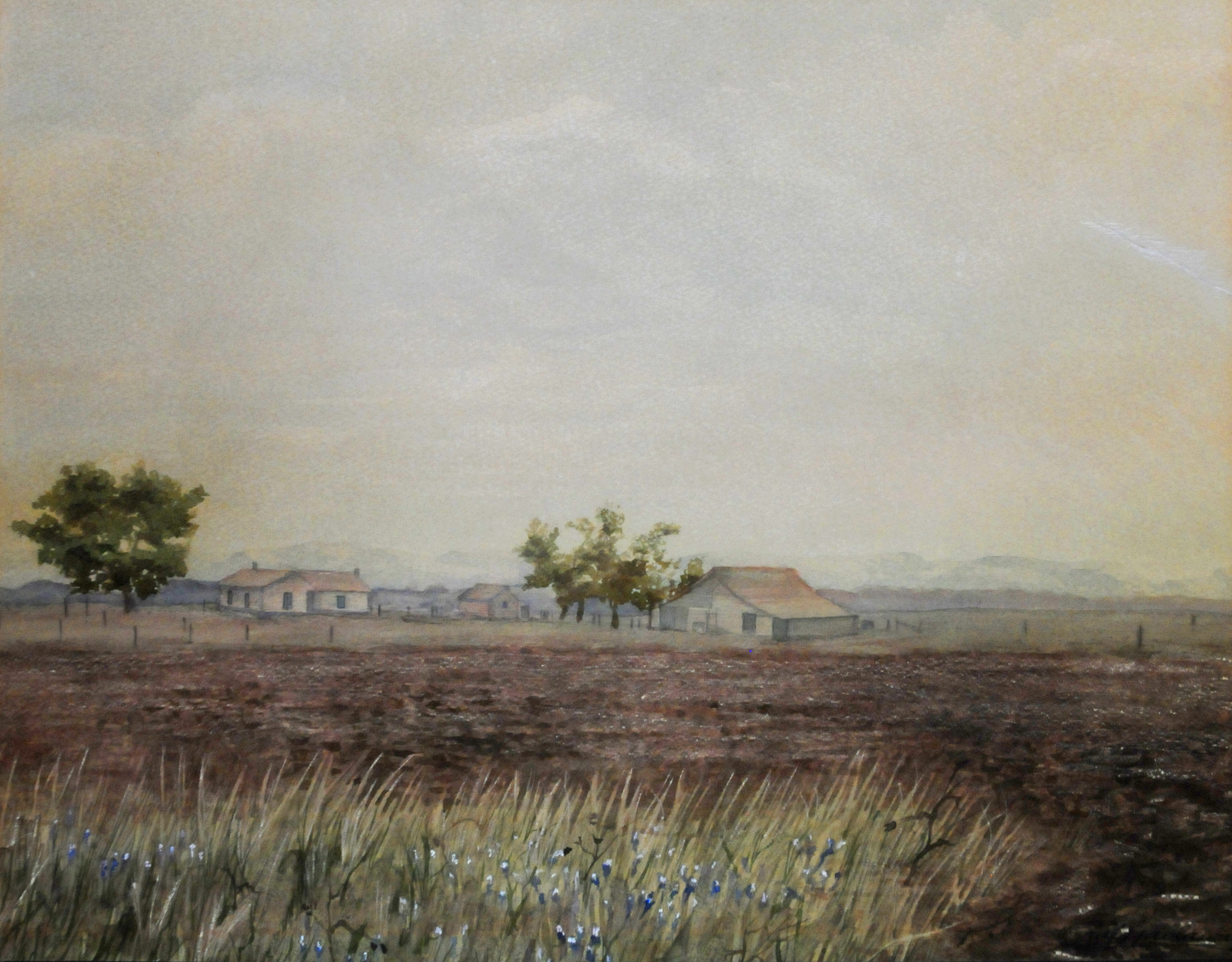
Glen Cove, watercolor by Craig Gallaway, copyright 1970. Based on a stock photograph and my own memories of my grandparents’ West Texas farm. I was trying to recall the atmosphere of their life and faith.

By the end of my second year at UTA (1970), still living at home with my parents, and hanging out with my rambling friends, the tension inherent in my double life was beginning to wear thin. Trying to live both as a cool neo-pagan rocker, and as a Christian (at least in private) has its fault lines and tremors. I had by then written a number of songs. I was surprised in a way to find myself in some of these songs (and in some of my paintings for watercolor class at UTA)  reaffirming the bonds of faith and country life that tied me to my family (for example, “The Hills of Coleman County”, mentioned at the end of Part 1). And though this kind of song resonated to some extent with a new turn in rock and roll at that time toward a more progressive country style (Dylan, the Birds, the Band), and wasn’t therefore a direct challenge to my revolutionary “style,” I think I knew at some level that this affirmation of family history was turning my political ideals toward something much more down to earth and grounded. I was letting go the world of sweeping claims about social justice and rediscovering the world of struggle, pain, and even joy in common life. This came out more explicitly in a Christmas song I wrote at the end of 1969, entitled “White Star.” (You can hear an early recording here.)

WHITE STAR

White star, how You came to be

shining down upon that country place

is beside me.

Bright and Morning Star, how you came to be

Walking around inside that country man

Is beside me.

And I was so surprised to find

That anything as ordinary as that country place

Could lighten every space

And brighten every face.

Bright and Morning Star, how you came to be

Looking right into these country eyes

Is beside me.

You’re inside me.

The tension inherent in my double life came to a head in the summer of 1970 when my father suggested that I might help out a young local preacher/evangelist named Billy Hanks. Billy was working with several young gospel singers, such as Cynthia Clawson, and he needed a guitarist for studio recording. I had a new red Guild guitar and I went straight to work. As a result, I myself became involved in some of Billy’s crusades, sharing my songs and my embryonic witness all over Texas, and eventually with the Youth for Christ organization in Europe. I also met a new set of friends and musicians; and this led later to my working with a popular Christian rock group called Love Song, as an opening act for concerts at various Texas colleges and universities.

Meanwhile, some of my old campus friends were wondering what was happening with my “music career.” I think some of them liked the music I was writing, and at least some of the lyrics. The band members even helped me, with various instruments, to produce some early recordings of the songs. But others in the troupe took offense at my increasingly public faith. The fellow on whose reel-to-reel tape machine we recorded even charged me with wanting to steal his tapes in order to get a music contract, get rich, and leave him out of the windfall. I had no such plans, and never pursued his vision for me; but I knew I had to walk away from that kind of suspicion and hatred. So, I did.

Another song that I wrote at about this time coincided with the decision to break more clearly from my old pattern. I was aware that my friends and I, with all of our ideals about social change and freedom and “love,” had long been disgruntled with life itself, working jobs that we didn’t really like or want, waiting for the weekend to come so we could party, get high, and escape our boredom, only to find ourselves worn out and starting another week in the same sort of stupor as the week before. I knew I needed to turn a corner, to spend my time differently. And what good did it do to keep sharing my songs when, as far as I could see, I might only be bugging them with my “witness”? I needed to strengthen what few real gains I had made (personal and spiritual) and begin with more effort to “redeem the time,” (Ephesians 5:16). The song I wrote about all of this was entitled “Time.” It was addressed in this case both to myself and to my old friends. It was a kind of farewell song and a wake-up call to make good use of time–and everything else we were being given. (You can hear an early recording of the song here.)

TIME

What can we do to save time that we think we can use

For a better time as soon as we have finished

What we’ve got to?

And what can we do to pass time when we find we’ve saved too much

And we’re spending all our time

Wondering just how we can pass it?

What does time mean to you?

Does it mean just that another day is through?

Are you rushing? Are you wishing? Are you lazy?

Do your days just pass you by, come and go?

Do you know the reason why?

I was letting go of one way of life. I was taking up another. In 1971, I began working as a youth director at the First Methodist Church in Carrollton, Texas, with pastor Ken Carter and his wife Freddie. I learned a lot at Carrollton about keeping a schedule and connecting with people who had regular jobs and families, people who were willing to work with me as we tried to make a difference in our surrounding community. In the summer of 1972, for example, instead of spending a lot of money, as we had done the year before, for the youth group to travel to Kentucky to work with the great Appalachian Service Project, we found a way to create our own service project in the rural countryside around Carrollton. Like ASP, we helped local people and families living in poverty to rebuild porches and roofs, and we enjoyed musical and cultural exchanges with the generous black congregations whose members welcomed us into their communities.

At the same time, among the people I had met through Billy Hanks, were two twin brothers, Brad and Stan Ferguson, who were part of the Inter-Varsity Christian Fellowship at North Texas State University in Denton. I lived with Brad and Stan on the NTSU campus for one semester in the fall of 1970, and then later spent time with them while I was completing my art degree at UTA. Among other things, my friendship with Brad and Stan helped me to clarify what it would mean to make a more grounded break from my old life of so-called “free love,” and to move into a new way of life in Christ that looked instead for a kind of wholeness, justice, joy, and wholesomeness in faithful marriage.

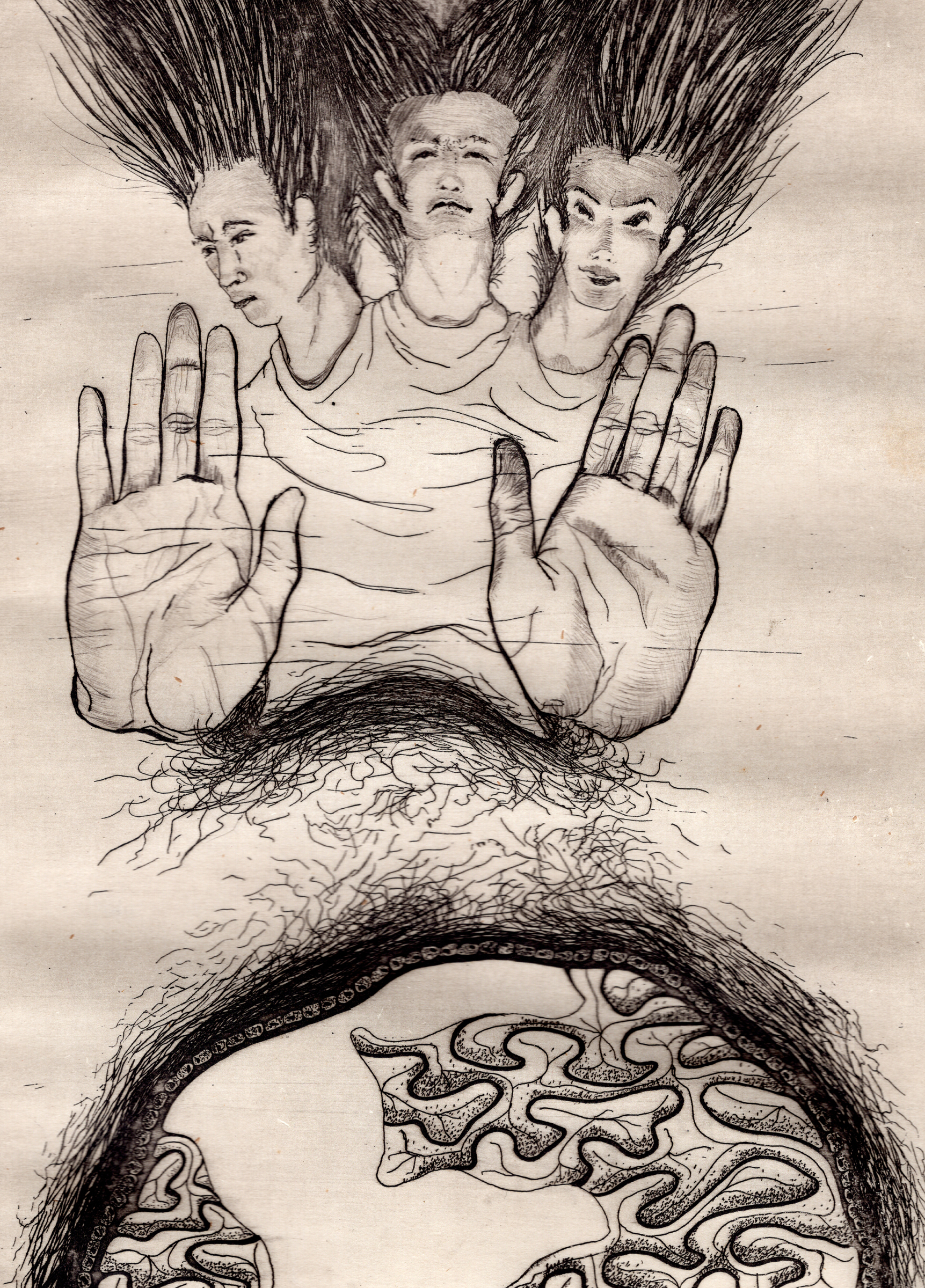
This was not a simple or easy time of transition for me. I was a young man in art school, taking life-drawing classes with nude models. I wrestled quite a bit with the meaning of my own desires. I even started at one stage in my art work, without really knowing the background or history, to drift toward the ancient gnostic heresy which once dogged the early Christians. This is the idea that the solution to our passions and unruly desires is in some way to get rid of the body itself, to be taken away to another world where there will be no body to bother with. I memorialized this in an etching that shows a young man, divided severally in his own mind, somehow breaking away from his brain and the world in order to find peace.

Gnostic Vision, etching by Craig Gallaway copyright 1970.

One day in Denton, when I was showing Brad some of my life drawings of nudes, I became embarrassed and said something about how he didn’t have to look at all of this “nasty” stuff. And Brad simply reminded me that for us as Christians, the body is not “nasty.” It is God’s good creation. Our task is not to escape it; but to learn to live faithfully with it and in it, in the physical world, with self-control, holiness, joy, and wisdom. Here, in a deeper connection, I was learning ever more clearly how the personal and the political, the social and the moral, far from being separate compartments, really belong together; and how practical and down to earth this way of Christian faith is designed to be. The Spirit was working with me, even as I at first misinterpreted what I thought the Spirit was aiming at. But this is how the Spirit often seems to work when one is in need of deconstruction and reconstruction!

In the summer of 1973, after graduating from UTA, I returned to the San Francisco area to live in Richmond and to work with a group known as “The Christian World Liberation Front.” Led by Jack Sparks on the campus of the University of California at Berkeley, CWLF sounded like another radical political group. And in a way it was. But it was focused on helping young people recover a sense of faith, hope, and grounding in Christ. I too was still learning how to bring my old revolutionary ideals down to earth, to embrace a way of life that was faithful in love, disciplined in work, focused on service, and open to all people under the guidance of the risen Lord and his Spirit. I came to see that these practical steps of faith, as common and ordinary as they seem, really are the Christian alternative to the overblown rhetoric that we often encounter in revolutionary circles, such as the Zealots in the New Testament, the hippies of the 1960s, and the recent cultural harangues from the riots of 2020. This is also, by the way, the kind of mission grounded in faith and individual responsibility that we find at work today among leading black Christians and public intellectuals such as Robert Woodson, Shelby, Steele, and Glen Loury.

So this is how I began to learn over time what it meant to sing the words of my own song: “Jesus’ blood, dripping on the stones, has set me free to soar.”  Set free not only from the physical confines of the SLO. CO. JAIL, but also from the spiritual and moral rabbit trails of my own limited vision, my story, my self-understanding. His death and resurrection, his defeat of the powers of sin and death, and his continuing power and presence by the Spirit, are the foundation for a real revolution that aims finally at resurrection and new creation. Nonetheless, like the Apostle Paul, those of us who follow him do not dare nor even wish to claim that we have already arrived, for we are still on the road hiking with purpose toward the final restoration and victory (Philippians 3:12-15). But we are “in him” and that makes all the difference: On the road of new creation, fighting back against the fallen powers, under the banner of the King!

[i] I wish I could say that I recognized clearly during the early years portrayed in this account just how much my father and my mother had been an ever-present help to me. After all, when Dad came to Haight-Ashbury to get Jerry and me out of trouble, he was, in a way, enacting the gospel in person. I didn’t see it so clearly then. Later, looking back, I was able to recognize how, to put it mildly, it had not been easy for him to come to that particular “far country” to find us, to bear the costs (monetary, personal, and emotional) and the drab ignominy of our sins and failures, and all of this in order to give us a second chance to start again; yet to see no immediate signs of gratitude or change in either of us. Dad was no more perfect than the Apostle Paul. But, like Paul, on behalf of the runaway slave, Onesimus, and like King Jesus who is the source and foundation of this whole endeavor, he was ready to take our debts upon himself in order to bring about, if possible, the desired reconciliation.


DESPERADO DECONSTRUCTED–1969-70, Part 2 of 3

A picture drawn in 1968 of my older brother Jerry, which also reflects how I saw myself, especially after our dreams for the “Summer of Love” began to crumble and fall apart.

After returning to Fort Worth from Haight-Ashbury in the summer of 1968, I was in an emotional and mental crisis. I had seen, and partially registered, some of the inconsistencies, some of the dysfunction, and the short-sightedness of the youth revolution in San Francisco at one of its central meccas; and yet I was also still alienated from my parents and their version of culture, religion, and life as well. They saw that I was suicidal for a while and, I am sure, prayed for me a lot. Yet, by the time the fall semester of what would be my first year in college rolled around, I had decided to make another stab at posing for the revolution with my old friends. I tried to register for the Vietnam draft as a conscientious objector in downtown Fort Worth; but was rejected and put into the normal lottery with everyone else, number 165. I moved into an apartment on the campus of the University of Texas at Arlington with a couple of friends, and our place became a hangout for a group of about twenty like-minded comrades. We formed a rock band, took drugs, played concerts at area colleges, preached and practiced “free love,” and looked for ways to make our mark as campus revolutionaries.

At the same time, I was constantly troubled by what, at an increasingly conscious level, I recognized as the weakness, ignorance, and arrogance of my and my friends’ positions. And I continued to read in secret other sources that put me in contact with a Christian view of things. Most significant in this regard was the Gospel of John, which gave me a window into the life of a person whose faithfulness was unlike anything or anyone else I knew, both scary and somehow reassuring. But I was in a state of cognitive dissonance, still trying to keep up appearances as a heroic young revolutionary. There was still a good deal of deconstruction left to do in my life, much more than I could have imagined.

As part of our revolutionary effort, I and several others in our group joined and helped to start the UTA chapter of the “Students for a Democratic Society” (SDS). This was a counterpart at that time to the kind of political philosophy one hears of today (in 2020) from people like A.O.C., Black Lives Matter, and others on the Left. Our group organized and participated in various public demonstrations, joining our voices with what were, in retrospect, perhaps sometimes “righteous” and sometimes not so righteous causes. We organized, for example, a “Pro Castro Rally” in one of Arlington’s public parks. We put up posters and sent out brochures. Bernie Sanders would have fit right in. On the day of the rally, as our speakers tried to hail the virtues of Castro and communist Cuba through a public address system, we were surprised to find that a large group of anti-Castro Cuban refugees (who had lost their homes, sometimes their families, and their country to Castro’s regime) showed up to shout and stare us down. I think we thought the crowd that day would be mostly other college kids out to demonstrate their political consciousness (like many of the “woke” today).

As I stood in the front line on our side, I looked across the gap between the two groups of demonstrators and saw my father looking back at me. He was standing in the second row of the counter-protestors, but he was not shouting. His face showed concern. When the rally was over, my friends and I went back to our apartment, proud of our demonstration and fairly sure of our righteousness though, truth be told, I could not at that time have told you anything beyond what our SDS speaker had asserted about Castro’s ideas, or what Castro had actually done on the island of Cuba. And I’m pretty sure the same could be said for most, if not all, of my friends. Being ill-informed and dogmatic is a heady, but a dangerous, cocktail. Dad never spoke to me about that day, or asked me any questions about it, though he had majored in International Law at UT Austin in his college days, and had also made a special study of Cuba, as I later learned.

I suppose someone reading this might interject, “Well, you were just being a normal adolescent, rebelling, striking out to find your own identity, etc.” And that would be true as far as it goes. But, remember, like those who are demonstrating and sometimes rioting today, we were taking positions on pivotal political issues, and we were beginning to vote, and to shape the future of this country. Indeed, the future we shaped then is in many ways fully visible in the present we are all living now. Yet, very often we were motivated (as seems also to be the case today) by little more than our hormones and a desire to appear bold and brave at the demonstration.

I might have continued to live, party, demonstrate, and accept the superficiality of our political and historical analyses at that time for who knows how long, had my own personal life not also been caught up in the inconsistency and self-indulgence of the scene. My friends and I saw, or at least we admitted, no contradiction between our high moral claims on selected social issues while, at the same time, rejecting any moral claims that might be placed upon our personal and sexual behavior. But in this, I reluctantly came to believe, we didn’t take account of the ways of the human heart, how we as human beings are made to live and love, and the need for faithfulness and commitment in any love that is worth having.

This finally came home to me when a young woman I was with at the time became pregnant, and we decided to have an abortion. I (and I think she) didn’t want to be tied down right then to a family, and I was already on the verge of taking up with someone else. But I also knew, somewhere in my gasping conscience, that there was something deeply wrong in all of this. Though my friends had no problem with it, it became a torment to me. I was reading The Problem of Pain, and realizing that much of our pain we bring upon ourselves, a lesson I had “learned” before. And I saw Jesus in the Gospel saying to the woman caught in adultery, “Neither do I condemn you. Go and sin no more.”

I wish I could say that I saw the light and decided to do the right thing, to marry this young woman, and to bring that child into the world. But I did not. She had the abortion, and I moved along to another relationship, which also later foundered. But in my secret reading of the Gospels, and in the beginning rudiments of prayer, I began to see myself for what I was. What I had become. Yet also to see a picture, in the face of Jesus the King, of the kind of person I might become. And, slowly, something began to turn inside of me. I finally came to a place with my “revolutionary” friends where, sitting together in a room of an evening, and listening to one of our more vocal leaders tell of how we were going to change the world, I objected. To everyone’s surprise, including mine, I found myself saying, “Do you really think that we are going to change anything?” Everyone’s jaws dropped open. But no one said anything.

Over the next two years, I continued to read, to think, to pray, to begin to apply myself to study, and gradually to separate from my old crowd as I found other people like myself who were trying to figure out what it would look like to care about social and political issues and yet, also, to be a Christian, a person of faith and of faithful relationships. And I continued to write songs, one of which was the story of the SLO. CO. JAIL, only now told with a further layer of deconstruction in place, and at least a hint of what reconstruction might look like. I realized even then, looking back on my journey since Haight-Ashbury, that I had gotten out of the SLO. CO. JAIL a long time ago; but I was still in jail in my heart and life.

THE SLO CO JAIL

Summer of 1968, San Luis Obispo County,

Peanut butter and jelly, standing on the street, waiting for him.

We stepped into a chapel and found the perfect gift

To set his mind on freedom.

It was Jesus, in a blood-red ruby stone.*

But the SLO CO JAIL, it’s a lonely place.

O, the men inside have such a lonely face.

Driving down the coast road, staring at the ocean.

And it’s so beautiful with the sun upon its motion.

We were heading down to Mexico, gonna make our fortune.

But we’re so fortunate we never made it.

  And the SLO CO JAIL, it’s a lonely place.

O, the men inside have such a lonely face.

What are those cagey shadows hanging on my wall?

No, I don’t think I’ve been here before.

And wild geese flying toward heaven, and Jesus in a blood-red ruby stone,

Cannot free this heart of mine.

But just as iron bars do not a prison make, neither can blue skies give freedom.

What are those cagey shadows hanging round my heart?

And wild geese flying toward heaven could only remind me

Of my desire for freedom.

But Jesus’s blood, dripping on the stones, set me free to soar.

And the SLO. CO. JAIL, it’s a lonely place.

O, the men inside, have such a lonely face.

And the SLO. CO. WORLD would be a lonely place

Had the Lion himself never shown his face.

*The reference to “Jesus, in a blood-red ruby stone” is about a trinket that one of our group bought in a small Catholic chapel to give to Jerry while we were waiting on the street in San Luis Obispo for him to be released. It appears in my 1968 drawing in the lower left corner.

In Part 3 of this reflection, I will take back up what it means to say that, unlike the trinket for Jerry, “Jesus’ blood dripping on the stones set me free to soar.” For that is finally what this reflection is all about. How the Gospel of Jesus’ death and resurrection has the power not only to deconstruct us from the false narratives, and the superficial posturing to which we become bound, but also to reconstruct us as the unique individuals that each of us is in the image of our Creator, who made and loves each one of us. Though that process may for some of us take a considerable amount of time.

DESPERADO DECONSTRUCTED–1968, Part 1 of 3

Desperado

A picture drawn in 1968 of my older brother Jerry, which also reflects how I saw myself, especially after our dreams for the “Summer of Love” began to crumble and fall apart.

In June of 1968 I graduated from high school in Fort Worth, Texas. I stood in the driveway of my family’s house on Danciger Street and bade my father “farewell,” hardly listening to his plea for me to take care of myself. I was heading to San Francisco, along with a couple of friends. I knew my older brother, Jerry, was already there, in the Haight-Ashbury district, and I and my friends couldn’t wait to leave our conventional families and neighborhood behind, and join in the “Summer of Love.” Indeed, I thought (very clearly in my own mind) that I would never return to my family again. I had had it with my parents, my grandparents, the whole scene of traditional religion, culture, and society. My friends and I would join the movement for free love, “make love not war,” “flower power.” We really believed that we might be able to usher in a new “age of Aquarius.” And so, we hit the road and drove to San Francisco. On the way, about the time we drove through Los Angeles, Robert Kennedy was killed there, following in the wake of the assassination of Martin Luther King, Jr., in April, and Kennedy’s brother John five years earlier.

As soon as we arrived, we learned rather abruptly that the “District” itself was not entirely free from the world’s problems. We found Jerry and his friends in one of the row houses that we so-called “hippies” occupied for several square blocks around the cross streets of Haight and Ashbury. No one paid rent. No one minded who came and went. The owners and the police had given up trying to enforce normal property laws (just like in Seattle today). On our first evening in the house, we encountered a young black man knocking from outside on the second story window of our house. He was leaning out of the window of the next-door house (those houses were only a few feet apart in many places). We opened the window and he shuttled through, running for the front door, and yelling back over his shoulder as he went that he had just shot someone in the other house, having been caught trying to rob it. Not exactly the welcoming party to the summer of love that we had expected, but perhaps this was just an aberration.

No. The next morning we found that everything we had left in our car parked on the street had been stolen as well, including all of our camping gear and most of our clothing. No problem, this was the place of the New Age, the new world of love, and we were going to make it happen, even if it cost us a little bit here and there. Revolutions do require sacrifice.

I began to have deeper doubts about the depth and soundness of our vision when I sat down with Jerry the next day to talk about our plans: How we were going to change everything for the better in our world of civil rights marches, assassinations, and the Vietnam war. I was only 18 years old, and I hadn’t really been a very committed student of history, philosophy, economics (or anything else, to put it mildly); but even I knew that something was deeply wrong and askew when Jerry explained to me that the way we were going to correct the imbalances of our society was to “Walk into the banks. Rob them. And then just redistribute the money equally to everyone” (a kind of defund the police solution if ever there was one). I remember thinking, though I didn’t say it out loud at the time because Jerry was the closest thing to a “Messiah” that I had, “But, Jerry, what will happen then? How will people behave with all of that cash? Will we all just suddenly become good?” I didn’t ask, so he didn’t get a chance to answer. But, had I asked, I imagine he might have regarded me as rather naïve or uncool, perhaps in need of some more LSD or marijuana, which we were all using a lot.

Jerry’s next plan sounded better, but it ended in disaster. We would take a homemade “house-truck” that belonged to one of his friends and drive down to Mexico. We would purchase a boatload of marijuana, and then bring it back into the country, literally, by boat, landing somewhere in the Big Sur area. We would distribute the weed, make some money, and everyone could get high and celebrate with a great “love-in,” which meant of course lots of sex with whomever was willing. Things went south when we were stopped on Highway 1 for making an illegal U-turn, and then arrested for having drugs in our possession. We were put into the county jail in separate cells at San Luis Obispo County ( or, as the name was ironically abbreviated on the building and on the side of police cars, “SLO. CO. JAIL,” and “SLO. CO. POLICE”). We spent several days in jail before they decided to let us go. They were arresting hundreds of kids every day along the coast, and had nowhere to keep all of us. They let all of us out except Jerry.

I hadn’t known it, but Jerry had been arrested a few days earlier for possession of marijuana in San Francisco, and was due for a court appearance. In leaving for Mexico, he had jumped bail and skipped town, so now there was a warrant for his arrest. After our release, the rest of us hung around for a couple of days in San Luis Obispo, before heading back to San Francisco where Jerry had been extradited. Back in Haight-Ashbury, without my brother, no money, and a head full of broken dreams (my Forth Worth friends had long since gone home) I tried to fit into the scene as best I could. But the social scene in the district was pretty much like the social scene anywhere, and the ideals of even a few months earlier were falling into disarray. Everyone pretty much looked out for themselves, and indulged their own appetites. People were taking drugs and having sex with pretty much anyone. And I had not eaten for about three days.

I remember getting very angry about the way things had turned out. At one point, I lay on a bathroom floor, cursing the god in whom I said I did not believe, the god in whom, even then, I did not want to believe. ”Why, god, have you put me in this position? Why did you let me come to this?” And some how, in my own mind, the words came through to me, “Craig, I did not put you here. You did this.”

As I began to starve, I felt I had no choice. I called my father and asked for help, the prodigal who couldn’t even make his own way home. But unlike the biblical prodigal, I wasn’t really repentant yet, or able to register what a fool I had been with all of my pseudo-romantic self-imagery and grandiose ideals. Dad said he would come right away, and told me where he would meet me. So, Dad came to Haight-Ashbury. He got a hotel room. Got some food into me. And then he went to talk with the judge in the court where Jerry was being held.

The judge agreed to release Jerry if Dad would pay the bail and promise to take Jerry out of the state, a deal to which Jerry agreed. The next morning, when Dad went to collect Jerry from the house where he had gone for the night, he was gone. No one knew where. Dad didn’t see Jerry again for at least three years. But he took me back to Fort Worth, where I felt alienated from everyone and everything. I felt I didn’t know my parents anymore. I thought of suicide. All of my dreams and visions had been deconstructed, and what was underneath was really just a desire to appear heroic, to indulge my desires, and to live my life free from the constraint of what others might want or need. All of the veneer of my social visions and commitments had crumbled. My friends and I didn’t really know how to save ourselves, much less the rest of the world. But that didn’t stop me from trying to hold on to the old narrative.

Back in Fort Worth, I took up with my old friends. I knew there were huge gaps in our world view, but where else could I turn? My world had been deconstructed by the raw data of experience; and I didn’t want to admit it. But I began secretly to read and ponder some other things, things that wouldn’t make any sense to my friends who still believed in the summer of love, things like the Gospel of John, C.S. Lewis’s Problem of Pain, and George Herbert’s 17th century poetry. And little by little I began to review the history of my life and to see resonances that I hadn’t seen before. And I began to write songs. One of the first was a surprising reversal of my rejection of family, called “The Hills of Coleman County,” a song about my grandparents’ old place out in the country:

I can still remember, back in my childhood days,

living with Mama and Papa, and eating the country way. . . .

And I am heading for the meadow that lies beyond those hills.

I feel there’s something calling to me, and I’ve got to take my fill.

Also, one of George Herbert’s poems (discovered in freshman English at the University of Texas at Arlington where I went with my friends in the fall) struck me like a shaft of light with images of something very like what had happened to me on the bathroom floor back in Haight-Ashbury some months earlier. I took Herbert’s poem “The Collar,” revised it for contemporary lyrics, and turned it into a rock song that I called “The Table.” This was indeed so very much like me on the floor cursing God:

I hit the table, and shouted, “No more do I want to spend any time
On this blasted living.
Why should I sigh. My lines and life are free, free as the road, loose as the wind.
Sure there was corn before my tears did drown it out.
Sure there was wine before my sighs did find it out.”
But as I grew more fierce and wild with every word, I thought I heard a voice
Calling, “My Child.”   “My Lord.”

In part two of this reflection, I will look further into how coming into contact with the Christian Gospel by various means affected my understanding of my time in San Francisco and the SLO. CO. JAIL.