
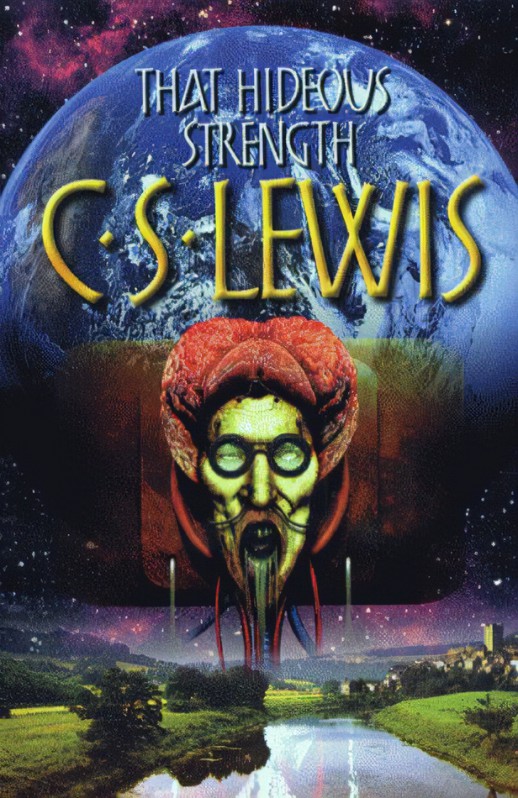
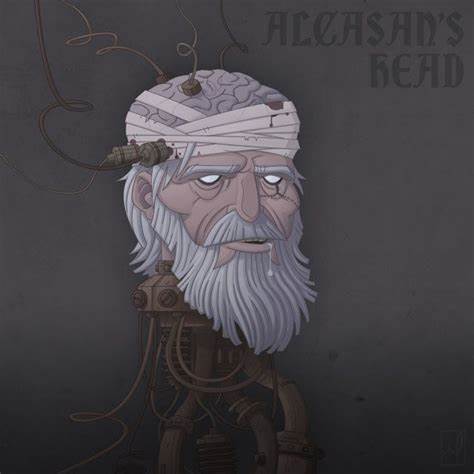
THE SARACEN’S HEAD
Overview Question
In this chapter we come at last, more directly and in greater detail, to the most challenging elements of Lewis’s science fiction fairytale. Indeed, now that we are about halfway through the novel, one of our primary tasks going forward will be to try to discern where the science fiction and fairytale end in Lewis’s story, on the one hand, and where the reality of spiritual forces at work in human life begins, on the other.
For my part, I will say from the outset that I think Lewis intends for his readers to regard the bodiless head experiment, with which the chapter begins and is titled, as well as the descriptions of Ransom’s space travels, which come later in this chapter (as well as in the earlier volumes of the trilogy) as science fiction. He does not want us to get tied up in knots trying to figure out if or how these things might really have happened.[1] The real question we must answer in order to understand their role in the story is what they represent.
Similarly, the idea of a bodily return of Merlin, the 5th century Druid, to 20th century England is, I feel sure, of allegorical importance and meaning. This does not mean that Merlin never existed (in Lewis’s own view) nor that he is of less importance in the modern setting of THS. The real question again is: What does the return of Merlin represent? What is it that the figure of Merlin brings into this story about a battle for the soul of England in the twentieth century that is of critical importance to what the story itself is trying to tell us? This, then, leads to our Overview Question for this week, focusing first on the eldil:
If we are not really asked to believe in Ransom’s space travel and his meetings on other planets with the so-called eldil, nor per se in the dark eldil who inhabit our planet and control Belbury, then what do these eldil and their planets represent in the real world and spiritual experience of human beings on planet earth?
In order to answer this question, you will need to call upon your knowledge of Scripture and of the history of Christian thought regarding the identity and role of angelic beings? Where do the good angels dwell? What do they do? What is their role in relation to human beings? What stories from Scripture can you recall that provide insight into any of these questions? And for the dark eldil: Who is the devil? By what names is he known? What are the demons? What are the fallen powers of which Paul writes? And what, according to Scripture, are the aims and methods of all of these dark creatures in the fallen world? How do they operate?
I don’t imagine that all of you will have lengthy responses to all of these questions. It isn’t a subject that many Christians today have spent much time studying. But the questions should, at any rate be familiar to you. And the answers you give can be measured against Lewis’s portrayal of the eldil, which is filled with biblical allusion as well as with the medieval allegories of the virtues and the planets (see also his, Discarded Image). We shall also, by the way, refer to Lewis’s Screwtape Letters for additional help with his views on this subject.
______________________________________________
[1] Just as Dante knew there was no opening in the ground near Florence leading down to hell, and John Bunyan knew there was no actual city of Vanity Fair, Lewis employs the classical and medieval imagery of the planets as an allegory related to the human experience of virtue, temptation, and vice.
DEEPER-DIVE QUESTIONS
1. The chapter opens with Jane’s most vivid dream yet, this time of Mark getting sick and fainting when he is forced to bow with Filostroto and Straik before the disembodied head (see the end of Chapter 8). Then in Part 2, when Mark wakes up the next morning at Belbury, he is full of disgust for what he has seen; yet afraid of what will happen to him if he does not cooperate and bring Jane to Belbury. How does the narrator (Lewis) account for this double-mindedness in Mark which finally leaves him unable to break away from Belbury even though he wants to? What would need to change in Mark’s worldview and lifeworld practices in order for him to become the kind of person that can stand up to Belbury?
2. In Part 3, Mr. McPhee, the household skeptic at St. Anne’s, tells Jane about Ransom’s story of space travel and meeting with the eildils on other planets, as well as the role of the dark eldils on earth (see also the first two volumes of the trilogy). But MacPhee is a strict empiricist, despite his own religious heritage that he seems to respect but does not embrace (his Scottish Presbyterian uncle). He will not believe in anything that cannot be proven by strict adherence to observable (physically measurable) evidence. How does this empiricism make MacPhee a great asset to the cause at St. Anne’s, yet leave him sadly shorthanded when it comes to understanding or dealing with the spiritual powers?
3. In Part 4, the council at St. Anne’s comes together to discuss the reality-status of the head in Jane’s dream. We saw in the last chapter, and now again in this one, how the head represents a desire at Belbury to achieve immortality through artificial intelligence and thus to give the NICE technological power and control over society and the world. What analogs for this kind of technocratic vision can you identify in American society and the world today? How widespread is this phenomenon?
4. At the end of Part 4, and in part 5 of Chapter 9, Ransom and Dimble wrestle further with the question of Merlin’s role in everything that is happening. They can’t seem to make up their minds about whether the Merlin they know from the Arthurian legend would come back today as a representative of the powers of coercive black magic and the dark eldils (such as Morgan Le Fay with her corrupting passions run amok) or as a representative of something much closer to the Christian view of nature and of man’s role in creation. Ransom is sure, however, that Belbury’s interest in Merlin is under the power of the dark eldil and, therefore, has to do with black coercive magic. He is also clear, moreover, that the good eldil will not use coercive power to accomplish the goals of Maleldil. What does this tell us about the methods and the goals of the good eldil? And why is Ransom so concerned about the danger of combining the technocratic vision at Belbury with the old dark powers of the passions and the fallen angels? What would be an example of this dreadful and destructive combination today?
5. Extra Credit: Given what you have learned about the importance of free participation and human partnership in the cause of the good eldil and of the people at St. Anne’s on the Hill, what sense can you make of Camilla’s love for the quotation from Charles William’s poem, Taliesin Through Logres, which portrays how the battle of Badon Hill (in the Arthurian legend) was won by an act of “patience” on the part of the poet Taliesin? Note that Camilla uses this quote to interrupt MacPhee’s interview with Jane: “Fool, All lies in a passion of patience, my Lord’s rule.” How does the quotation sum up the basic traditional worldview of the people at St. Anne’s?
 Faith and the Arts