
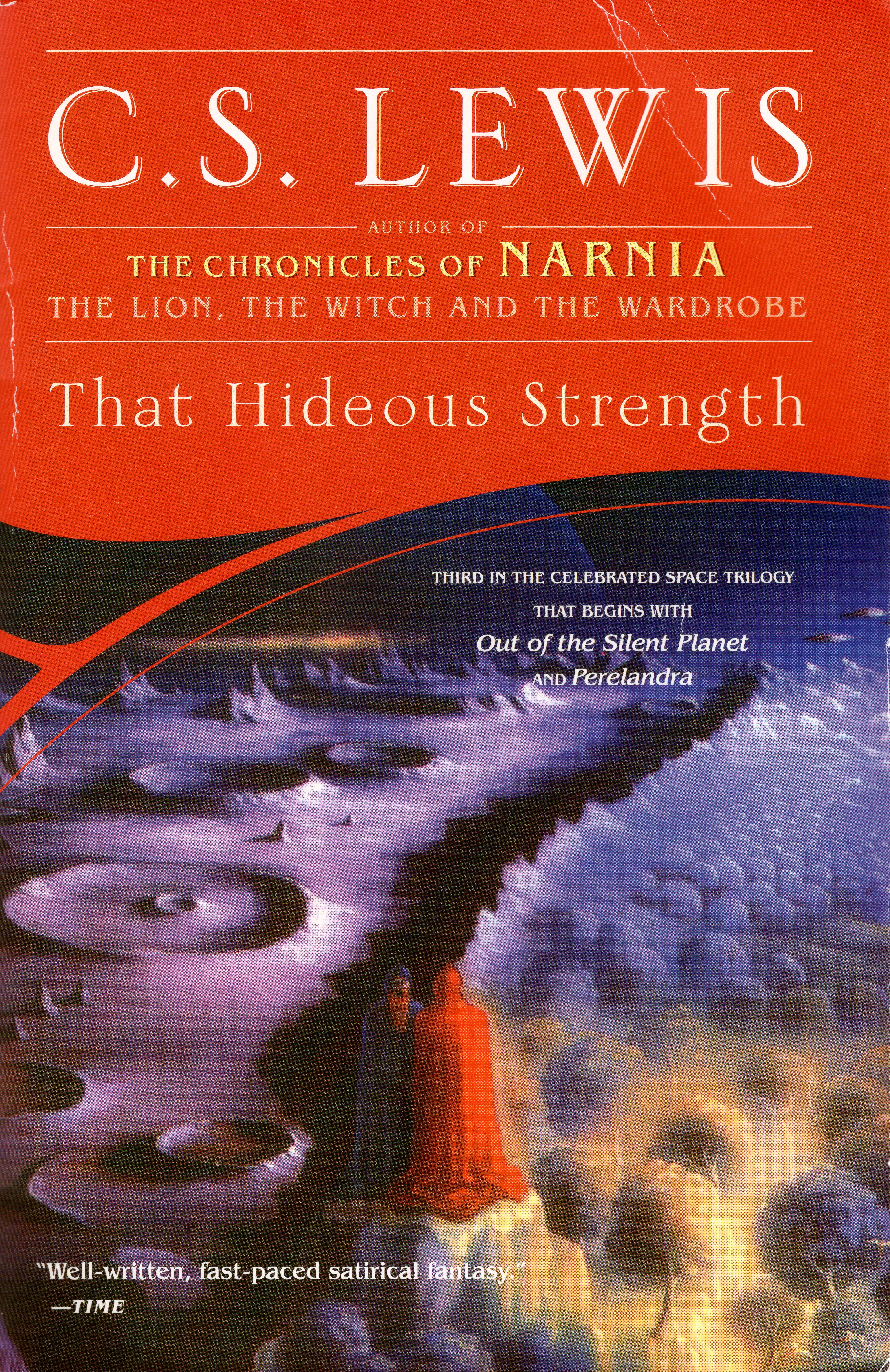
THAT HIDEOUS STRENGTH: STUDY GUIDE 2022

THS cover

That Hideous Strength (THS) by C.S. Lewis (1945), is an amazing and multilayered story about spiritual and cultural warfare in the modern world.1 Set in the fictional college town of Edgestow in mid-twentieth-century England, the story portrays events that presage the troubles and traumas of American society today. Anyone reading the story in the United States today will surely discover many alarming and revealing parallels. This should not surprise us, however, for the forces that are at war in America today have their roots in movements that have been trying to reshape both England and America since at least the early twentieth century.2 Lewis was aware of these forces.

The “Big Picture.”

In his preface to THS, Lewis says that his book is a “fairy-tale” with a “serious point,” a point that he has tried to make elsewhere in The Abolition of Man (TAM). In TAM, Lewis also describes a cultural war: a war between the modern post-enlightenment worldview (or life-world), with its exaltation of so-called “objective” or “scientific” knowledge, and the traditional worldview (or life-world) that reaches back through the Middle Ages to the Bible, with its emphasis on spiritual values and virtues that shape every part of human life in obedience to God.3 According to Lewis, the shift toward the modern life-world, especially in the institutions of modern British education, has resulted in “men without chests,” that is, people without training in the kinds of virtues and values that build strong families, congregations, communities, nations, and a healthy interaction with nature. These are, indeed, the themes of THS as well, though in THS they appear in a fictional story of dramatic detail with an unfolding narrative of personal struggle.

Thus, the conflict between the modern worldview and that of the biblical tradition through the Middle Ages is the “big picture” within which the story of THS is set. In a way, it is a story about the conflict between two big pictures, two life-worlds.

Major Corporate Characters of THS: The NICE at Belbury and St. Anne’s on the Hill

There are two primary institutional “characters” in THS, and each represents one of the life-worlds in question. At Belbury, we find the organization known as the N.I.C.E. (the National Institute for Co-ordinated Experiments). This group promotes the modern worldview, where all moral and religious values are considered subjective and relative, and where the primary goal is to create an administrative state, led by scientific elites who will manage and control the lives, the work, the futures, and even the sexuality of the common people. Sound familiar?

In this way, the NICE embrace, in a fairly straightforward manner, the modern post-enlightenment worldview. It is a world in which “nature” includes everything in the universe in a vast cause-and-effect system; and man is free to experiment on nature guided only by his own reason. As such, the NICE are also in league with what is called in THS the “progressive” element at the local Bracton College where, once again, the goal is to move the college away from its older scholars who represent the traditions of classical learning (Prof. Jewell) and even away from basic, “hard,” laboratory science (Prof. Hingest).

On the other side of this spiritual and cultural battle, we have the group that lives together at St. Anne’s on the Hill. This group, which is really more of a community—with marriages and families, gardens and animals—is led by Dr. Ransom, who is also variously called the “Director” and the “Pendragon” (the latter is a link to the medieval Arthurian legend).4 The plot thickens at this point, note well, for where the NICE are in league with the progressive element at Bracton, the community at St. Anne’s is in communication through Ransom with a group of “angelic” beings known as the Eldil. These angelic messengers, or Eldils, are guiding the people at St. Anne’s in their efforts to defeat the demoralizing influence of the NICE and to restore what is truly good, natural, and normal to the people of England.5

In this way, the life-world at St. Anne’s is open to many things that are simply unthinkable at Belbury. For at St. Anne’s, nature is not a vast cause-effect machine, ruled only by human reason. Rather, it is a living organon in which the power of God and of other spiritual forces are at work. Within this world, moreover, and shaped as it is in Lewis’s story by the medieval tradition, human beings are guided above all by their obedience to God and their submission to the living order of creation itself which God sustains. Their practices of marriage, prayer, and care for creation, for example, are inherent in how they view and value the world.

Major Individual Characters: Jane and Mark Studdock, and Merlin 

Among all of the characters in THS, both at Belbury and at St. Anne’s—all of whom carry in some way the weight of their group and its life-world—there are three characters whose roles deserve special attention now. The first two are married to each other, Mark and Jane Studdock. They are a young professional couple. She is a feminist who wants an academic career rather than a family. He is an ambitious young professor who wants, above all, to climb the ladder of success. One might look at them in the story or in a real-life situation and say, “My, what a fine young couple.” But Mark’s and Jane’s marriage is in trouble. She wonders if she has made a mistake. They do not share deeply with each other about anything.

As the story progresses, furthermore, Mark and Jane move in opposite directions; one toward Belbury, and the other toward St. Anne’s. But in neither case are their movements streamlined or seamless. Both wrestle a lot with how to understand themselves, and with how to understand what is happening to them in these very different settings. Indeed, with Mark and Jane, we are given a personal life, two lives in a personal relationship with each other, as the canvas upon which to discover what is really at stake in the life-worlds and the worldviews that they (and we) embrace.  

And then there is Merlin. Part of the medieval worldview that Lewis loved was the Arthurian legend. In THS, in this regard, both Dr. Dimble and Dr. Ransom are character types of Lewis himself. Both are Arthurian scholars, and both are aware that the NICE are trying to unearth the legendary grave of Merlin at Bragdon Wood. As a result, Dimble and Ransom are concerned about what this blending of modern atheistic science with ancient “magic” may portend for the spiritual battle ahead. In the end, Merlin—back from the dead after 1,500 years—plays a critical role in the defeat of the dark powers at Belbury. But he also presents one of the greatest challenges for us in trying to figure out how the fictional battle of THS may also apply to our own situation in America today.

Some Contemporary Concepts to Keep in Mind

As we work through the story, reading about both the individual characters and the corporate ones, each of us will, I believe, notice parallels, analogies, and echoes between what is going on in the story and what seems to be going on in America today. I want to encourage you to take note of these parallels and, indeed, some of my questions will ask you to name and list the parallels that you discover. In addition, I want to offer three major conceptual tools that I believe will help you to interpret what these parallels signify, both in our time and at the time of Lewis’s story. Keeping these in mind as you read may help you to make sense of the sometimes-chaotic strands of Lewis’s story, a kind of chaos that I believe we also encounter as we try to understand the strange and nonsensical things that are taking place today.  

  1. The Four Stages of Cultural Revolution – As described by former KGB agent Yuri Bezmenov in the 1970s, these are the stages by which Russian agents worked to infiltrate and undermine America and other western societies. 1. Demoralization – using pornography and other methods through media, entertainment, education, etc., to break down the moral courage of the people.  2. Destabilization – By undermining police, courts, borders, etc., to overwhelm public safety and further demoralize the people. 3. Crisis – Build 1 and 2 to the point of a crisis where people resort to rioting or to civil war. 4. New Normal – Declare emergency powers and install the administrative state as a solution for all of the problems which the revolutionary forces have themselves caused.6
  2. The Long March through the Institutions – This is a central concept of cultural Marxism, (see endnote 2). It concerns the strategy of neo-Marxists in America and in other Western societies to overcome the resistance of successful middle-class cultures to the Marxist rhetoric of revolution. Middle-class people tend to be somewhat satisfied with their lives and tolerant of income differences with others. Cultural Marxists therefore target all of the institutions of middle-class society—church, family, public education, media, the press, entertainment, business, academia, science, law, etc.—in order to create the problems and crises that lead to the imposition of emergency powers and the administrative state.  
  3. Mass Formation – This is an academic concept that has been used for many years to try to understand the mass psychology that appears to be at work in societies like Bolshevik Russia, Nazi Germany, and Mao’s China, where thousands of ordinary citizens either turned a blind eye to the suffering of their fellow citizens or, in some cases, joined the forces that shamed and tortured them. The process is based on fear and the desire to survive or escape the threat of suffering. Under these conditions, “normal” people may become callous to the suffering of others. They “go along to get along.” But the result is a complete collapse of genuine religious and moral civilization.7

A Coherent Picture?

Using these conceptual tools, and others that come in along the way, I believe our reading of That Hideous Strength will provide numerous insights into the troubles—cultural, political, and spiritual—that we are facing in America today. And, since the conclusion of Lewis’s story involves a time of reflection by the people of St. Anne’s on what has happened and what may be expected to happen in their future, the story also gives us an opportunity to consider what kind of strategy and what view of our future we should take if we are to embrace the traditional worldview, at least as C. S. Lewis understood it. My hope is that our reading of THS will enable us to make a more informed response to these kinds of issues for the sake of our own time, for the sake of our own country, for the sake of our own “great heartedness.”

__________________________________________________________

1. That Hideous Strength (1945) is the third volume in Lewis’s famous space trilogy. The first two volumes are Out of the Silent Planet (1938) and Perelandra (1944). All three are connected by their main character, Dr. Elwin Ransom, Cambridge philologist and space traveler. But each can be read separately as a story in itself.

2. I am thinking of the movement known as “cultural Marxism” or “Neo-Marxism” which began in Europe in the 1920s when Antonio Gramsci and the early members of the Frankfurt School of Critical Theory in Germany launched their plan to revitalize the forces of Russian Marxism in America and in Europe by engaging in what they called “the long march through the institutions.” This involved infiltrating and undermining the traditional institutions of Western culture—such as the church, the family, education, the media, entertainment, the courts and police, etc.—in order to create an administrative state by which to manage and control society. See, for example, Roger Kimball, The Long March: How the Cultural Revolution of the 1960s Changed America.

3. As this paragraph already suggests, and as the story of THS shows, a worldview is more than simply a set of beliefs, ideas, or first principles. It is also a way of life that people live out in various ways because they look at the world the way they do. For example, we only pray in a world where we believe God listens. For this reason, I will also use the term “life-world” interchangeably with “worldview” to indicate the kind of consequential process that I believe Lewis himself has in mind. 

4. In the Arthurian legendarium, King Arthur’s father was Uther Pendragon, and “Pendragon” became one of the names for the line of kings that later descended from Arthur himself. Thus, Ransom is identified as one of these descendants.  

5. The traditional worldview, as I am using this term, includes both the biblical worldview and that of the Middle Ages as both of these influence Lewis’s story. His portrayal in THS of the angelic eldil, in relation to the planets, for example, is borrowed from the medieval tradition. In this regard, Lewis brings into his story not only the biblical references to angels, powers, and principalities, and the like (Col. 1:16; Eph. 6:12); he also articulates this in terms of the medieval analysis of the major virtues (angels) and vices (fallen angels) that were metaphorically associated with the planets. Thus, the power of love, Venus, can become the fallen power of unbridled passion. And the power of courage, Mars, can become the fallen power of coercion, the bully. Or, yet again, the power of language and intelligence, Mercury, when it is warped by fallen power becomes the confusion of Babble. Lewis gives an extended description of the medieval worldview in his book, The Discarded Image.

6. You can still find videos online of Yuri Bezmenov giving lectures to Canadian and American audiences on these topics. He often remarks how easy it was to influence the American public by these methods.  

7. See Matthias Desmet, The Psychology of Totalitarianism. According to Desmet, in a totalitarian society, three groups emerge: 1. Those who support the totalitarian power, usually a minority. 2. Those who resist it. Also, a minority. And 3. Those in the middle who swing toward whichever side seems to offer safety and security, usually a majority. Against this backdrop, one can see why the great freedom fighters of history, like Alexander Solzhenitsyn, speak of the importance of faith in God in order to follow conscience and “live not by lies.” Desmet himself appears to hope for a resolution based on human reason alone (the modern worldview). So, though his analysis of the problem is helpful as far as it goes, he doesn’t seem to understand the spiritual depths of the problem of evil or its resolution in obedience to God’s guidance and power as portrayed in THS.   

Ordinary Time and the Echo of the Far Country [1]


Canyon, Watercolor, copyright 2007 by Craig Gallaway

According to the Apostle Paul, Jesus our King (the “Messiah” of Israel) has risen from the dead and is, even now, praying for us as we walk in his Spirit on the road of new creation (Romans 8:34). And as he prays, again according to Paul, he is also working through his Spirit to extend his reign over every enemy that opposes the godly order of creation, including the final enemy, death (1 Corinthians 15:25-26). His goal in all of this is to restore the order of Creation throughout the world, corrupted and misshapen as it is since the fall of Adam (Romans 1:18-32), and in particular to restore the order of our Maker’s own creative, strong, and loving image in us human beings (Romans 8:18-29). This is all in fulfillment of the Creator’s promise to Abraham, described in the book of Genesis, that Abraham’s descendent (his seed) would be the means by which the Maker would restore the fallen world (Genesis 12:1-3). According to Paul again, this promise to Abraham, and this restoration of the fallen world, is what King Jesus came into the world to accomplish through his victory over sin, death, and the fallen powers in his cross, his resurrection, and the sending of his Spirit (Romans 4:13-5:21; 8:1-17). That is, in his own body—his faithful life and death, and then through his victorious resurrection and the sending of His Spirit—he is even now at work in those who put their lives into his hands by faith. He is transforming and restoring us and the whole created order with us (Romans 5:12-21; 6:6-14; 12:1-2; 1 Corinthians 15:20-22).

This story of Jesus’s victory over sin and death and his reign as the risen Lord through his Spirit is, Deb and I believe, what Paul means by the word “gospel” as in Romans 1:16. If we want to know what Easter is really about, what Christmas is about, and what God’s purpose for the world is all about, this is the story. There are, of course, various opinions and theories[2] in the history of Christian thought which attempt to interpret some part or facet of these bedrock Scriptural events; but the good news embodied in the events themselves is the main path of Scripture. Jesus was faithfully obedient even unto death on the cross (Philippians 2:6-8). He died to sin once and only once, so death no longer has any authority over him (Romans 6:10-11). Therefore, God has raised him from the dead and made him Lord and King over all (Philippians 2:9-11). So now, by his Spirit, he is guiding, strengthening, and leading us toward the great day of our own resurrection, judgement, and the new heaven and earth, of which we now have the first fruits (Romans 8:18-39). With this scriptural account of Jesus’s victory over sin, death, and the devil in his own body, and his continuing work as our risen Lord by the presence and power of his Spirit to restore the fallen world, we find ourselves, if we put our faith in him, on the main path of Scripture moving toward the fulfillment of the promise of new creation (Romans 8:18-39).[3]

With this journey of faith in Christ on the road of new creation in mind, and mindful also of the suffering and spiritual warfare of the current time in our culture, Deb and I offer the attached song as a kind of theme “music for the road,” expressing at least part of the emotional range of the daily path and battle as we know it. The title of the tune is “Craigieburn” which ties Craig’s own name to its Scottish origins, and means “rocky stream.”[4] We hear this music as an “echo from the far country,” a kind of longing for and foretaste of the beauties of the world fully restored. And yet it also has something in it of the groaning that Paul acknowledges for those who are on this new creation path with our Lord (Romans 8:18-26). And isn’t this why the Apostle exhorted the believers at Philippi to put their minds on certain kinds of things: “Whatsoever things are true, noble, just, pure, beautiful, admirable, virtuous, and worthy of praise, think on these things” (Philippians 4:8-9). We are called to be cheerful in a still fallen, dangerous, and disordered world. Jesus also spoke of this when he encouraged his first disciples, “In this world you will have much suffering, but be of good cheer, for I have overcome the world” (John 16:33). And, for a more recent witness, we can recall C. S. Lewis’s thoughts about the Christian doctrine of suffering and how our Lord encourages us to live a life of cheerful insecurity:

The Christian doctrine of suffering explains, I believe, a very curious fact about the world we live in. The settled happiness and security which we all desire, God withholds from us by the very nature of the world: but joy, pleasure, and merriment He has scattered broadcast. We are never safe, but we have plenty of fun, and some ecstasy. It is not hard to see why. The security we crave would teach us to rest our hearts in this [present] world and oppose an obstacle to our return to God: a few moments of happy love, a landscape, a symphony, a merry meeting with our friends, a bathe [swim] or a football match, have no such tendency. Our Father refreshes us on our journey with some very pleasant inns, but will not encourage us to mistake them for home.[5]  

Craigieburn Wood, arranged by William Coulter, played by Craig and Deborah Gallaway

And so, Deb and I offer this music as an inn along the way, echoing with strains of the good, the true, and the beautiful from the far country of the restored and reordered world. And as we continue on our journey, we are convinced—despite all of the troubles that we are surely facing—that nothing can separate us from the promise of this homecoming. The Lord is risen. He is risen indeed.

_____________________________________________________________

[1] “Ordinary Time” refers to those stretches in the calendar of the Christian year when the great festivals of Advent-Christmas and Lent-Easter are not in action; when the days and weeks are simply numbered with the numbering system known as the “ordinals,” such as the first Sunday in Pentecost, or the second Sunday in Kingdomtide. Thus, the word ordinary doesn’t really imply that nothing special or “extraordinary” ever happens during these periods; yet it does, in a different sense, remind us that there are times in our daily Christian lives when we have simply to practice with patience the regular disciplines of our faith. And one of those disciplines is surely to remember well the basic story of the gospel and the Scripture which brings order to all of our lives.    

[2] For example, the various “theories of atonement” such as the moral influence theory, the penalty substitution theory, and so forth; but none of these hold together the full range and depth of our Lord’s new creation purpose which animates and integrates the narrative of Paul’s faith and world view.    

[3] For additional help in tracking this Scriptural story of salvation, see for example: Athanasius, On the Incarnation; John Wesley, “The Scripture Way of Salvation;” Craig Gallaway, The Presence of Christ with the Worshipping Community; and N. T. Wright, How God Became King.

[4] We first heard this lovely melody and the basic arrangement that we are using, on a CD by the guitarist William Coulter titled “The Crooked Road.” The title of the original tune is “Craigieburn Wood,” which comes from a poem by Robert Burns (1759-1796). The compound word “Craigieburn” in the Scottish dialect refers to a rocky or stony stream (a “craggy burn”). The connection with Craig’s own name has given him a chance to reflect on the parallels between his journey, with its many ups and downs and twists and turns, and that of the Apostle Peter (Petros, “rock”) as well as the description of our shared and sometimes-rocky Christian journey to new creation given in Romans 8. All of these journeys evoke the attitude of patient faith and hope that is the way of new creation, of life in the Spirit, as we journey toward the great day of fulfillment and banqueting, when “the knowledge of the glory of the Lord shall cover the earth as the waters cover the sea” (Isaiah 11:9; Habakkuk 2:14; Revelation 21:1-4).

[5] C. S. Lewis, The Problem of Pain (Macmillan, 1966) p. 115.  

The Way of True Romance: Valentines Day 2018

Two robins, under their Maker’s care, find their way within the bleak yet beautiful conditions of mid-winter.

The painting above (Two Robins, 2010, Craig Gallaway) and the song below (Love Is Like, 1994,Craig and Deborah Gallaway) are a poetic introduction to the themes explored in the longer essay below. Both song and painting evoke reflection on our human experience of romantic love. Love, as something deeper and more difficult than we often acknowledge; something that is grounded, moreover, in the Mind of our Maker and in the order of creation itself. We hope you enjoy the song and the painting, and then, if you choose, spend some time with us thinking about the way of true romance.

Love Is Like, 1994, Craig and Deborah Gallaway

Deb and I first met in the fall of 1975 at Regent College in Vancouver, British Columbia. A little over a year later, with a strong sense of adventure and romance, we began our journey into the mystery of Christian marriage. From the beginning, we were buoyed up by many things. We were studying together at a great school, surrounded by brilliant teachers and stimulating friends. We took long walks along the shores of English Bay, and watched one night as a family of geese swam through the channel of light reflected from the moon over the top of Hollyburn Mountain. We snowshoed up that mountain, strolled the seawall at Stanley Park, and shared wonderful meals, music, and church services with friends and colleagues. And then we completed our degrees, left Canada, and moved to Texas.

We moved to Dallas to work with some of my old friends in a rundown, inner-city neighborhood. Our first child, Ben, was born in 1979, and we began the long pilgrimage of making a household, keeping jobs, and building our family. Our second son, Chris, came to us in 1983 while I was completing doctoral work at Emory in Atlanta. And then we moved to Nashville to take a job in publishing where our third son, Zach, was born in 1992. Of course, not all of these times were as “romantic” as those early days in Vancouver. We had to face hard times financially, to rediscover our own woundedness while learning to face differences and work through conflicts with each other; and then, later, to wrestle with rearing our sons through adolescence, and even to lose dear Zach in a motorcycle accident in Birmingham in 2013, just when he had nearly made it through those stormy years.

There have been times in this pilgrimage when, as both Deb and I could tell you, we weren’t sure there was much left of the two young romantic people who met in Vancouver. And yet, by a providence not our own, the dark and trying times did not destroy us, or ruin our journey into the mystery of Christian romance and marriage. That mystery, as we see it now, might be summed up in a single phrase from the letter of Paul to the Ephesians (5:21). “Submit to one another out of reverence for Christ.”

To be sure, this idea of “submission” will raise red flags for some in our era of sexual “liberation” and romantic adventurism (which Deb’s and my 60’s generation sadly helped to launch). The mantra now, as we all know, is that everyone is “free” to explore, or to invent, one’s own sexual identity or romantic style, and then to honor these experiments, so long as they are consensual, with the title of “marriage.” Likewise, the commonplace of “Hollywood” romance (both in the movies and among the stars) is that one “falls in love” under the thrill and ecstasy of romance; but then one is free again, when difficulties arise, or the shine wears off, to fall out of love, and to seek a new partner who will take one’s breath away. The idea of “submitting to one another out of reverence for Christ” sounds archaic and stilted over against these contemporary themes. Is Christian marriage then simply out of touch with what is really romantic?

In 1976, when Deb and I first began to think about marriage, we started discussing a book with a somewhat daunting title, The Theology of Romantic Love. This book, by Mary McDermott Schideler, explores the ideas of Charles Williams concerning how our experiences of human romance, at their best, are grounded in the reality of God’s love for the world in Christ. Williams (a friend of C. S. Lewis) also followed the logic of Ephesians 5, where Paul urges “husbands to love their wives as Christ loved the church and gave himself up for her.” And “wives to submit to their husbands as the church submits to Christ.” Paul’s conclusion anticipates Williams’s main theme. The gift of marriage is given to us as a sign of an even greater and deeper mystery: God’s sacrificial love for the whole world in his Son, the Bridegroom, Jesus the King. From our first conversations, Deb and I felt that we were touching here on something deep and rich, a key to the full reality and potential of our own romance and marriage. But, of course, we were just starting out, and there was as yet a long way to go.

Charles Williams’s reflections on romantic love are also illuminated with Dante’s poetry about his beautiful and beloved Beatrice. Williams saw in Dante and Beatrice three stages In the romantic journey of lovers, which parallel three stages in the love of Christ for the world. First is the stage of the appearance, or the revelation, of the image of love. For Dante this occurred when he first met Beatrice. She was the very image of love incarnate. Her beauty and grace stunned him. To be addressed by her on the street was to have his whole world set right all at once, to see the color of the sky anew, to hear the sounds of nature as if for the first time. This is what we call “falling in love.” It is echoed, at least dimly, in the scripts of Hollywood. It is what Deb and I experienced along the shores of English Bay, when the whole world seemed to have been remade just for us. And in the life of Christ, it is the period of his first appearance, his birth, and his early, vibrant ministry. He was the image of God’s love made visible. And the response of the people, at least at first, was like that of Dante, or me, or any lover: They were flocking to be near him, to see him, to touch his garment, to be healed and fed, and to hear his words of authority and power. Once they opened their hearts to him, they couldn’t get enough of this wonderful, magical person.

But just as Jesus’ popularity with the people came under strain as he and they met with resistance from various sources–trials, testings, temptations, difficulties, and direct opposition–so the first glories of romance do not last forever, as lovers go on to face the challenges and responsibilities of life together. This leads to the second stage of romantic love, the stage at which the image of love fades and dies. According to Williams, this happens to all lovers. For one reason or another, sooner or later the beloved no longer embodies all of those superlatives that once seemed to set the whole world humming. For Dante, this occurred when Beatrice literally died. For Deb and me, and for many married couples, it comes with the daily grind of living, the trials of being different, with conflicts about important decisions, or poor communication, and eventually with the trials of growing older. It can also come, of course, with abuse, or unfaithfulness. In Jesus’ case, it came with his growing conflict with the religious authorities, and then emphatically with his crucifixion by the state. At this point, lovers (even spouses and disciples) often lose faith and turn away. The really important question, then, is whether lovers will make it through this death to what lies beyond.

Williams expands on this: In the first stage of love, the image of the beloved comes to us and shocks us, almost as if we were a passive observer. As we open our hearts to the other person, despite the dangers and risks involved, we are overwhelmed with life and joy. Likewise, in the second stage, we may feel anxious and helpless as the exhilarations of romance begin to fade. Even Hollywood seems to get these two stages more or less right. In the third stage, however, the stage of Ephesians 5, of “submitting to one another out of reverence for Christ,” we enter a new dynamic. There is to be no more passivity, no more waiting for everything to be given to us. We are called, instead, to make a very conscious and active choice in faith, to become the image of love for our beloved, to lay down our lives in love for our wife or our husband, as Christ laid down his life for the world. And the promise in this is that those who lay down their lives will find them. “The happy old couples,” wrote C. S. Lewis, “have come through a difficult death and re-birth. But far more have missed the re-birth.”

The third stage of romantic love, then, according to Williams, is the stage of resurrection. Had the cross been the end of Jesus, we probably would never have heard anything more about him. He would have been at best another brave revolutionary whose vision and foresight betrayed him. But as the Scriptures attest, and as his presence by the power of his Spirit with his people, the church, has proven to countless believers throughout history, his life did not end with his death on the cross. As Paul says elsewhere, “He humbled himself, even unto death on a cross . . . therefore God has highly exalted him.” And for those of us who face the loss of romance, when it seems that love itself has died, this is our calling in Christ as well. He submitted his life to his Father, and so broke through the fearful power of death that binds the world; just so, “out of reverence for Christ,” and by faith in Him, we are called to serve and to love one another, even when it looks like love has died.

In this way, Deb and I are still seeking to live into the mystery of Christian marriage and romance. We see how the prototype for our love is the deeper reality of God’s love for the world in Christ. We bear witness that Christ’s presence and guidance in our lives has made our love and romance grow richer, finer, fuller–not thinner or duller. And yet we also see that our marriage, on this foundation, is not in itself the goal of everything, even for us. There is, after all, to be no marriage or giving in marriage in the world to come. When Dante encounters Beatrice again, in his vision of Paradise, she is his guide for a while; but then she turns back to the eternal fountain. The kind of love we are learning in marriage, then–including eros, friendship, family, shared decision-making, and sacrificial serving–is not just about us. It pulls us forward and outward, beyond ourselves, to anticipate with justice, beauty, and kindness toward others in this life, the wedding feast of the Lamb of God, when all things shall be made new and we shall “grow up into Christ in all things.” And this also means, even now, the best and richest and most down-to-earth romance as well.


Lenten Disciplines like a Walk in the Woods

A quiet walk in an old growth forest offers a place of refuge and retreat from the bustle and pace of modern urban life. We need time in such places–set aside, left alone, undeveloped–to restore our physical and emotional life.

The same can be said for the promise of spiritual disciplines (such as fasting, solitude, and scripture meditation) as practiced during the season of Lent (or at any other time). They serve as places to listen quietly for the Word and the Spirit of God, to restore our souls, and to recalibrate the connections between our emotional, our intellectual, and our physical lives.

Trying to find those connections without the space offered by the disciplines is like trying to listen to a long lost friend on the phone while sitting in a noisy nightclub, or standing on the floor of the stock exchange, or doing the wave in a crowded stadium. Under such conditions we may not hear the message at all. In the midst of our busy lives, apart from places of refuge and discipline, we can become like the impoverished child of which C. S. Lewis spoke: content to sit in the gutter with our mud pies yet unable to grasp what is being offered with an invitation to the beach.

For the early church fathers and mothers, this was at least in part the logic of (as it may seem to us) their strange practices of curtailing food and sleep. They were aiming at something better: to cleanse the palate, to clear the mind, to recover God’s image given originally in creation, revealed again in the life of Jesus. Leaving off all of the extra things allowed them to rediscover the taste of spring water.

The painting featured in this post is entitled Generations. For more information on this painting, and other paintings in the series, go to the Landscape gallery of my art work at Fine Art America.

Who will save Narnia at the movies?

For several years now the wonders of hollywood and computer-graphics have been harnessed with remarkable creativity to bring C. S. Lewis’s Narnia Tales to the world of the popular theater. A worthy undertaking! I wish yet wonder if we shall ever see a new episode. There is, however, and in my opinion, a problem. With each production in the series the movies have gotten farther and farther afield from the true spirit and wisdom of C. S. Lewis’s original stories. Lewis was a remarkable apologist for an orthodox Christian view of the world, what is wrong with it (us) and how it (we) can be set right. But the theatrical adaptations of Lewis’s fantasy world of Narnia have increasingly avoided the more difficult and incisive insights of their source both in Lewis and in his biblical and Christian sources. This became especially clear with the recent production by Walden Media of The Voyage of the Dawn Treader. If you would like to read an indepth article on this subject, with insights drawn from Lewis’s other writings, see my article on Narnia at the Movies