THAT HIDEOUS STRENGTH: Chapter 6

Within the space of two chapters (5 and 6) Mark Studdock goes through in microcosm and as an individual all four stages of the neo-Marxist “cultural revolution” described by Yuri Bezmenov. When this occurs at the societal and collective level it may also exhibit the characteristics of “mass formation” described by Matthias Desmet (see Introduction).

FOG

Overview Question

Another way to analyze the content of Chapters 5 and 6 is to evaluate what is happening to Mark as an individual within the framework of Yuri Bezmenov’s “Four Stages of Cultural Revolution” (as described in the Introduction). Given the four stages–1. Demoralization, 2. Destabilization, 3. Crisis, and 4. New Normal–how would you track Mark’s progress through these stages from his first interviews with Wither and Miss Hardcastle, to the job-insecurity that arises from Feverstone, to his frantic effort to regain solid footing with Curry, and finally to his capitulation to what he knows to be the nefarious yet required role of churning out propaganda for the NICE. This will reveal how the stages of Bezmenov’s model appear in the life of one individual; but the wider collective phenomenon will also appear in future parts of Lewis’s story. Overview Question:  

Given the four stages of Bezmenov’s model, try to locate Mark’s “progress” as he makes his way through the difficulties that he faces in Chapters 5 and 6. For example, at what point does he become demoralized, and when does this shift to the more serious stage of being destabilized? At what point does Mark enter a condition of crisis? And when does he finally cave into what is, at least for a period of time, his new normal?  

DEEPER-DIVE QUESTIONS

1.In Part 1, Wither continues to work on Mark with a style of communication that leaves Mark at sea about whether he has a job, or not. At the same time, Mark’s own self-absorbed motives, especially his ambition to be part of the inner circle, make him very vulnerable to this kind of manipulation. Describe the “fit” between Wither’s leadership style and Mark’s personality. What different character traits or virtues might have provided Mark with a means of resistance to Wither’s mechanizations?

2.  Absent the needed character traits to resist, Mark finally caves in and begins to do the bidding of the NICE. He begins to work as a fake news “journalist,” providing the kind of cover, spin, and suppression that are needed to keep the NICE from taking responsibility for their own destructive actions. What parallels can you see between the kinds of problems that the NICE causes, the kinds of articles that Mark writes to cover them, and the events and media coverage that have shaped public opinion in America over the last 5 or 6 years? Try to be specific and think of at least three examples.

3.  In Part 3 of Chapter 6, we meet again the Rev. Straik whose reflections on Jesus and the resurrection typify the role of religion in the modern worldview. What is that role, according to Straik, and where do you see a similar use of religion at work in the political and cultural battles of our time?

4. In part 5, Jane goes into Edgestow and runs into Professor Frost of Belbury, whom she has seen previously only in her dreams (see part 2). The nature of this man’s actions in her dreams, and the atmosphere of his person when she nearly touches him on the street, send a shock of repulsion through her. She hadn’t really wanted to go to St. Anne’s to see the Director, but now her desire to go is urgent. What do these hints suggest about what is happening in Jane’s inner life, quite apart from her initial or deliberative plans?   

THAT HIDEOUS STRENGTH: Chapter 5

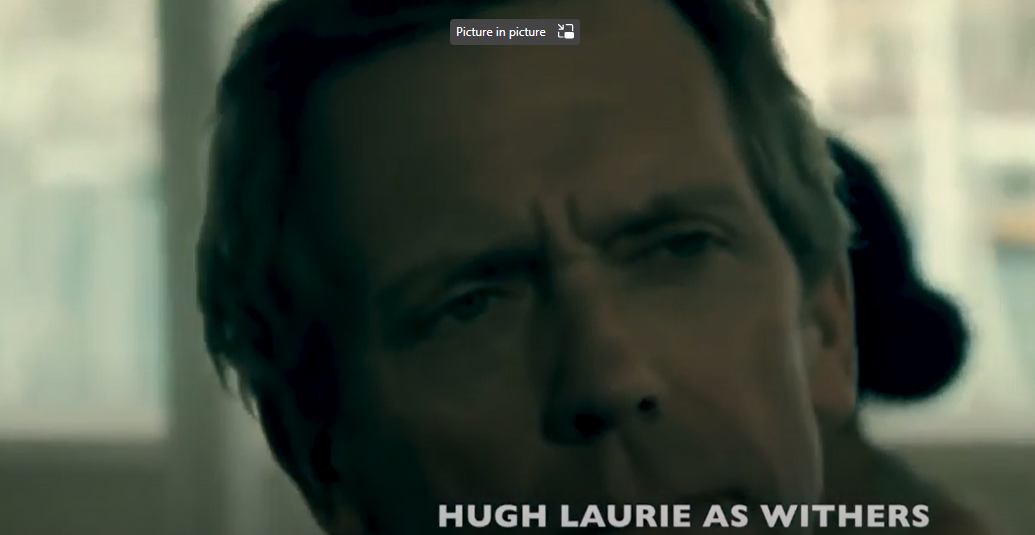
Once again, the pre-covid cast for the THS movie directed by Antione Fuqua included a promising actor, this time for the role of John Wither, that creepy embodiment of prevaricating obfuscation and manipulating control.

ELASTICITY

Overview Question

In Parts 1 and 2 of Chapter 5, Mark is drawn yet further into the manipulations of the lifeworld of Belbury. Deputy Director Wither continues to flatter Mark’s vanity while refusing to give him a clear job description or to make a solid job offer. Fairy Hardcastle warns Mark not to expect a clear job description from Wither; and then explains how, if only Mark will do as he is told, he can begin to rise as a kind of activist journalist swaying public opinion for the NICE. And then Mark learns that his position at Bracton College is in jeopardy because Lord Feverstone has informed them that Mark is joining the NICE. When confronted, Feverstone simply shrugs Mark off with a dismissive comment. All of these passages portray in some detail how the modern worldview operates at the level of personal and interpersonal relationships. And this leads to our Overview Question for the week:

How do the different actions of Wither, Fairy Hardcastle, and Lord Feverstone in relation to Mark’s own servile mentality illustrate the basic principles and practices of the modern worldview and lifeworld at Belbury?

For additional help in answering this question, remember the brief outline that I provided with the Chapter 3 Overview Question: Yoram Hazony’s analysis of the “practices” that characterize both the modern and the traditional worldviews. In particular, keep in mind how the modern worldview valorizes above all individual freedom and reason, and rejects the need for religious, moral, or even familial traditions of loyalty, honor, and acknowledged hierarchy to guide and shape the freedom or the reason of the individual.    

As artfully evoked in the expression of actor Ewan McGregor, Mark’s lack of a transcendent religious and moral point of reference, and his desire above all to be counted among the elite, leaves him imminently vulnerable to the manipulations of nearly everyone at Belbury.

DEEPER-DIVE QUESTIONS

1. In Part 3 of Chapter 5, Arthur and Camilla Denniston take Jane on a picnic, and treat her in a manner that is quite opposite of how Mark is treated at Belbury. They propose a specific role for Jane: namely, to consider her dreams as a special gift that can be of great help to the community at St. Anne’s. When Camilla begins to put pressure on Jane to decide right away, however, Arthur reminds her that the Director of their community would not want Jane to join them under that kind of pressure or coercion. In contrast to Mark’s interview, what interpersonal conditions are given priority in Jane’s interview, and how do these reflect the principles and practices of the traditional worldview? (see again Yoram Hazony)   

2. How do the conditions of the two interviews reflect the customs and values of the two groups of people and the two worldviews that inform Lewis’s story, the modern worldview and the traditional worldview? In particular, what role do the values related to the family and religion at St. Anne’s play, in contrast to the emphasis at Belbury on the individual and his or her “freedom.”

3. Where, in our current cultural and political turmoil in 2022, do you see signs of the kind of individualism, disunity, coercion, cancellation, and manipulation of power that characterize Mark’s job interview at Belbury? Where are there signs of the open discussion, debate, transparency, and the freedom to deliberate and practice informed consent that are given to Jane?

THAT HIDEOUS STRENGTH: Chapter 3

Ewan McGregor was well chosen, in my opinion, as Mark Studdock in the pre-covid 19 cast for the THS film directed by Antoine Fuqua. MacGregor would have helped us see, I can well imagine, how the manipulative and unaccountable atmosphere of alleged “equality” at Belbury was perfectly suited to exploit Mark’s obsequious desire to please those in power.

BELBURY AND ST. ANNE’S ON THE HILL

Overview Question

In this chapter we encounter the very different social and interpersonal dynamics that characterize Belbury and St. Anne’s on the Hill. What is most striking is how nearly opposite these two groups of people are in terms of how they treat Mark and Jane. Indeed, the contrast is so sharp that it begs for some kind of explanation. And this provides the focus for our overview question this week:       

Why do the people at Belbury (who hold the modern worldview, as we have seen) confound and manipulate Mark the way they do; while the people at St. Anne’s (who hold the traditional worldview) make every effort to behave with candor, transparency, and informed consent toward Jane? 


Rose Byrne, as Jane Studdock, has also been replaced in the post covid 19 cast for the new THS film. But these screen shots give us an opportunity to reflect on these characters, Mark and Jane, and how different they are from each other though both begin as holders of the modern worldview. And then how differently Jane is treated by Grace Ironwood and others at St. Anne’s in comparison to Mark’s entry into an arena where “every man for himself” is the unspoken rule.

Note well, I am asking you (with the overview question, above) to think about why each worldview–lifeworld seems to produce such starkly opposite results at the level of personal and interpersonal relationships. Of course, Lewis doesn’t do this analysis directly in the story itself; but his very consistent portrayal of both groups, which only gets sharper and clearer as the story proceeds, suggests a definite set of observations on his part. In order to clarify this contrast, let me recommend another interpretive tool that you may at your choosing find helpful: A brief sketch of Yoram Hazony’s analysis of worldview practices from Conservatism: A Rediscovery.

Hazony gives a remarkable history of what he calls the Anglo-American Conservative paradigm with its traditional worldview, on the one hand, and the Liberal Enlightenment paradigm with its modern worldview, on the other. Of particular interest in this regard are Hazony’s observations that the traditional worldview valorizes specific principles and practices such as loyalty, honor, family, hierarchy, religion, and empirical knowledge (based on evidence); while the modern Enlightenment worldview valorizes the opposite: freedom and independence of the individual, the alleged “self-evident” truths of reason and nature, and the rationalistic approach to knowledge (based on a priori first principles rather than evidence). As such, the modern individualistic worldview rejects the need for religious or moral traditions and practices to guide or inform its use of reason; while this is precisely what the traditional or conservative point of view calls for. Are there clues here about the two opposing “styles” of Lewis’s two groups?

I think Hazony’s observations are in close alignment in many ways with what Lewis is trying to show us in his fictional portrayals of the very different worlds of Belbury and St. Anne’s on the Hill.

The cover illustration of Scribner’s 2003 edition of THS portrays the landscape of the moon with its dark cold side (pointing toward earth where the marriages are “barren and cold”) and its bright living side (pointing toward the joys and creativity of deep heaven) as Ransom describes this to Merlin later in the story. Are there hints here of the two very opposite ways of living–specifically in this case related to marriage and sexuality–that are reflected at Belbury and at St. Anne’s on the Hill?


DEEPER-DIVE QUESTIONS

1. In Part 1 of Chapter 3, Mark has a long conversation with John Wither about the possibility of taking a new job with NICE. How would you describe the “style of communication” that Wither uses with Mark? What seems to be Wither’s purpose for using this style? How does this style tie in with what you already know about the larger social vision, lifeworld and worldview at Belbury?    

2. In Part 3 of Chapter 3, Jane tells Miss Ironwood about the strange dreams that she has been having. How would you describe Miss Ironwood’s style of communication with Jane? How does Miss Ironwood’s style and manner differ from that of Wither? What does Miss Ironwood’s different communication style suggest about the different values of the worldview embraced at St. Anne’s?

3. In Parts 2 and 4 of Chapter 3, we are introduced more fully to Professor Hingest (chemist at Bracton) and Fairy Hardcastle, head of the NICE institutional police. We learn that Hingest and the NICE hold nearly opposite views of what science is really all about. Why do the NICE regard Hingest as “the wrong sort of scientist” while he regards their work, including Mark’s sociology, as not really science at all? How are the two worldviews reflected in these different approaches to “science,” and how are the differences also reflected in the politicization of science in America today?

4. In Parts 3 and 5 of Chapter 3, Jane struggles through her interview with Miss Ironwood. Everything that happens–Jane’s wandering thoughts about Camilla’s beauty, her premonition of a passage on sex and sexual attraction in a book she picks up while waiting to see the Director, and Miss Ironwood’s unwelcome advice about her dreams—seems to go against how Jane wants to see herself. What pattern, if any, can you detect in what Jane wants for her own self-image, and what keeps happening to her to interfere with this?

THAT HIDEOUS STRENGTH: Chapter 2

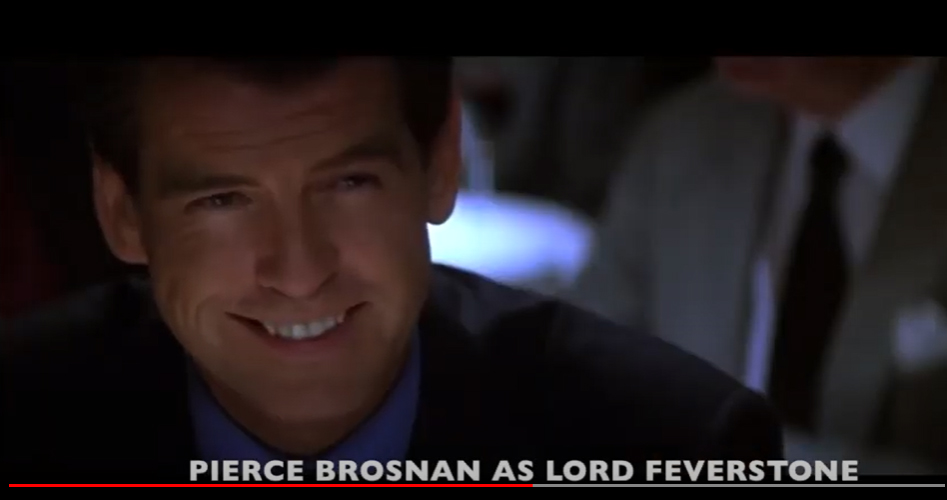
Screen shot of Pierce Brosnan as Lord Feverstone in the 2019 pre-covid cast for what was then planned as a new THS movie directed by Antoine Fuqua. In my view, Brosnan would have made a convincing, cold-blooded Lord Feverstone.1

DINNER WITH THE SUB-WARDEN

Overview Question

Having accepted Sub-Warden Curry’s invitation to dinner after the all-day faculty meeting (where Bragdon Wood was sold!) and hoping to strengthen his position in the “progressive element” at the college, Mark attends the gathering in Curry’s rooms with several elite college faculty and sponsors including Rev. Busby the bursar, Curry himself, and Lord Feverstone, the latter an important political figure with connections in London.2   

As the evening progresses, it becomes clear that these men do not really know each other in a personal way, nor are they loyal to each other. Both Busby (as a representative of the college) and then Feverstone (as a representative of the NICE) expound their views on “man, nature, science, and society,” and then speak at length about how the elite leaders of the NICE will take over all of the major institutions of society. All of this echoes what we saw in the introduction (8/3/22) concerning the modern worldview with its administrative state and its neo-Marxist “long march through the institutions.” Meanwhile, Mark is watching every move to see where his best opportunity will arise to join the “inner ring,” if he can only figure out where the real “ring” is.    

Question: As you read the speeches of Busby and Feverstone in Part 1, what specific cultural institutions do they name or allude to as they spin out their visions for the influence of the NICE in the college and in the wider world? How are these same institutions at play today in the culture wars of America?

Cover for the 1965 Simon & Schuster edition of THS illustrating the different levels of local, global, and spiritual forces at work in the story.3

DEEPER-DIVE QUESTIONS

1. At the faculty dinner, after Curry and Busby have left, Feverstone belittles them and declares them to be mere pawns in the grander scheme of the NICE, which is global in scope, not just local or academic. What parallels for this two-tiered struggle for power between the local (regional or national) focus, on one hand, and the global (or interplanetary!) focus, on the other, can you discern in the geo-politics of the world today? And why is it important (for us as for Lewis) to mark these levels?

2. Still in Part 1, Mark becomes flushed with excitement as Feverstone verbally runs down the college men and goes on to paint a picture of the administrative state in which “some men have got to take charge of the rest.” What does this scene tell us about the pattern of loyalty and honor that one may expect (not only between Mark and Feverstone) but also in an administrative state that is based strictly on natural reason and individual freedom, as opposed to the values of religion, family, congregation and community that guide the traditional lifeworld?

3. In Part 2, after lunch with the Dimbles, Jane hoped her anxieties about her dream would go away. But they didn’t. So, when Mark comes home from his dinner, he finds her in an unusually vulnerable mood. But then in Part 3, the next morning, Jane is angry and defensive about having let herself get upset in the first place. What do these layered reactions say about Jane’s struggle with her own personal formation? Are there hints about her own nature that she has a hard time accepting given her preferred self-image?

4. In the final Part of chapter 2, Jane and Mark are moving in opposite directions, one by fast sports car to Belbury, the other by slow train to St. Anne’s. How do the details of Lewis’s descriptions reveal not only the two very different geographic destinations, but also the two opposing worldviews (modern and traditional) that are, so to speak, hidden in the landscape?

A train trailing smoke through the English countryside may help to remind us of the kinds of beautiful, agrarian places Jane would have seen on the way from Edgestow to St. Anne’s on the Hill. Photo from stock images online at Flickr and Pinterest.

_________________________________________________________________

  1. A new cast has recently been announced for this movie version of THS which will, at the time of this writing, feature Hugh Grant as Feverstone. Other new cast members include: Daniel Day-Lewis as Ransom, Emily Blunt as Jane Studdock, Emma Thompson as Grace Ironwood, and Jeremy Irons as Frost, plus a host of other great picks. Should be a worthy effort if our government, in contrast to Feverstone’s vision for 1940s England, can wean itself from further lockdown and emergency powers.
  2. Lord Feverstone is also the Richard Devine of Out of the Silent Planet, the first volume of the space trilogy. Devine/Feverstone is an old classmate and enemy of Dr. Ransom, the Director at St. Anne’s. In the first book, Devine and his partner Edward Weston kidnap Ransom and try to use him to gain control of the creatures on the planet of Malacandra (Mars). But Ransom fights back and makes some surprising discoveries about interplanetary spiritual powers. The portrayal of good and evil in the first two books will add much to the understanding of these themes in THS; but as Lewis himself says in his Preface, though the stories form a sequence, each “can be read on its own.”
  3. The illustration for this 1965 Simon & Schuster cover with its picture of a) the college, b) the chess game pieces, c) an interplanetary map, and d) a symbol of mysterious power floating overall, suggests the various “levels” of interest and engagement for the different kinds of actors who support the NICE (in keeping with Lord Feverstone’s own description in Chapter 2). At one level, there are those, like the college faculty, who support the NICE simply because it promises to increase their salary. And then there are those somewhat higher up, like the administration of the college or Mark himself, who see an opportunity to rise within the frame of regional politics. And then, yet higher (or spiritually lower as the case may be), there are those like Lord Feverstone and the leaders at Belbury who represent forces that want to use the NICE to dominate and control the whole world or even the universe. One reason it is important to mark these levels is that, as in Dante’s Inferno, they reveal different motivations and degrees of evil that betray people at each level. This is also relevant as we try to take stock of the spiritual forces at work in the geo-politics of our own time. Some people at the lower levels of involvement are what the Marxists have called “useful idiots,” for they do the regime’s dirty work and are later dispensed with. One such group was the Red Guard in Mao’s China who were banished to the wilderness after helping to oppress the general population into subservience. Lewis was clearly aware of these different levels in the culture war of his time. And he explores this issue in greater detail as the story proceeds.

THAT HIDEOUS STRENGTH: Chapter 1

Illustration by J. P. Cokes

Illustration by J. P. Cokes.

SALE OF COLLEGE PROPERTY

Overview Question

Mark and Jane Studdock are in many ways a typical young modern couple: college educated, with professional aspirations. One might look at them, whether as characters in Lewis’s 1940s story or as people we meet on the street today and conclude that they have everything going for them. What more could they ask? Given this, who would think that Jane’s feminism, or Mark’s professional ambition, could lead either of them into any serious trouble? And yet, spoiler alert, that is what happens.

Likewise, who would think that the long description of Bragdon Wood and Merlin’s Well in Chapter 1, or the account of the Wood’s devaluation by Mark and the “progressive” element at the college, could have any special import for our story as a whole? But what if the Wood represents that whole sense of sacramental and mediated life in creation which we find both in the Bible and in the Middle Ages—including the importance of obedience to God, submission in marriage, humility toward creation, and the disciplined practice of the virtues and affections of the Christian community? For that is what the Wood does symbolize already at this early stage in the story.

Question: What conflicts can you see brewing between the worldview/lifeworld of Jane and Mark, as well as the “progressive” element at Bracton College, on the one hand, and the values and traditions represented by the history of Bragdon Wood, on the other?

DEEPER-DIVE QUESTIONS

  1. From the beginning of the story, how does Jane view marriage and family life? How does she see these traditions fitting into her larger plan for her own life?
  2. What seems to be Mark’s strongest motivation in life? How does this affect his relationships with other faculty at Bracton? With Jane? (For a major clue into Mark, if you are able, look up Lewis’s short essay “The Inner Ring” in The Weight of Glory.)
  3. Given what you already know about Jane, why do you think she becomes so troubled by: a.) her dream, and b.) Mrs. Dimble’s womanly attentions? Do these somehow interfere with or “trigger” her desired self-image and life-world?
  4. What impressions of Arthur and Merlin do you get from Dr. Dimble’s descriptions, and how is this reinforced by the narrator’s sketch of Bragdon Wood and Merlin’s well?
  5. What signs of the opposition between the modern and the traditional worldviews can you identify in the story so far?

________________________________________________________________________

The illustration (above) of Bragdon Wood and Merlin’s well, with the college and Merlin’s visage rising on the horizon, was the cover for the 1983 Pan Books edition of THS.

THAT HIDEOUS STRENGTH: STUDY GUIDE 2022

THS cover

That Hideous Strength (THS) by C.S. Lewis (1945), is an amazing and multilayered story about spiritual and cultural warfare in the modern world.1 Set in the fictional college town of Edgestow in mid-twentieth-century England, the story portrays events that presage the troubles and traumas of American society today. Anyone reading the story in the United States today will surely discover many alarming and revealing parallels. This should not surprise us, however, for the forces that are at war in America today have their roots in movements that have been trying to reshape both England and America since at least the early twentieth century.2 Lewis was aware of these forces.

The “Big Picture.”

In his preface to THS, Lewis says that his book is a “fairy-tale” with a “serious point,” a point that he has tried to make elsewhere in The Abolition of Man (TAM). In TAM, Lewis also describes a cultural war: a war between the modern post-enlightenment worldview (or life-world), with its exaltation of so-called “objective” or “scientific” knowledge, and the traditional worldview (or life-world) that reaches back through the Middle Ages to the Bible, with its emphasis on spiritual values and virtues that shape every part of human life in obedience to God.3 According to Lewis, the shift toward the modern life-world, especially in the institutions of modern British education, has resulted in “men without chests,” that is, people without training in the kinds of virtues and values that build strong families, congregations, communities, nations, and a healthy interaction with nature. These are, indeed, the themes of THS as well, though in THS they appear in a fictional story of dramatic detail with an unfolding narrative of personal struggle.

Thus, the conflict between the modern worldview and that of the biblical tradition through the Middle Ages is the “big picture” within which the story of THS is set. In a way, it is a story about the conflict between two big pictures, two life-worlds.

Major Corporate Characters of THS: The NICE at Belbury and St. Anne’s on the Hill

There are two primary institutional “characters” in THS, and each represents one of the life-worlds in question. At Belbury, we find the organization known as the N.I.C.E. (the National Institute for Co-ordinated Experiments). This group promotes the modern worldview, where all moral and religious values are considered subjective and relative, and where the primary goal is to create an administrative state, led by scientific elites who will manage and control the lives, the work, the futures, and even the sexuality of the common people. Sound familiar?

In this way, the NICE embrace, in a fairly straightforward manner, the modern post-enlightenment worldview. It is a world in which “nature” includes everything in the universe in a vast cause-and-effect system; and man is free to experiment on nature guided only by his own reason. As such, the NICE are also in league with what is called in THS the “progressive” element at the local Bracton College where, once again, the goal is to move the college away from its older scholars who represent the traditions of classical learning (Prof. Jewell) and even away from basic, “hard,” laboratory science (Prof. Hingest).

On the other side of this spiritual and cultural battle, we have the group that lives together at St. Anne’s on the Hill. This group, which is really more of a community—with marriages and families, gardens and animals—is led by Dr. Ransom, who is also variously called the “Director” and the “Pendragon” (the latter is a link to the medieval Arthurian legend).4 The plot thickens at this point, note well, for where the NICE are in league with the progressive element at Bracton, the community at St. Anne’s is in communication through Ransom with a group of “angelic” beings known as the Eldil. These angelic messengers, or Eldils, are guiding the people at St. Anne’s in their efforts to defeat the demoralizing influence of the NICE and to restore what is truly good, natural, and normal to the people of England.5

In this way, the life-world at St. Anne’s is open to many things that are simply unthinkable at Belbury. For at St. Anne’s, nature is not a vast cause-effect machine, ruled only by human reason. Rather, it is a living organon in which the power of God and of other spiritual forces are at work. Within this world, moreover, and shaped as it is in Lewis’s story by the medieval tradition, human beings are guided above all by their obedience to God and their submission to the living order of creation itself which God sustains. Their practices of marriage, prayer, and care for creation, for example, are inherent in how they view and value the world.

Major Individual Characters: Jane and Mark Studdock, and Merlin 

Among all of the characters in THS, both at Belbury and at St. Anne’s—all of whom carry in some way the weight of their group and its life-world—there are three characters whose roles deserve special attention now. The first two are married to each other, Mark and Jane Studdock. They are a young professional couple. She is a feminist who wants an academic career rather than a family. He is an ambitious young professor who wants, above all, to climb the ladder of success. One might look at them in the story or in a real-life situation and say, “My, what a fine young couple.” But Mark’s and Jane’s marriage is in trouble. She wonders if she has made a mistake. They do not share deeply with each other about anything.

As the story progresses, furthermore, Mark and Jane move in opposite directions; one toward Belbury, and the other toward St. Anne’s. But in neither case are their movements streamlined or seamless. Both wrestle a lot with how to understand themselves, and with how to understand what is happening to them in these very different settings. Indeed, with Mark and Jane, we are given a personal life, two lives in a personal relationship with each other, as the canvas upon which to discover what is really at stake in the life-worlds and the worldviews that they (and we) embrace.  

And then there is Merlin. Part of the medieval worldview that Lewis loved was the Arthurian legend. In THS, in this regard, both Dr. Dimble and Dr. Ransom are character types of Lewis himself. Both are Arthurian scholars, and both are aware that the NICE are trying to unearth the legendary grave of Merlin at Bragdon Wood. As a result, Dimble and Ransom are concerned about what this blending of modern atheistic science with ancient “magic” may portend for the spiritual battle ahead. In the end, Merlin—back from the dead after 1,500 years—plays a critical role in the defeat of the dark powers at Belbury. But he also presents one of the greatest challenges for us in trying to figure out how the fictional battle of THS may also apply to our own situation in America today.

Some Contemporary Concepts to Keep in Mind

As we work through the story, reading about both the individual characters and the corporate ones, each of us will, I believe, notice parallels, analogies, and echoes between what is going on in the story and what seems to be going on in America today. I want to encourage you to take note of these parallels and, indeed, some of my questions will ask you to name and list the parallels that you discover. In addition, I want to offer three major conceptual tools that I believe will help you to interpret what these parallels signify, both in our time and at the time of Lewis’s story. Keeping these in mind as you read may help you to make sense of the sometimes-chaotic strands of Lewis’s story, a kind of chaos that I believe we also encounter as we try to understand the strange and nonsensical things that are taking place today.  

  1. The Four Stages of Cultural Revolution – As described by former KGB agent Yuri Bezmenov in the 1970s, these are the stages by which Russian agents worked to infiltrate and undermine America and other western societies. 1. Demoralization – using pornography and other methods through media, entertainment, education, etc., to break down the moral courage of the people.  2. Destabilization – By undermining police, courts, borders, etc., to overwhelm public safety and further demoralize the people. 3. Crisis – Build 1 and 2 to the point of a crisis where people resort to rioting or to civil war. 4. New Normal – Declare emergency powers and install the administrative state as a solution for all of the problems which the revolutionary forces have themselves caused.6
  2. The Long March through the Institutions – This is a central concept of cultural Marxism, (see endnote 2). It concerns the strategy of neo-Marxists in America and in other Western societies to overcome the resistance of successful middle-class cultures to the Marxist rhetoric of revolution. Middle-class people tend to be somewhat satisfied with their lives and tolerant of income differences with others. Cultural Marxists therefore target all of the institutions of middle-class society—church, family, public education, media, the press, entertainment, business, academia, science, law, etc.—in order to create the problems and crises that lead to the imposition of emergency powers and the administrative state.  
  3. Mass Formation – This is an academic concept that has been used for many years to try to understand the mass psychology that appears to be at work in societies like Bolshevik Russia, Nazi Germany, and Mao’s China, where thousands of ordinary citizens either turned a blind eye to the suffering of their fellow citizens or, in some cases, joined the forces that shamed and tortured them. The process is based on fear and the desire to survive or escape the threat of suffering. Under these conditions, “normal” people may become callous to the suffering of others. They “go along to get along.” But the result is a complete collapse of genuine religious and moral civilization.7

A Coherent Picture?

Using these conceptual tools, and others that come in along the way, I believe our reading of That Hideous Strength will provide numerous insights into the troubles—cultural, political, and spiritual—that we are facing in America today. And, since the conclusion of Lewis’s story involves a time of reflection by the people of St. Anne’s on what has happened and what may be expected to happen in their future, the story also gives us an opportunity to consider what kind of strategy and what view of our future we should take if we are to embrace the traditional worldview, at least as C. S. Lewis understood it. My hope is that our reading of THS will enable us to make a more informed response to these kinds of issues for the sake of our own time, for the sake of our own country, for the sake of our own “great heartedness.”

__________________________________________________________

1. That Hideous Strength (1945) is the third volume in Lewis’s famous space trilogy. The first two volumes are Out of the Silent Planet (1938) and Perelandra (1944). All three are connected by their main character, Dr. Elwin Ransom, Cambridge philologist and space traveler. But each can be read separately as a story in itself.

2. I am thinking of the movement known as “cultural Marxism” or “Neo-Marxism” which began in Europe in the 1920s when Antonio Gramsci and the early members of the Frankfurt School of Critical Theory in Germany launched their plan to revitalize the forces of Russian Marxism in America and in Europe by engaging in what they called “the long march through the institutions.” This involved infiltrating and undermining the traditional institutions of Western culture—such as the church, the family, education, the media, entertainment, the courts and police, etc.—in order to create an administrative state by which to manage and control society. See, for example, Roger Kimball, The Long March: How the Cultural Revolution of the 1960s Changed America.

3. As this paragraph already suggests, and as the story of THS shows, a worldview is more than simply a set of beliefs, ideas, or first principles. It is also a way of life that people live out in various ways because they look at the world the way they do. For example, we only pray in a world where we believe God listens. For this reason, I will also use the term “life-world” interchangeably with “worldview” to indicate the kind of consequential process that I believe Lewis himself has in mind. 

4. In the Arthurian legendarium, King Arthur’s father was Uther Pendragon, and “Pendragon” became one of the names for the line of kings that later descended from Arthur himself. Thus, Ransom is identified as one of these descendants.  

5. The traditional worldview, as I am using this term, includes both the biblical worldview and that of the Middle Ages as both of these influence Lewis’s story. His portrayal in THS of the angelic eldil, in relation to the planets, for example, is borrowed from the medieval tradition. In this regard, Lewis brings into his story not only the biblical references to angels, powers, and principalities, and the like (Col. 1:16; Eph. 6:12); he also articulates this in terms of the medieval analysis of the major virtues (angels) and vices (fallen angels) that were metaphorically associated with the planets. Thus, the power of love, Venus, can become the fallen power of unbridled passion. And the power of courage, Mars, can become the fallen power of coercion, the bully. Or, yet again, the power of language and intelligence, Mercury, when it is warped by fallen power becomes the confusion of Babble. Lewis gives an extended description of the medieval worldview in his book, The Discarded Image.

6. You can still find videos online of Yuri Bezmenov giving lectures to Canadian and American audiences on these topics. He often remarks how easy it was to influence the American public by these methods.  

7. See Matthias Desmet, The Psychology of Totalitarianism. According to Desmet, in a totalitarian society, three groups emerge: 1. Those who support the totalitarian power, usually a minority. 2. Those who resist it. Also, a minority. And 3. Those in the middle who swing toward whichever side seems to offer safety and security, usually a majority. Against this backdrop, one can see why the great freedom fighters of history, like Alexander Solzhenitsyn, speak of the importance of faith in God in order to follow conscience and “live not by lies.” Desmet himself appears to hope for a resolution based on human reason alone (the modern worldview). So, though his analysis of the problem is helpful as far as it goes, he doesn’t seem to understand the spiritual depths of the problem of evil or its resolution in obedience to God’s guidance and power as portrayed in THS.   

Ordinary Time and the Echo of the Far Country [1]


Canyon, Watercolor, copyright 2007 by Craig Gallaway

According to the Apostle Paul, Jesus our King (the “Messiah” of Israel) has risen from the dead and is, even now, praying for us as we walk in his Spirit on the road of new creation (Romans 8:34). And as he prays, again according to Paul, he is also working through his Spirit to extend his reign over every enemy that opposes the godly order of creation, including the final enemy, death (1 Corinthians 15:25-26). His goal in all of this is to restore the order of Creation throughout the world, corrupted and misshapen as it is since the fall of Adam (Romans 1:18-32), and in particular to restore the order of our Maker’s own creative, strong, and loving image in us human beings (Romans 8:18-29). This is all in fulfillment of the Creator’s promise to Abraham, described in the book of Genesis, that Abraham’s descendent (his seed) would be the means by which the Maker would restore the fallen world (Genesis 12:1-3). According to Paul again, this promise to Abraham, and this restoration of the fallen world, is what King Jesus came into the world to accomplish through his victory over sin, death, and the fallen powers in his cross, his resurrection, and the sending of his Spirit (Romans 4:13-5:21; 8:1-17). That is, in his own body—his faithful life and death, and then through his victorious resurrection and the sending of His Spirit—he is even now at work in those who put their lives into his hands by faith. He is transforming and restoring us and the whole created order with us (Romans 5:12-21; 6:6-14; 12:1-2; 1 Corinthians 15:20-22).

This story of Jesus’s victory over sin and death and his reign as the risen Lord through his Spirit is, Deb and I believe, what Paul means by the word “gospel” as in Romans 1:16. If we want to know what Easter is really about, what Christmas is about, and what God’s purpose for the world is all about, this is the story. There are, of course, various opinions and theories[2] in the history of Christian thought which attempt to interpret some part or facet of these bedrock Scriptural events; but the good news embodied in the events themselves is the main path of Scripture. Jesus was faithfully obedient even unto death on the cross (Philippians 2:6-8). He died to sin once and only once, so death no longer has any authority over him (Romans 6:10-11). Therefore, God has raised him from the dead and made him Lord and King over all (Philippians 2:9-11). So now, by his Spirit, he is guiding, strengthening, and leading us toward the great day of our own resurrection, judgement, and the new heaven and earth, of which we now have the first fruits (Romans 8:18-39). With this scriptural account of Jesus’s victory over sin, death, and the devil in his own body, and his continuing work as our risen Lord by the presence and power of his Spirit to restore the fallen world, we find ourselves, if we put our faith in him, on the main path of Scripture moving toward the fulfillment of the promise of new creation (Romans 8:18-39).[3]

With this journey of faith in Christ on the road of new creation in mind, and mindful also of the suffering and spiritual warfare of the current time in our culture, Deb and I offer the attached song as a kind of theme “music for the road,” expressing at least part of the emotional range of the daily path and battle as we know it. The title of the tune is “Craigieburn” which ties Craig’s own name to its Scottish origins, and means “rocky stream.”[4] We hear this music as an “echo from the far country,” a kind of longing for and foretaste of the beauties of the world fully restored. And yet it also has something in it of the groaning that Paul acknowledges for those who are on this new creation path with our Lord (Romans 8:18-26). And isn’t this why the Apostle exhorted the believers at Philippi to put their minds on certain kinds of things: “Whatsoever things are true, noble, just, pure, beautiful, admirable, virtuous, and worthy of praise, think on these things” (Philippians 4:8-9). We are called to be cheerful in a still fallen, dangerous, and disordered world. Jesus also spoke of this when he encouraged his first disciples, “In this world you will have much suffering, but be of good cheer, for I have overcome the world” (John 16:33). And, for a more recent witness, we can recall C. S. Lewis’s thoughts about the Christian doctrine of suffering and how our Lord encourages us to live a life of cheerful insecurity:

The Christian doctrine of suffering explains, I believe, a very curious fact about the world we live in. The settled happiness and security which we all desire, God withholds from us by the very nature of the world: but joy, pleasure, and merriment He has scattered broadcast. We are never safe, but we have plenty of fun, and some ecstasy. It is not hard to see why. The security we crave would teach us to rest our hearts in this [present] world and oppose an obstacle to our return to God: a few moments of happy love, a landscape, a symphony, a merry meeting with our friends, a bathe [swim] or a football match, have no such tendency. Our Father refreshes us on our journey with some very pleasant inns, but will not encourage us to mistake them for home.[5]  

Craigieburn Wood, arranged by William Coulter, played by Craig and Deborah Gallaway

And so, Deb and I offer this music as an inn along the way, echoing with strains of the good, the true, and the beautiful from the far country of the restored and reordered world. And as we continue on our journey, we are convinced—despite all of the troubles that we are surely facing—that nothing can separate us from the promise of this homecoming. The Lord is risen. He is risen indeed.

_____________________________________________________________

[1] “Ordinary Time” refers to those stretches in the calendar of the Christian year when the great festivals of Advent-Christmas and Lent-Easter are not in action; when the days and weeks are simply numbered with the numbering system known as the “ordinals,” such as the first Sunday in Pentecost, or the second Sunday in Kingdomtide. Thus, the word ordinary doesn’t really imply that nothing special or “extraordinary” ever happens during these periods; yet it does, in a different sense, remind us that there are times in our daily Christian lives when we have simply to practice with patience the regular disciplines of our faith. And one of those disciplines is surely to remember well the basic story of the gospel and the Scripture which brings order to all of our lives.    

[2] For example, the various “theories of atonement” such as the moral influence theory, the penalty substitution theory, and so forth; but none of these hold together the full range and depth of our Lord’s new creation purpose which animates and integrates the narrative of Paul’s faith and world view.    

[3] For additional help in tracking this Scriptural story of salvation, see for example: Athanasius, On the Incarnation; John Wesley, “The Scripture Way of Salvation;” Craig Gallaway, The Presence of Christ with the Worshipping Community; and N. T. Wright, How God Became King.

[4] We first heard this lovely melody and the basic arrangement that we are using, on a CD by the guitarist William Coulter titled “The Crooked Road.” The title of the original tune is “Craigieburn Wood,” which comes from a poem by Robert Burns (1759-1796). The compound word “Craigieburn” in the Scottish dialect refers to a rocky or stony stream (a “craggy burn”). The connection with Craig’s own name has given him a chance to reflect on the parallels between his journey, with its many ups and downs and twists and turns, and that of the Apostle Peter (Petros, “rock”) as well as the description of our shared and sometimes-rocky Christian journey to new creation given in Romans 8. All of these journeys evoke the attitude of patient faith and hope that is the way of new creation, of life in the Spirit, as we journey toward the great day of fulfillment and banqueting, when “the knowledge of the glory of the Lord shall cover the earth as the waters cover the sea” (Isaiah 11:9; Habakkuk 2:14; Revelation 21:1-4).

[5] C. S. Lewis, The Problem of Pain (Macmillan, 1966) p. 115.  

The Politics of Jesus: First Born of the New Creation

Hello Sparrow, pen and ink drawing, copyright 1973 by Craig Gallaway. The presence of a bird sitting and singing peacefully just beyond the bathroom screen once put me in mind of the biblical promise of new creation, when “the lion shall lie down with the lamb and a little child shall lead them” (Isaiah 11:6).

When Jesus rose from the dead on the first Easter morning, he became what Paul would later call him, the “Firstborn from the realms of the dead” (Colossians 1:18). Thus, Jesus was for Paul the beginning, the source, and the pattern for the restoration of the whole world, human beings included, according to the Creator’s original and ultimate intention for creation. This vision of creation restored is at the very heart of Paul’s theology as shown throughout his letters, and especially in several climactic passages such as Romans 8:18-39 and 1 Corinthians 15:20-28. It is echoed as well in the final visions of John’s Revelation, (chapters 21-22).

The big picture, according to Paul, is that something has happened in the death and resurrection of Jesus that comprises a complete reset for fallen human beings in our role as stewards and keepers of God’s good creation. Moreover, the restoration is ongoing for those who live in Jesus’s Spirit, and it will not be complete until the Day of the Lord when all things are finally and fully restored (1 Corinthians 15:20-28). So, right now, “the whole creation waits in eager expectation for the sons and daughters of God to be revealed,” and to take back up the role that we lost under idolatry and sin (Romans 1:14-32; and 8:19-21).

What is more, this restoration of creation that has begun first in Jesus himself—his faithful life, his death, and his resurrection—is now going forward among those who put their faith in Him and are, thereby, led, guided, corrected, strengthened, and restored by his Spirit in the pattern of his life, death, and resurrection. But what does this pattern look like in terms of public life and behavior? Can we really speak of something like the “politics of Jesus,” the “politics of the new creation?”

I believe we can. But if we want to be true to Paul, perhaps we should begin with an important distinction between things that are essential to this political vision of new creation in Christ, and things that are not essential. Other terms for the non-essential side of this contrast include: things indifferent, and the Greek term, adiaphora. Paul uses the latter term in Romans 14:1, where he begins a longer discussion about disputable “cultural” matters such as what one should eat or drink, or which special religious rules and holidays one should observe. His primary point is to steer the Christians at Rome away from the temptation to make a federal case out of every type of issue. Not all issues are absolute. And when we are dealing with non-absolutes, Paul says, we should practice charity; that is, we should be willing to let go of our own preferences in order to support, protect, or appreciate the consciences or sensibilities of others (Romans 14:1-6).  

John Wesley, in the eighteenth century, summed up Paul’s concern in terms of a threefold principle:

“In essentials unity. In nonessentials, liberty. In all things, charity.”

A simple ecclesial example of what it means to defer to others regarding something non-essential is C.S. Lewis’s memory of the value to his soul of joining in the hymn singing of his little Anglican congregation at Oxford, even though his own more highbrow tastes were sometimes offended in the process. This may sound petty until it is one’s own musical tastes that have to be set aside. Another example might be the decision to forego a “harmless” glass of wine if one’s alcoholic friend could be tempted as a result to “fall off the wagon.” There are many such examples, where the Lord’s Spirit of love could lead us to give up our own “rights” or preferences in order to help, appreciate, or take care of others. Indeed, it is not hard to imagine situations in our schools and communities where the political decisions we face offer no single best solution for all parties, but only trade-offs between different agendas and priorities. In such situations, it is important that we remain open, flexible, and neighborly toward different opinions and possibilities.   

At the same time, the principle of adiaphora does not mean that all of our behaviors and decisions are indifferent, or disputable. This is certainly true for Jesus’s followers. It is also true for other groups who self-define their priorities in the culture wars of our time, such as Antifa and Black Lives Matter, though their list of “essentials” is in many cases diametrically opposed to the politics of Jesus.

It should be noted right away that Paul keeps his list of essentials relatively short. He is interested in life in the Spirit of Christ, not in creating a continuously expanding list of rules for behavior. Nevertheless, Paul does not fail to identify areas where Jesus’ followers are called to a specific way of life in his Spirit that is absolutely non-negotiable. We will look here at three of these: 1.) Unity in Christ which moves beyond all ethnic identity groups or divisions, 2.) Holiness in personal life that focuses especially on marriage and sexual self-control and rejects the pan-sexual self-invention of pagan or neo-pagan culture, and 3.) The servant goal of work in Christ that springs from the motive of service rather than status or entitlement. These three essentials in the politics of Jesus, moreover, clearly address several contested issues of racism, justice, and economics which preoccupy our current political debate. Let us look briefly at each in turn.   

Unity in Christ beyond Ethnic Divisiveness:  In his letters to various churches (Galatians, Corinthians, Romans) Paul often addresses claims of favoritism, superiority, or abuse between different ethnic groups. The primary tension he faced arose between those of his own Jewish background who believed that their identity as God’s people conferred a special status, superior to all of the other ethnic groups of the ancient world—Gentiles, barbarians, Scythians, Greeks, Romans, etc. Though he had himself once been a zealous Jewish Pharisee (Saul of Tarsus), who sought above all to priviledge his own people, and probably hoped at one time to see them freed from Roman domination through violent revolution, Paul the Christian had come to see, after his encounter with the risen Jesus, that, as he put it in Galatians 3:28, “In Christ there is neither Jew nor Greek; neither slave nor free, neither male nor female; for you are all one in King Jesus.”

For Paul, this unity of all ethnic groups in Christ was an essential. One could not compromise this unity and remain a member in good standing of Christ’s people, the church. When Jews came from Jerusalem to insist that the Galatian Gentile Christians must be circumcised according to strict Pharisaic custom, Paul insisted that to submit to this demand would make the death and resurrection of Jesus of no value (Galatians 2:21). Indeed, what Jesus accomplished in his death and resurrection was to fulfill the ancient promise to Abraham that God would bless all nations (ethne) through Abraham’s seed. He would bless, that is, not just the Jews but the whole world. And Jesus was the fulfillment of this promise. For he was the “seed” of Abraham, along with the people of every ethnic background who put their trust in Him (Galatians 3:16, 29).

We see a very similar set of ethnic tensions playing out in the culture wars of our own time. On one side, we find groups like Black Lives Matter insisting that since whites have been priviledged in the past, African Americans must be priviledged now. In other words, one of Black Lives Matter’s essential principles is the notion that blacks and whites must be kept in adversarial conflict in order to achieve the BLM conception of justice. On the other side, we find a large and growing group of leading black Christians and public intellectuals who argue that the Black Lives Matter strategy is a sad diversion from the real problems that trouble the black community and other struggling groups. Leaders such as Robert Woodson, Shelby Steele, Glen Loury, Carol Swain, and others, take a more Pauline and Christ-centered approach to this debate and argue that what is needed in the black community is a recovery of individual self-discipline and responsibility grounded in the renewal of the black family, educational choice, leadership training, and in the community of faith. This kind of renewal, furthermore, according to Shelby Steele, will focus on the individual as an American citizen, not as a black, or brown, or white person who belongs to a separate identity group. The contrast could not be clearer. (See Shelby Steele, Race in America, Virtual Policy Briefing, the Hoover Institute.) 

Here, then, are two pictures in high contrast to each other of our political and racial future as a country. One is a picture of the unity of all ethnic groups as citizens of one country, working together with common tools for common goals. This is a picture that is commensurate with the politics of Jesus and the new creation. The other is a picture that promotes and prolongs ancient divisions between ethnic groups, pitting identity groups against each other as a strategy for correcting the past. Such demands for diversity have a long history already of producing division rather than unity. This vision is not consistent with the politics of Jesus. A similar set of contrasts emerges when we look at matters of marriage, sexual ethics, and the role of the family in relation to recent political debates.

Holiness in Marriage beyond Pan-sexual Self-invention: As mentioned before, Paul did not make a long casuistic list of behavioral practices that are essential for the political life of Jesus’ followers in the new creation. But holiness in sexual practice and marriage is one of the essentials about which he was very clear. He writes again and again in his letters of the necessity of turning from the old fallen pattern of sexual license, self-indulgence, and promiscuity in the surrounding pagan culture (1 Corinthians 6:9-11; Ephesians 5:1-10) and of channeling the God-given desire for sexual union into the central Christian praxis of marriage (Ephesians 5:21-33). Indeed, when this praxis is idly ignored at Corinth, he insists that the community there must discipline a wayward brother in no uncertain terms if they are to maintain their identity as a community in Christ (1 Corinthians 5:1-5). Furthermore, as his extended discussion in Ephesians 5 and 6 suggests, Paul’s long-range concern is not just about sex per se. It is about the fully human and healthy formation in Christ of husbands and wives along with their children and other members of the household. And all of this relates, finally, to the restoration of the Creator’s original intention for human beings (Genesis 1:28; 2:24; Ephesians 5:31). To be “in Christ,” the first born from the dead, and to celebrate life and faith in Christian marriage (whether one is married or not), is to be on the way to the new creation.  

Someone might think that marriage and sexual ethics are a rather tangential topic if our focus is on solutions for political, economic, and racial issues. It is remarkable, however, that some of the primary voices in the current debate take positions precisely on this topic. In the Black Lives Matter mission statement, for example, there is a clear rejection of the biblical essential for holiness in marriage and sexuality as an obstacle to the kind of social changes that BLM seeks. According to the statement, BLM seeks to disrupt what they call (oddly, given its sources in the Middle-East) the “Western-prescribed nuclear family structure . . . by supporting each other as extended families and ‘villages’ that collectively care for one another, especially our children . . ..” Also, the statement goes on to affirm “the intention of freeing ourselves from the tight grip of heteronormative thinking” in order to foster “a queer-affirming network.” By contrast, according to Shelby Steele and others in the 1776 Unites project of the Robert Woodson Center, the recovery of the black family, with a mother and a father in the home raising children, is an essential key to the economic and political recovery of the black community. Indeed, according to Steele, if the black community does not address this issue of individual character formation within the black family, then there really is no hope for a broader political or economic recovery. (Shelby Steele, Race in America)

Unity in Christ across ethnic lines that would otherwise divide, and holiness in marriage against sexual self-indulgence and self-invention: To these two essentials in the politics of Jesus and the new creation can be added a third.

Work as Service Rather Than Status:  What motivates us in the work we do? Paul clearly encountered a lot of status seeking among the early Christian communities with whom he worked. Jesus himself was tempted by vanity just before he began his public ministry (Matthew 4:1-11; especially 6-7). Over against this status-seeking or vanity, Paul regularly raised up a picture of the Body of Christ, given a variety of gifts, all of which are given for one purpose, “to serve others” (1 Corinthians 12-13). In Romans 12:3-8, after calling Christians to offer their whole lives to God as a living sacrifice, he advises them not to “think of yourselves more highly than you ought to think,” but rather to think soberly, in line with the special gifts that God has given to each one. If the gift is giving, he says, then give generously; if it is kindness, do so cheerfully. And all of this aims in the end toward a great and final goal in the new creation, to be fully formed as those who love as God loves (1 Corinthians 13:1-13).

Loving service is the ultimate goal and motive for the Christian life in the new creation, of which Jesus is the first-born from among the dead. But how does this play out in the political ideas that are shaping our current debate? Perhaps the best place to address this topic is with the strategy of the Woodson Center to foster “Community Enterprise Centers” and “Violence Free Zones.” In various parts of their print, video, and audio resources, members of the Woodson Center staff, including Robert Woodson himself, speak of how they work with youth in troubled neighborhoods to build self-esteem and a sense of dignity and leadership that comes from helping others; and of how this has led to the transformation of neighborhoods once oppressed by gang violence into “Violence Free Zones.” The emphasis in these programs is upon Christlike service and self-discipline that transforms individuals from the inside out. By contrast, what we see and hear from the Black Lives Matter groups are threats of violence, riots, and unlawful mayhem (“No justice, no peace!”) unless they are given what they demand, whether this be reparations, defunding of the police, or other collective and monetary demands.

Again, the contrast between the politics of Jesus and the new creation, and the politics of groups who seek a solution through government programs and collective threats, could not be clearer. On one side is a clear set of three essentials for those who embrace the Christian way toward political health and healing: ethnic unity, the family, and work as service. On the other side, in direct opposition, are three contrary essentials aiming at a very different outcome: identity politics, pan-sexual anti-family ethics, reparations and entitlement. One may choose between these optional visions. One cannot combine them. The essentials on either side are not so superficial as that. They drive all the way down to bedrock in both social praxis and in the human heart. Even so, it is important in concluding these brief remarks to frame the essentials of the politics of Jesus as what they indeed are: partially realized goals toward which the Christian community is called and committed to work. The essentials of the Christian vision are grounded in the ongoing work of God’s Spirit to bring his Kingdom on earth as it is in heaven. Still, the work we do now is not in vain (1 Corinthians 15:58).       

Desperado Deconstructed: 1970-1973, Part 3 of 3

A picture drawn in 1968 of my older brother Jerry, which also reflects how I saw myself, especially after our dreams for the “Summer of Love” began to crumble and fall apart.

By the end of my first year at the University of Texas at Arlington (June 1969) the pain of staying the same had become greater than the pain of making some kind of change. Not only had I returned the previous summer from the debacle of Haight-Ashbury. I had now lived and partied with my friends on campus for a year. My girlfriend had become pregnant and had an abortion. I had played in a rock band, demonstrated with SDS, been arrested and put in jail with the band in Sherman,Texas for helping stage a curfew demonstration against the Sherman police. And I was aware that my personal life was a wreck, and my political ideals, though grand in scale (“Make love, not war!”) were also historically vague and practically incoherent.

When summer came, I moved home to live again with my parents. I had not reconciled myself to their culture or religious ideas; but I knew I needed something more stable  and more self-disciplined in my life.[i] I was still going out with my campus friends, partying at local lakes and rivers, and trying to live it up. Yet I was also dissatisfied with this scene. I knew it was empty of something more substantial that I was longing for. An early sign of this shift in perspective came when I resigned my summer job at a local music store where my friends often hung out, and took a job as a garbage man with the city of Fort Worth. I could make about twice as much per hour. Dad said to me, “Well, at least you can say that you started right at the bottom.”

I also began at this time to read more regularly in the New Testament, especially the stories in the four Gospels about Jesus: what he did, whom he met, and how he interacted with a wide variety of people. I would be out with my friends until late at night; then come home, fall into bed, and open my Bible to read until I fell asleep. I saw how Jesus interacted with a full range of everyday ordinary sinners: an adulterous woman, a greedy tax collector, power-hungry men like the Chief Priest and Pilate, and with his own failing followers (like Peter) who had wanted (like me and my friends) to be known for their revolutionary style and bravado, only to run away in confusion and bewilderment when their ideals proved groundless and self-indulgent.

As I read the gospel stories, I knew they were also about me; and given the ending of the Gospels, where the risen Jesus promises to continue to be present with his followers by the presence and power of his Spirit, I took a second step. Lying alone in my bed in the wee hours, after earlier efforts to live it up with the gang, I began to pray. The prayer was very simple, somewhat in the vein that my father later told me had also been one of his early prayers, “Lord, if you are there, can you also help me?” And the wonder of the thing was this: He was there. “Yes, I will help you. Trust me, Lean on me” (Matthew 11:28). The responding message came through very clear in my mind and heart. And, for the first time in a long time, I rested.

Thus began a couple of years of rather bumpy beginnings. Bumpy, yes, but not all that uncommon I think for a young believer, even in its bumpiness. A sort of two steps forward, one step back; start, stop, and start again, journey. One big step forward came as I found that my experiences of faith were inspiring me to write my own songs and music. Until then I had played mainly cover songs with the band (Cream, Dylan, etc.). Now I was writing about something that was rising up in my own life. Yet even now, my songs sometimes expressed a kind of ambivalence about leaving my old way of life and actually identifying myself as a Christian. One song in particular, the “Washday Blues,” expressed this ambivalence, drawing for its imagery on then popular TV ads about laundry soap. The song is addressed to Jesus, though he is never named explicitly. (You can hear an old recording of the song here.)

WASHDAY BLUES

I’ve been wondering, just what to do about You.

And you know, my mind needs laundering

Cause all I’ve got is dirty confusion.

And I’ve been looking for a brand-new recipe;

But I can’t seem to get nothing cooking:

Baked, broiled, fried, stewed, or fricasseed.

And you know, I need some real good enzymes to brighten up my day.

But it can’t be just any old detergent.

I need something strong to wash my dirt away.

I’ve got a ring around my collar, and a spot on my tie.

I’ve got the washday blues; I feel like I could cry.

If something doesn’t happen soon, I may lay down and die.

What can change my scene? Is it Mr. Clean?

O, I’ve been wondering just what to do about You.

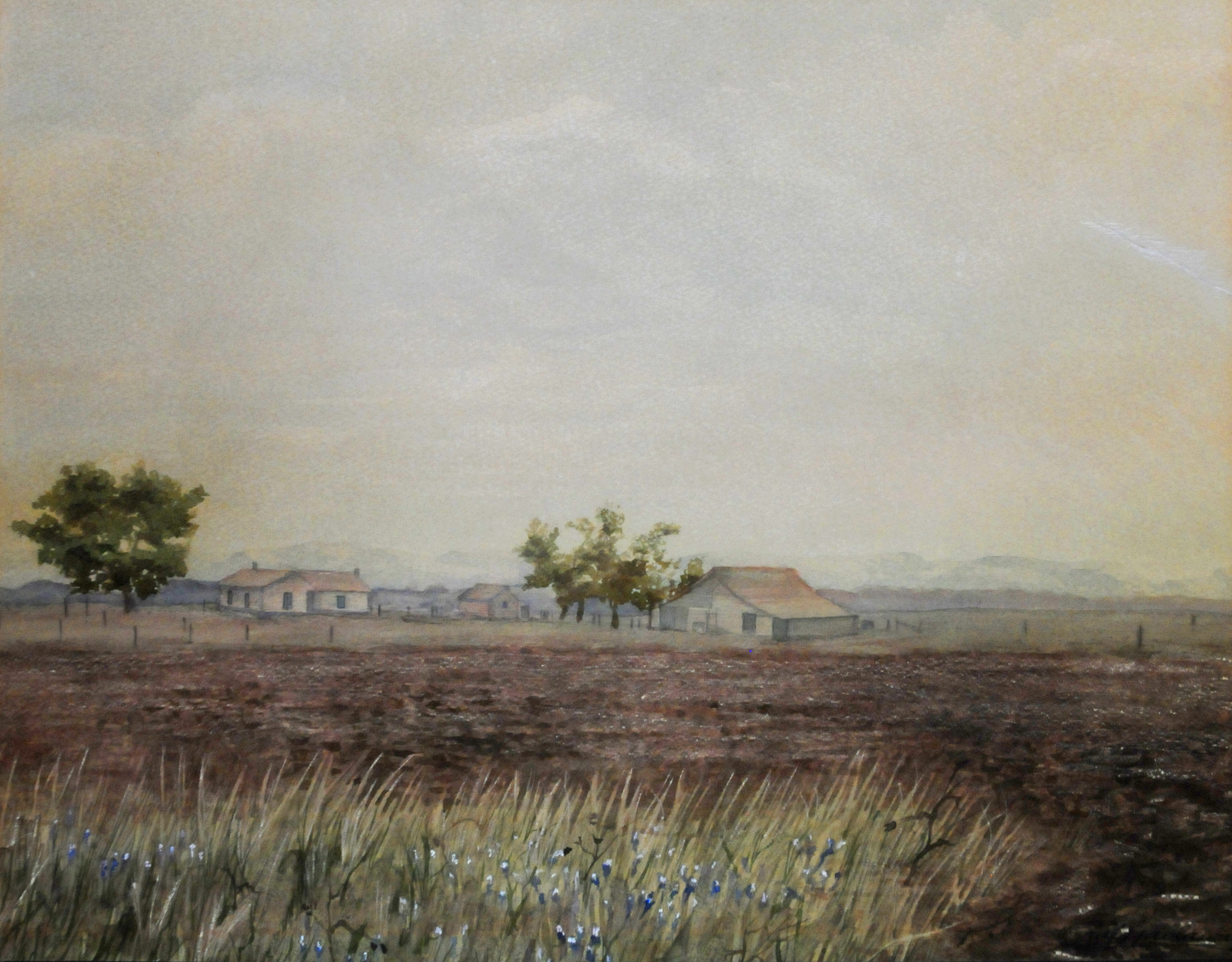
Glen Cove, watercolor by Craig Gallaway, copyright 1970. Based on a stock photograph and my own memories of my grandparents’ West Texas farm. I was trying to recall the atmosphere of their life and faith.

By the end of my second year at UTA (1970), still living at home with my parents, and hanging out with my rambling friends, the tension inherent in my double life was beginning to wear thin. Trying to live both as a cool neo-pagan rocker, and as a Christian (at least in private) has its fault lines and tremors. I had by then written a number of songs. I was surprised in a way to find myself in some of these songs (and in some of my paintings for watercolor class at UTA)  reaffirming the bonds of faith and country life that tied me to my family (for example, “The Hills of Coleman County”, mentioned at the end of Part 1). And though this kind of song resonated to some extent with a new turn in rock and roll at that time toward a more progressive country style (Dylan, the Birds, the Band), and wasn’t therefore a direct challenge to my revolutionary “style,” I think I knew at some level that this affirmation of family history was turning my political ideals toward something much more down to earth and grounded. I was letting go the world of sweeping claims about social justice and rediscovering the world of struggle, pain, and even joy in common life. This came out more explicitly in a Christmas song I wrote at the end of 1969, entitled “White Star.” (You can hear an early recording here.)

WHITE STAR

White star, how You came to be

shining down upon that country place

is beside me.

Bright and Morning Star, how you came to be

Walking around inside that country man

Is beside me.

And I was so surprised to find

That anything as ordinary as that country place

Could lighten every space

And brighten every face.

Bright and Morning Star, how you came to be

Looking right into these country eyes

Is beside me.

You’re inside me.

The tension inherent in my double life came to a head in the summer of 1970 when my father suggested that I might help out a young local preacher/evangelist named Billy Hanks. Billy was working with several young gospel singers, such as Cynthia Clawson, and he needed a guitarist for studio recording. I had a new red Guild guitar and I went straight to work. As a result, I myself became involved in some of Billy’s crusades, sharing my songs and my embryonic witness all over Texas, and eventually with the Youth for Christ organization in Europe. I also met a new set of friends and musicians; and this led later to my working with a popular Christian rock group called Love Song, as an opening act for concerts at various Texas colleges and universities.

Meanwhile, some of my old campus friends were wondering what was happening with my “music career.” I think some of them liked the music I was writing, and at least some of the lyrics. The band members even helped me, with various instruments, to produce some early recordings of the songs. But others in the troupe took offense at my increasingly public faith. The fellow on whose reel-to-reel tape machine we recorded even charged me with wanting to steal his tapes in order to get a music contract, get rich, and leave him out of the windfall. I had no such plans, and never pursued his vision for me; but I knew I had to walk away from that kind of suspicion and hatred. So, I did.

Another song that I wrote at about this time coincided with the decision to break more clearly from my old pattern. I was aware that my friends and I, with all of our ideals about social change and freedom and “love,” had long been disgruntled with life itself, working jobs that we didn’t really like or want, waiting for the weekend to come so we could party, get high, and escape our boredom, only to find ourselves worn out and starting another week in the same sort of stupor as the week before. I knew I needed to turn a corner, to spend my time differently. And what good did it do to keep sharing my songs when, as far as I could see, I might only be bugging them with my “witness”? I needed to strengthen what few real gains I had made (personal and spiritual) and begin with more effort to “redeem the time,” (Ephesians 5:16). The song I wrote about all of this was entitled “Time.” It was addressed in this case both to myself and to my old friends. It was a kind of farewell song and a wake-up call to make good use of time–and everything else we were being given. (You can hear an early recording of the song here.)

TIME

What can we do to save time that we think we can use

For a better time as soon as we have finished

What we’ve got to?

And what can we do to pass time when we find we’ve saved too much

And we’re spending all our time

Wondering just how we can pass it?

What does time mean to you?

Does it mean just that another day is through?

Are you rushing? Are you wishing? Are you lazy?

Do your days just pass you by, come and go?

Do you know the reason why?

I was letting go of one way of life. I was taking up another. In 1971, I began working as a youth director at the First Methodist Church in Carrollton, Texas, with pastor Ken Carter and his wife Freddie. I learned a lot at Carrollton about keeping a schedule and connecting with people who had regular jobs and families, people who were willing to work with me as we tried to make a difference in our surrounding community. In the summer of 1972, for example, instead of spending a lot of money, as we had done the year before, for the youth group to travel to Kentucky to work with the great Appalachian Service Project, we found a way to create our own service project in the rural countryside around Carrollton. Like ASP, we helped local people and families living in poverty to rebuild porches and roofs, and we enjoyed musical and cultural exchanges with the generous black congregations whose members welcomed us into their communities.

At the same time, among the people I had met through Billy Hanks, were two twin brothers, Brad and Stan Ferguson, who were part of the Inter-Varsity Christian Fellowship at North Texas State University in Denton. I lived with Brad and Stan on the NTSU campus for one semester in the fall of 1970, and then later spent time with them while I was completing my art degree at UTA. Among other things, my friendship with Brad and Stan helped me to clarify what it would mean to make a more grounded break from my old life of so-called “free love,” and to move into a new way of life in Christ that looked instead for a kind of wholeness, justice, joy, and wholesomeness in faithful marriage.

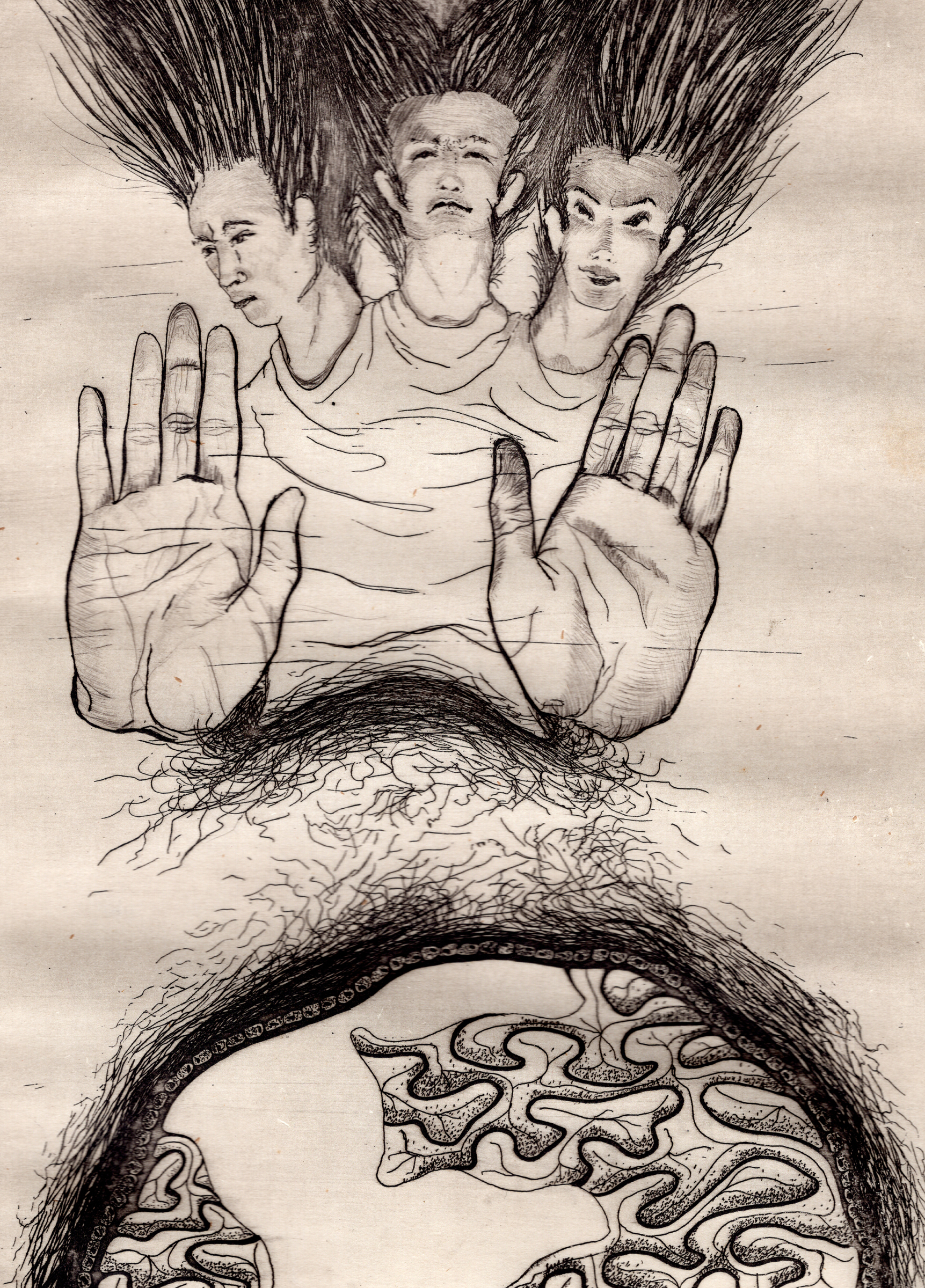
This was not a simple or easy time of transition for me. I was a young man in art school, taking life-drawing classes with nude models. I wrestled quite a bit with the meaning of my own desires. I even started at one stage in my art work, without really knowing the background or history, to drift toward the ancient gnostic heresy which once dogged the early Christians. This is the idea that the solution to our passions and unruly desires is in some way to get rid of the body itself, to be taken away to another world where there will be no body to bother with. I memorialized this in an etching that shows a young man, divided severally in his own mind, somehow breaking away from his brain and the world in order to find peace.

Gnostic Vision, etching by Craig Gallaway copyright 1970.

One day in Denton, when I was showing Brad some of my life drawings of nudes, I became embarrassed and said something about how he didn’t have to look at all of this “nasty” stuff. And Brad simply reminded me that for us as Christians, the body is not “nasty.” It is God’s good creation. Our task is not to escape it; but to learn to live faithfully with it and in it, in the physical world, with self-control, holiness, joy, and wisdom. Here, in a deeper connection, I was learning ever more clearly how the personal and the political, the social and the moral, far from being separate compartments, really belong together; and how practical and down to earth this way of Christian faith is designed to be. The Spirit was working with me, even as I at first misinterpreted what I thought the Spirit was aiming at. But this is how the Spirit often seems to work when one is in need of deconstruction and reconstruction!

In the summer of 1973, after graduating from UTA, I returned to the San Francisco area to live in Richmond and to work with a group known as “The Christian World Liberation Front.” Led by Jack Sparks on the campus of the University of California at Berkeley, CWLF sounded like another radical political group. And in a way it was. But it was focused on helping young people recover a sense of faith, hope, and grounding in Christ. I too was still learning how to bring my old revolutionary ideals down to earth, to embrace a way of life that was faithful in love, disciplined in work, focused on service, and open to all people under the guidance of the risen Lord and his Spirit. I came to see that these practical steps of faith, as common and ordinary as they seem, really are the Christian alternative to the overblown rhetoric that we often encounter in revolutionary circles, such as the Zealots in the New Testament, the hippies of the 1960s, and the recent cultural harangues from the riots of 2020. This is also, by the way, the kind of mission grounded in faith and individual responsibility that we find at work today among leading black Christians and public intellectuals such as Robert Woodson, Shelby, Steele, and Glen Loury.

So this is how I began to learn over time what it meant to sing the words of my own song: “Jesus’ blood, dripping on the stones, has set me free to soar.”  Set free not only from the physical confines of the SLO. CO. JAIL, but also from the spiritual and moral rabbit trails of my own limited vision, my story, my self-understanding. His death and resurrection, his defeat of the powers of sin and death, and his continuing power and presence by the Spirit, are the foundation for a real revolution that aims finally at resurrection and new creation. Nonetheless, like the Apostle Paul, those of us who follow him do not dare nor even wish to claim that we have already arrived, for we are still on the road hiking with purpose toward the final restoration and victory (Philippians 3:12-15). But we are “in him” and that makes all the difference: On the road of new creation, fighting back against the fallen powers, under the banner of the King!

[i] I wish I could say that I recognized clearly during the early years portrayed in this account just how much my father and my mother had been an ever-present help to me. After all, when Dad came to Haight-Ashbury to get Jerry and me out of trouble, he was, in a way, enacting the gospel in person. I didn’t see it so clearly then. Later, looking back, I was able to recognize how, to put it mildly, it had not been easy for him to come to that particular “far country” to find us, to bear the costs (monetary, personal, and emotional) and the drab ignominy of our sins and failures, and all of this in order to give us a second chance to start again; yet to see no immediate signs of gratitude or change in either of us. Dad was no more perfect than the Apostle Paul. But, like Paul, on behalf of the runaway slave, Onesimus, and like King Jesus who is the source and foundation of this whole endeavor, he was ready to take our debts upon himself in order to bring about, if possible, the desired reconciliation.


Valentines Day 2019: Reverance for Christ, Submission to Each Other, and the Way of True Romance, Part 2

BRIDE, by Craig Gallaway, graphite on paper, copyright 1999. A drawing of Deborah, my dearest friend and beloved wife, who joined her journey with mine on December 22, 1976, and who still travels this mysterious road of romance and marriage with me in the light provided by our King. The song below, “Deborah’s Song,” was written in 1994. It echoes the counsel of our trusted friend and mentor, Jim Houston, “Never lose touch with the sense of mystery in each other.”

In a post for Valentine’s Day 2018, one year ago, I looked at the meaning of Christian marriage and romance in the light of Charles Williams’s “theology of romantic love,” and the Apostle Paul’s teaching (Eph. 5:21) that husbands and wives should “submit to one another out of reverence for Christ.” As I brought that post to a conclusion, I was aware that I hadn’t said much about what such an approach to romance through “mutual submission” might look like in the context of daily married life: living, working, experiencing emotional ups and downs, making decisions, and sexual intimacy.

What I want to do in this post is to look at several very practical parts of marriage that, it seems to me, can be grounded clearly in Jesus’ teaching and way of life with his first disciples. I hope to suggest how these practices might be worked out in the daily round and the ongoing journey of Christian marriage, something like a set of goals and exercises, fleshing out part of what it might mean to submit to one another out of reverence for Christ. I don’t consider myself an expert in these practices (just ask Deb); but the topic has fascinated me for many years as an on-the-job-learner-in-progress. With that in mind, and speaking therefore as “one without authority,” I want to look at three practices to begin with: 1. shared work, 2. shared inner life, 3. shared decisions, and then I will look again at the dimension of sexual love (eros) as this is woven into and enriched by the other practices. In this way, I think I can see how the wider dimensions of shared life may indeed become ways of submitting to each other out of reverence for Christ and, at the same time, ways of discovering the deeper and richer meanings of romantic love.

Shared Work:  One of Jesus’ most surprising actions with his first disciples occurred when he took a towel and a bowl of water and began to wash their feet (John 13). He was their Master and teacher, and yet he stepped into one of the dirtiest jobs in the household. And then he made clear his goal for them as well. “If I your Master and Lord have washed your feet, you also should wash one another’s feet.” Jesus was clearly challenging the status and pecking order that the disciples were used to. The reversal of roles was so unexpected, in fact, that Peter tried in two different ways to keep the old order in place, first by refusing to let Jesus wash his feet, and then by suggesting a special ritual to make the occasion more dignified for all concerned, especially for Peter. Jesus insisted that his action was not about ego or status at all. It was about performing a basic service that was needed. And he called his disciples to follow him in this kind of servant ministry, this shared work.

How might this principle of shared work be an exercise for husbands and wives in what it means to submit to one another out of reverence for Christ? Like the first disciples, we live in a culture today where different jobs, roles, and professions are accorded very different levels of status. Certain professions are automatically given a lot of respect; others, not so much. This can lead to envy and confusion about who is important and why, even (perhaps especially?) in marriage. And yet, as Christians, our identity is centered in Christ, not in any profession or job. And so we must fight the real spiritual battle to resist the idolatry of job, career, or profession. From Jesus’ point of view, the essential thing in any job or profession is the possibility of serving a real human need. “All good work is service,” said the Bruderhof community. In this light, whether both spouses work, or one stays at home to care for children or manage the household, there can finally be no difference of status for those who are in Christ. Division of labor can be negotiated in many different ways between caring spouses; but when the toilets need scrubbing, or the house needs cleaning, there can never be a question of a role that is beneath “me.” Sharing work in this way, moreover, can be a source of rich and deep bonding as well; and a way to submit to one another out of reverence for Christ.

Of course, working together is not always easy. Deb and I do not always agree about what is the best way to do a job. So arguments arise, and we may find ourselves in conflict. In this case it might seem better just to avoid working together! But Jesus never said that serving would come easily. And the process of working through conflicts is also an important goal for those who want to go deeper and further in romantic love (see below “shared decisions”). So, washing each other’s feet by sharing the work load remains a significant way to open our hearts both to Christ and to each other.

Shared Inner Life:  Have you ever wondered how the writers of the gospels knew so much about Jesus’ personal struggles and temptations? Jesus’ forty days in the wilderness at the beginning of his ministry took place when he was alone, except for wild animals and the tempter (Mark 1:12; Matt. 4:1). And yet we know very clearly the nature of his three temptations (appetite, ego, power) and how he responded in each case. Can there be any doubt that Jesus confided these details to his disciples because he wanted them to know that he faced the same kinds of trials and temptations that they did? In a similar vein, the author of Hebrews reminds his readers that Jesus “is not unable to sympathize with our weakness, because he has been tempted in every way as we are, yet without sin” (Heb. 4:15). And likewise the Apostle Paul calls us to “bear one another’s burdens and so fulfill the law of Christ” (Gal. 6:2). All of this is grounded again in Jesus’ own practice when, just before his arrest, at a time of deepest struggle, he asked Peter and the other disciples to “stay here and watch with me,” though they failed to stay awake (Matt. 26:38). Our life together in the community of faith is to be one of shared inner life, not one of Stoic repression or hidden emotional struggle. “Weep with those who weep, and rejoice with those who rejoice” (Rom. 12:15), says Paul.

And how might this shared inner life work out as an exercise in “submitting to each other out of reverence for Christ”? As with sharing work, there are no doubt many different ways that different couples can work out what seems right or best for them. Some of us may need more of this kind of sharing, perhaps, some less. I do not presume to know a one-size-fits-all prescription. But Deborah and I can witness out of our own experience to the immense importance of learning to share our grief and our hope in significant detail on an almost daily basis when we lost our twenty-year-old son in an accident. I wonder if our marriage could have survived that time if we had not felt free in Christ to let the Spirit “groan within us with groans too deep for words” (Rom. 8:26), and yet also to affirm in the teeth of our pain that “nothing can separate us from the love of God in Christ,” not even death (8:39). Some people may try to bottle up such strong emotions; but one of our mentors at the time reminded us that “pain brought before God with his people is redemptive and healing; while trying to hold it inside is deadly” (cf. 2 Cor. 7:10). And this principle surely applies as well to the whole range of emotional life, including joy, frustration, humor, fun, fear and courage. To share our inner emotional lives with each other sends the bonds of relationship and romance ever deeper, and it is clearly a way of submitting to each other out of reverence for Christ.

Does this mean, then, that we always share everything that pops into our heads, or that there is no shut-off valve between mind and tongue? I don’t think so. As Jesus went about the villages and countryside with his disciples, he regularly went off alone to an “empty place” to pray. Deb and I spend a good deal of time every day regrouping in our own inner lives by means of prayer and study. And I know for myself, I sometimes have to think really hard about how to share some thoughts and feelings with her, especially after a time of conflict or disagreement. I’m sure Deb does this as well. And yet, it remains very important that we have access to each other’s inner life, including a sense of each other’s deepest joys, sorrows, humor, doubts, and struggle. To ignore or avoid this would leave our reverence for Christ and our submission to each other on rather flat and uninspiring ground. Bad, both for faith and for romance.

Shared Decisions: When Jesus was preparing to leave this world, he talked with his disciples about what it would mean for them that he would no longer be present with them in the flesh. He promised them that it was a good thing that he was leaving, because he would send his Spirit to be their guide and friend, and by this means he would still be with them wherever they went and whatever they encountered (John 14-17). In his epistle to the Philippians, Paul assumes this kind of Spirit-led way of life when he describes our life “in Christ,” and calls us to “work out our salvation with fear and trembling, because it is God who is at work within us” (Phil. 2:12). This way of life together in the Spirit leads finally to the kind of decision-making process that we find reflected in Acts 15:28, where the apostles and elders, and the whole church, made an important decision about basic doctrines and ethics, and then explained their process with the phrase, “It seemed right to the Holy Spirit and to us not to burden you with anything more.” Clearly Jesus intended his followers to make important decisions together under the guidance of his Spirit, to reach consensus with each other, and to be confident in doing so.

But what does this have to do with decision-making in marriage? When Deb and I were first engaged, we sought marriage counseling from a respected mentor. Based on his interviews with us, he told us that one thing we clearly needed was to learn how to argue well. We explained to him that we didn’t really have that problem. We just didn’t argue. He said that we had better start learning, and soon. So we left and had our first argument about how to argue. To be honest, this has been one of the most difficult challenges for Deb and me throughout our marriage. How can we argue, or “fight the good fight,” without one of us, or both, trying to dominate or control the other, while the other merely shrinks back and hides their thoughts and feelings with a growing sense of hurt and disrespect? And how can we do this, whether the decision is a small one, like how to trim the roses, or a large one, like how to respond to a teenager’s rebellion? How can we address such issues out of reverence for Christ, and with submission to each other?

We have come to believe that Jesus’ model for the early church (shared decision- making in the Spirit) has significant parallels with what is known as “shared decision- making” in the literature of contemporary marriage counseling (see for example, Susan Heitler, The Power of Two). Shared decision-making is essentially a matter of both partners stating clearly for each other (thus, “submitting”) what each one really wants (with regard to the issue at hand), and then crafting a solution together that refuses to cancel or ignore any reasonable priority of either person. It is amazing how arguments can become planning sessions when partners keep the focus on the task at hand and possible solutions, rather than blowing things up with charges of bad motives, hurt feelings, and past history; only to end up with anger and more hurt feelings. The rules of good communication can help a lot at this point. For example, state what you want, and how the conflict is making you feel, rather than trying to state what is wrong with your spouse or where they have gone wrong. Such strategies place the focus on goals, empathy, and solutions; rather than blame and defenses.

Working together in this way, under the Spirit’s guidance, is not easy. It requires submitting our thoughts and desires to each other, rather than trying to dominate, conceal, or manipulate. And it’s not easy for some of us simply to say what “I” want, or for others simply to listen and look for a shared plan. Yet this model resonates with the kind of process that we find reflected in Jesus’ promise of how his Spirit would guide the early church into the truth. And it is clearly a way to build a sense of closeness and trust, rather than the barriers and fissures that would otherwise arise.

Romance and the Sharing of Eros: Perhaps it is obvious how these ways of sharing work, inner-life, and decisions, can serve to keep the channels of communication, as well as our hearts and imaginations, open, both to Christ and to each other. Such openness is good in most relationships, including those that are not romantic or sexual; and the purpose of sharing in these ways in marriage is not simply to pave the way for sexual intimacy. At the same time, does it really need to be said, that the sense of closeness and support that comes from sharing work and inner life and successful decisions can be a very real and powerful inspiration for a deeper sense of closeness, romance, and sexual intimacy in marriage? Or, to put it the other way around, the desire of husband and wife to be close to each other sexually can only be enhanced by sharing and submitting to each other in these other ways as well. All of this suggests, for those who submit to each other out of reverence for Christ, that the best and truest kind of romance is a larger reality than sex per se. Sexual intimacy may be part of romance, but romance has a broader and richer framework. Perhaps there is a clue here as to why Paul urges us to pattern our marriages on the greater and higher reality of Christ and his church.

It is easy to miss what Paul was really saying at this point. God’s love for the whole world, focused in Christ’s sacrificial love for his church, is the greater reality that creates the full and highest meaning of our human marriages and sexuality. Our marriages are not the greater reality; they are a way for us to grow up into the greater reality. In Ephesians 5, Paul points to Christ’s sacrificial love for his people, the church, and then he says, “For this reason, a man shall leave his mother and father, and a woman shall leave her home, and the two shall become one flesh.” For this reason: that is, the Creator has given us marriage as a reflection of his own love for the world, so that we might discover over time, and live into, what is really going on in God’s care and purpose for the world. We are part of a mystery that is illuminated by the metaphorical comparison with Christ’s joyful, sacrificial love; God and His people in the new creation are the reality that illumines us, bringing new joy and discovery.

If Christ’s love is truly the compass bearing, the north star for the best and highest experience of romance, marriage, and, yes, sexual intimacy, is it any wonder then that our experience of these things is deeply fractured and distorted today by our culture’s constant focus on eros as an end in itself? Movies, TV shows, books, advertising, pop psychology, and other media continually focus on sex and sex appeal as an end in itself, an “idol” around which we are invited to organize our lives, our identities, and our imaginations, often without even being aware of the powers at work. And yet, one of the ironies of the modern and postmodern (just like the ancient) obsession with eros is the awful emptiness of sex when the other dimensions of friendship, family, and sacrificial service are absent. What if, like many other good things in life, eros makes an excellent servant, but a terrible master? What if, as with job and career, we really aren’t meant to find our personal identity in our sexual desires, drives, and inclinations? In this light, the ancient biblical ethic for marriage and sexuality, far from interfering with the best and highest values of romance and sexuality, is actually the path to sanity, health, deep commitment, and romantic love. Happy Valentine’s Day, in the name of Christ!