
THE SPIRITUAL AND POLITICAL BATTLE OF OUR TIMES, PART 5: A CRITICAL TIME IN OUR NATION’S HISTORY

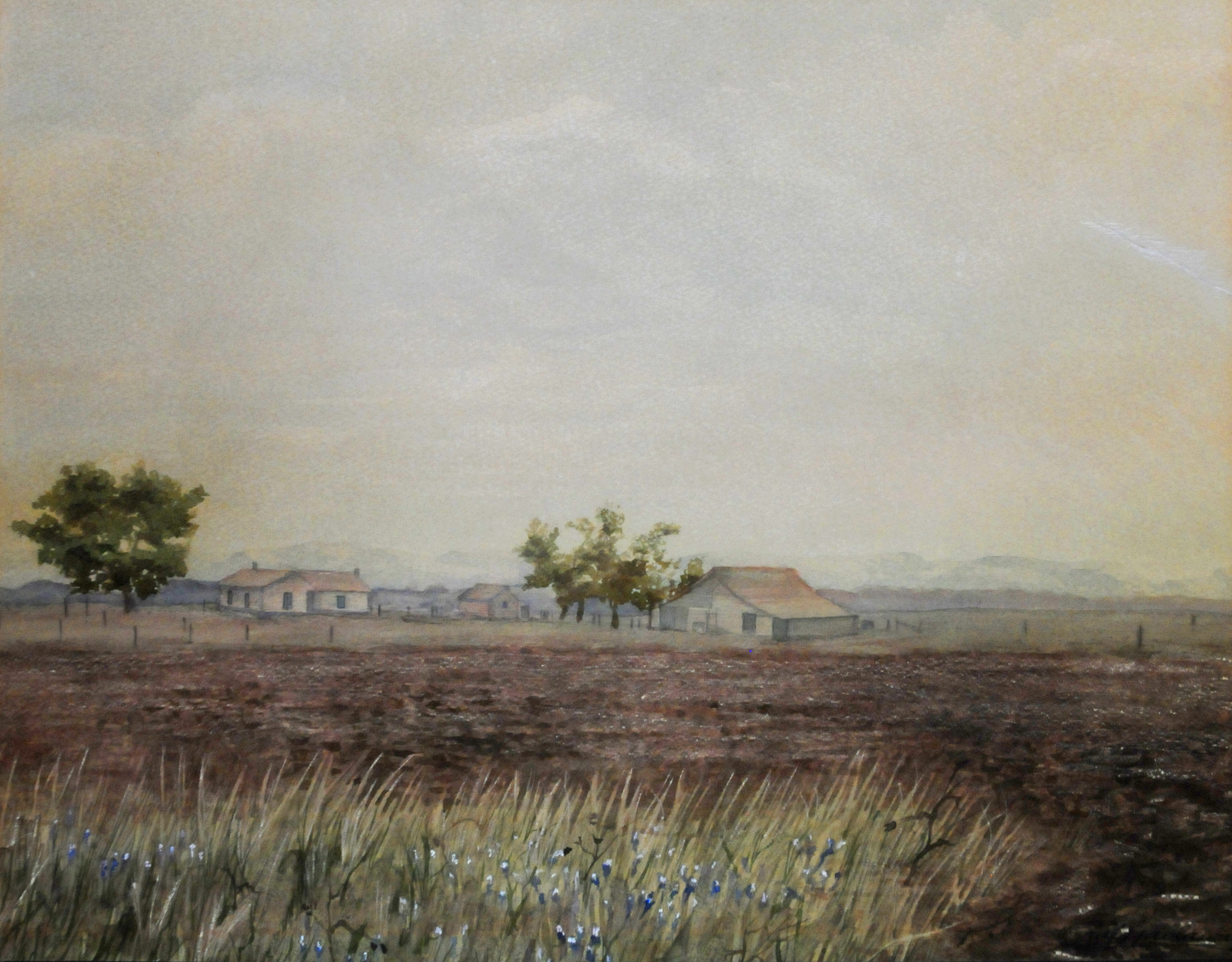
Title: Glen Cove, watercolor by Craig Gallaway, copyright 1970. After getting lost as an eighteen year-old in the free-wheeling idealism of the 1960s in the Haight-Ashbury district of San Francisco, I returned to my family in Texas and began to try to “re-member” what had been the deeper soil of my life, my upbringing, and my faltering faith. This painting was an attempt to remember and to honor the first fruits of that legacy from my grandparents little farm in West Texas. Remembering and honoring that legacy was a crucial step in my own recovery of our national heritage, and a preparation for the battle now at hand.

[In the previous part of this essay, Part 4, we concluded our brief review of the Anglo-American Conservative Tradition (ACCT) as it provides ways to recover from the destructive and disintegrative results of the administrative state. We also began to inquire about the relative seriousness of the differences between the policy positions of the Biden administrative state (on matters such as climate alarmism and economic policy, or racial and gender ideology and public education), and the policy positions of the Anglo-American Conservative Tradition. Are these differences just a matter of partisan and cultural opinion, or do they strike a deeper, more critical blow at moral and political principles that really and truly are non-negotiable for those on either side? In this part, we seek to answer these questions following the insights of Eric Metaxas and his mentor, Dietrich Bonhoeffer.]

A Critical Time in Our Nation’s History

In his small but compelling book, Letter to the American Church, Eric Metaxas helps us face these questions, and begin to answer them. Metaxas’s Letter is a plea to our American churches, but also to American citizens in general, to wake up to the awful and calamitous moment in which we are living. He thinks, and I agree with him, that this moment in our history is ominously similar to the period of the 1930s in Germany, when the German people and their churches closed their eyes and sat quietly by (no doubt in concern for their own comfort, safety, and security) while Hitler and his Nazi party turned their country into a totalitarian state that would eventually decimate other nations and destroy its own soul by its demonic genocide of the Jews. Perhaps one who has not studied this period closely, or looked in our own time beyond the thin virtuous veneer of the Biden state (constantly patched and polished by the corporate media) might doubt this comparison. Isn’t this talk of Germany, Hitler, and America just a lot of hyperbole? Except, perhaps, when Biden applies it to Trump and his supporters?   

If we are to take seriously Metaxas’s comparison between America under the Biden state and Germany under the Hitler regime, we need to revisit some of the “false crises” mentioned earlier in Part 2, only now to see them in sharper detail and to grasp why they cannot be regarded merely as “policy” choices. For example, let us try to form a concrete picture in our minds of the desperate plight of inner-city neighborhoods in Chicago, Baltimore, Detroit, or New York, where no one is safe, not even children, because young black men have been told that they are the victims of systemic racism and therefore have a right to snatch life and property from anyone who gets in the way of their “freedom.” Picture, if you will, the bodies lying in the street as life and possibility drain away? This is happening now in Democrat-led cities across our nation, as rogue prosecutors push their agenda on unsuspecting voters under the guise of legal reform. This is what Kamala Harris herself has promoted on public video during the BLM, defund-the-police riots of 2020. This is what the administrative state produces when “pure reason” and politicized “science” are applied to social problems without the moral guardrails of religion and the family, the Constitution, and the rule of law.

Or, we might look more closely at the devastation caused to thousands of people and small businesses by Biden’s COVID lockdown policies and vaccine mandates. Thousands are still waiting for our government to take responsibility for the terrible harm it has done. Can you see those who are still shaking with neurological tremors caused by adverse reactions to the experimental COVID shots, not to mention those who are already dead? They are invisible to the Biden state. Or, yet again, we might look at the explosion of fentanyl deaths, human trafficking, and sex trafficking caused by the criminally-open Biden-Harris border policies. Neither Biden nor Harris, nor their DHS staff, nor their cooperant media ever speak of these deaths and depravities. And then, looking to the future, God help us, we should try to picture soberly what will happen to our economy if the miscalculations of the Biden-Harris Green-New-Deal policies ever take full effect. The outcome could literally rival the atrocities and degradations of Mao’s infamous “bird famine” as supply chains falter and food supplies stop. Ideological, politicized science is not real science. 

All of these and more could be depicted in graphic and ruinous detail; but my goal is to awaken our consciences and to stimulate courage and conviction that leads to active resistance and change; not to overwhelm with shocking images, however realistic the images are in fact. Nonetheless, in the interest of conscience and conviction, let me give one more example in greater detail, one that may be the most compelling of all for many of us. 

If we need to face with full seriousness the resident evil of the Biden state (just as German citizens had eventually to face the death camps in 1945) then let us picture without turning away the scarred and mutilated bodies of children and minors who have been subjected under Biden’s Public Health Service to the lucrative medical experiments of so-called “gender affirming care.”[i] These are minors and children as young as 11 years old (with younger children in public schools across the nation being indoctrinated as we speak) who have followed the advice of “experts,” teachers and counselors, and some psychologists and doctors. They have taken experimental drugs (puberty blockers) for which no long-term studies of safety or effectiveness are as yet even possible, much less available.[ii] They have submitted to radical experimental surgeries that leave them with ghoulish scars and monstrous appendages that require ongoing medical care and attention, often for the rest of their lives. They face a life with permanent disfigurement, often combined with the loss of any ability to have children of their own. And yet, the promoters of this defacement of human life in the Biden state (and in groups like WPATH, whose junk science provides the so-called “standards of care”) do not want us to see or hear from the growing number of “de-transitioners,” children who have come of age, changed their minds, and are now being left to face all of this damage, much of it irreversible, on their own.[iii]

How much further would radical gender surgery have to go before people of common sense and sensitive conscience, and a measure of good faith, stand up and cry out, “Enough! Cease! Desist! Stop in the name of God and of all that is decent!”? We ourselves may not want to hear these stories. They are hard to imagine, nearly at times imponderable in their devastation. But then, Hitler did not want the German people to know what was going on in the camps under the direction of Joseph Mengele. And the German people did not want to hear or believe what they were forced by Eisenhower to see and smell when the camps were thrown open after the war. Metaxas warns us, in the spirit of his mentor, Dietrich Bonhoeffer, that if we refuse to face what is happening now, then we, like the German people in the 1930s, are at least tacitly accepting and supporting it.

“Silence in the face of evil is itself evil. Not to speak is to speak. Not to act is to act. God will not hold us guiltless.”[iv]

And if we do hear and begin to speak out, will we then follow up this outcry with campaigns to elect leaders who represent a genuinely religious and moral people, leaders who will dismantle the authoritarian administrative state, and require again that our country’s laws and its character be subject to a truly representative process? According to Metaxas what we need most is a recovery of genuine faith.

Looking ahead to Part 6

In the next two parts of this study, Parts 6 and 7, we shall look more closely at what went wrong among the German churches and the German people in the 1930s that allowed Hitler and his Nazi Party to come to power without greater opposition. According to both Dietrich Bonhoeffer and his biographer, Eric Metaxas, what went wrong had to do with a fundamental misunderstanding of the biblical meaning and practice of “faith” and “discipleship.” As you prepare for the next part, consider the following questions: Does our faith in Jesus and his Spirit prepare us to engage in matters of cultural and political consequence? If so, why and how does our faith in him have this result? And, if not, why not?

Endnotes


[i] The head of Biden’s Public Health Service is, of course, Admiral Rachel Levine, who has been aggressive in promoting radical gender ideology in our public health services and in our public schools, even when this involves hiding the school-based “counseling” process from parents. For up to date tracking of state sponsored rules and mandates for radical gender ideology in public schools across the nation see the online data and research of Parents Defending Education, and consider becoming a supporter of their important work.

[ii] See Dr. Jay Richards, Fight the Good Fight: How an Alliance of Faith and Reason Can Win the Culture War (Salem Books, 2024), and Abigail Shrier, Irreversible Damage: The Transgender Craze Seducing Our Daughters (Regnery, 2020).

[iii] For firsthand accounts of the suppression of information about de-transitioners by WPATH and other medical groups (who now have a great deal to lose, given the rising number of malpractice cases) see the stories of Chloe Cole and the ongoing research of groups such as Genspect. A recent Genspect webinar compared the current craze for radical gender surgery on minors with the infamous fad for lobotomies that captured the medical profession for a brief time during the 1930s and 40s.

[iv] Eric Metaxas, Letter to the American Church (Salem Books, 2022) p. 51.

THE SPIRITUAL AND POLITICAL BATTLE OF OUR TIMES, PART 4: THE ANGLO-AMERICAN CONSERVATIVE TRADITION (cont.)

Title: Glen Cove, watercolor by Craig Gallaway, copyright 1970. After getting lost as an eighteen year-old in the free-wheeling idealism of the 1960s in the Haight-Ashbury district of San Francisco, I returned to my family in Texas and began to try to “re-member” what had been the deeper soil of my life, my upbringing, and my faltering faith. This painting was an attempt to remember and to honor the first fruits of that legacy from my grandparents little farm in West Texas. Remembering and honoring that legacy was a crucial step in my own recovery of our national heritage, and a preparation for the battle now at hand.

[In the last part, we looked at the first three of five principles that, according to Yoram Hazony, characterize the Anglo-American Conservative Tradition. In this part, we will look at two more: Limited Executive and Freedom. All five of these principles together describe a pathway for creating a national political order that moves forward by trial and error as it is grounded in the common faith, the moral and legal tradition, and the familial formation of the people themselves. Historical Note: On July 13, four days before my last posting, Thomas Matthew Crooks attempted to assassinate former President Donald Trump in Butler, PA. He narrowly failed. Since that time, Joe Biden has dropped out of the presidential race, and Kamala Harris is now the democrat candidate for 2024. In view of these as yet unresolved events, I will continue to refer in these comments to the “Biden Administrative State,” since he is still president; but I shall also begin to speak of the Biden-Harris state as well, because she has been his full partner in every policy at every step along their way.]

4. Limited Executive. The principle of a limited executive in the AACT came into its own with what is known in English history as the Glorious Revolution. After a long period of warfare and unrest between Protestant and Catholic forces, the British Parliament voted to return William of Orange to the throne as a limited monarch in 1689. This was, at the same time, a rejection of absolute monarchy as promoted by those in the Catholic (Stuart) tradition. The decision established a “constitutional monarchy,” limiting the authority of the king by leaving various powers (such as taxation and the raising of an army) in the hands of the Parliament, not the king. Parliament (French parle, to speak) was to be a place of representative governance where the members debate issues in an open forum to establish laws and make national decisions. This framework is, of course, reflected in our American heritage by several principles: the branches of government, the separation of powers, the demarcation between federal and state powers in the Tenth Amendment, and the principle of checks and balances by which each branch is held in check by the others against any attempt at absolute or dictatorial authority.

The executive activities of the Biden state that regularly defy the checks and balances of the other two branches are everywhere in evidence: From the Biden DHS’s open southern border that willfully ignores existing immigration laws, to the Biden DOE’s attempts to forgive unilaterally billions of dollars of student debt and to indoctrinate children in public school with DEI and radical gender ideology, to the Biden EPA’s attempts to dictate rules for major consumer products, to the Biden DOJ’s use of lawfare to prosecute January 6th protestors and Trump himself, using statutes that have been stretched beyond all recognition. The Biden state evidently sees no inconsistency between its dictatorial practices and the call of our Constitution for legislative and judicial checks and balances. So much for representative “democracy.”

To restore the kind of limited executive envisioned by the AACT will require, among other things, a significant reform and downsizing of the administrative state itself, as well as a return to regular order in the budgetary practices of the House of Representatives. The executive branch should not control its own budget, as Biden seeks to do. This means returning for the first time since the 1970s to the use of individual budgetary committees in the House, where each of the major budget areas can be debated in a bipartisan manner before any bill is brought to the floor of the House for general debate and voting. It will also mean getting rid of the current fiasco of omnibus bills, cobbled together by a partisan majority with lots of “pork barrel” spending run in, without open debate (and often without serious reading) and passed under premeditated pressure at the last minute “to avoid a government shutdown.” The latter procedure under the Biden administrative state promises to turn our current $35 trillion national debt into some $50 trillion over the next ten years. This is the path to economic ruin led by an absolute executive who does not know how to say “no” to himself or to his party. (Kamala Harris has shown that she will keep or even increase these levels of government spending if she becomes president.) The health of our country depends on a return to fiscal and monetary self-control and discipline, a return to a limited executive. 

5. Individual Freedom. The fifth and final principle of the AACT, as outlined by Hazony, is one that nearly everyone will want to affirm, yet many will define in nearly opposite ways. This is the principle of individual freedom. Given what we have already seen about the AACT, and its wariness toward the idealistic rationalism of the French Revolution, it will perhaps come as no surprise that the meaning of the concept of “freedom” was itself under scrutiny from the earliest days of our national experiment. And this concern, still very much alive in our cultural and political conflicts today, has to do largely with the role of tradition in relation to the meaning and practice of freedom.

Within the framework of the AACT, freedom in its deepest sense has to do with achieving a good and virtuous way of life. One is truly free only when one is free for healthy, life-giving relationships, and free from what is harmful or destructive. To get one’s way, and yet to be destructive of one’s own life or the lives of others is not to be free, but a slave to one’s own appetites and passions. Thus, the AACT conception of freedom is the freedom of moral tradition and constraint. By contrast, for the point of view that descends from the Enlightenment and the French Revolution, freedom is primarily understood as the freedom of the individual from all constraints except those to which one chooses to give consent (based on the individual’s alleged access to pure reason). In one case, freedom is discovered through the obligations of family, congregation, and community life as these have been shaped by a specific religious, moral, and legal tradition. In the other, freedom implies release from all such obligations unless the individual finds his own independent “reasons” to consent. The latter conception is the freedom of the liberal post-enlightenment worldview with its related fantasy notions of “natural equality” and “pure reason.”[i]  

The liberal conception of individual freedom without parental, religious, or traditional moral constraint is clearly assumed in the Biden administration. The promotion of radical gender and sexual ideologies in our public schools in defiance of parental authority is a case in point. The scientific basis for such programs is, it should be noted, subject to serious doubt due to the denial of basic biology in defining sex and gender. Nonetheless, schools that do not comply by teaching and promoting the state’s ideology are threatened with loss of government funding. And schools that do comply are encouraged to teach and counsel children without parental involvement or approval, especially when teachers or counselors think the parents might not approve.[ii] With this ideology in place, cases of so-called “gender dysphoria” have risen by over 4,000 percent in recent years, especially among young teenage girls.[iii] This clearly confirms Sowell’s claim that the government’s programs often provoke and even promote the very problems they are supposed to address.

To recover the practice of freedom in the AACT will require, above all, rediscovering and reaffirming the role of religious faith and the family in the formation of individual character. This is crucial for all ethnic groups; but especially for the black community, where the welfare state has wrecked immense havoc on both the family and the traditions of faith.[iv] In very practical terms the recovery of the family will include a recovery of the role of prayer and Scripture in family life, and of the biblical injunction to honor one’s parents “that it may be well with you in the land.” In an age where young people have taken up the neo-Marxist cudgel against all traditions by tearing down monuments and cursing the heritage of leaders like Washington, Lincoln, and Martin Luther King, Jr., this will mean learning again a sense of humility toward our elders, despite their flaws and failings. Learning, that is, to ask questions again of our parents and grandparents about what they have experienced, why they think as they do, and why they have embraced the values that they hope to pass along to us.[v] 

We have only touched the surface here of the five principles that shape the AACT. And we have only mentioned a few highlights of what it would mean in practical terms to recover these principles in 2024. A thorough reading of Hazony will suggest many more, especially with regard to the role and practice of the family and family life. Some readers may look at this forecast of recovery as a fool’s errand. Does anyone really believe that it is possible today for our society to experience a religious and cultural awakening where the role of the family and the rule of law are once again the testing ground for our best efforts and our highest aspirations? Perhaps the real question we should be asking, given the trajectory of the Biden state, is just the reverse: “What will it mean if we do not take up this task and recover our heritage?”

Looking ahead to Part 5

The contrast between the political order of the administrative state and that of the Anglo-American Conservative Tradition should be clear by now, at least in basic terms, to anyone who has followed the argument thus far. The question must now be asked, however, if this contrast is nothing more than a continuation of the disagreements and diverging opinions that have always characterized the American two-party system. In other words, are the differences between radical gender ideology and the Christian moral tradition of the family, or that between legal immigration and an open border, or that between a command-and-control economy and a free market, only a matter of differing policy opinions? Or is something deeper, harsher, and more fracturing at stake? Are all of these “options” negotiable? Or are some of them beyond the pale of negotiation? These are the questions I would ask you to consider as you prepare for Part 5.

Endnotes


[i] Fantasies? If we simply assume the Enlightenment rhetoric of “pure reason” and “natural equality,” then we may question why these concepts should be regarded by anyone as rationalistic or idealistic fantasies. The hard truth, however, is that neither can be demonstrated in concrete human experience. No two naturally born people are ever equal to each other in every way, nor even in most ways, even among siblings in the same family. This can be empirically tested in a variety of ways, as Thomas Sowell has shown in Social Justice Fallacies, p.1-21. Likewise, as the structure of all academic and scientific debates amply demonstrates, not to mention ordinary human conversation, the use of reason leads inevitably to disagreements about what is reasonable. One can always seek a better and a more consistent explanation, but the notion of “pure reason” accessible to all people as individuals is a pure fantasy. See Hazony, Conservatism, p. 104-110, and Thomas Kuhn, The Structure of Scientific Revolutions

[ii] For up to date statistics and descriptions of public school systems across the country that are engaged in these activities of radical gender, sexual, and racial ideology see the online resources of Parents Defending Education.

[iii] Abigail Shrier, Irreversible Damage: The Transgender Craze Seducing Our Daughters, Regnery, 2020; and Liz Wheeler, Hide Your Children: Exposing the Marxists Behind the Attack on America’s Kids, Regnery, 2023.

[iv] Robert Woodson frequently points out the great irony that during the awful Jim Crow era, prior to the 1960s, when black families were by and large still intact, older people could walk without fear of crime in their own neighborhoods and teen pregnancies were below the national average.

[v] See Hazony, Conservatism, pp. 118-125.

THE SPIRITUAL AND POLITICAL BATTLE OF OUR TIMES, PART 3: THE ANGLO-AMERICAN CONSERVATIVE TRADITION

Title: Glen Cove, watercolor by Craig Gallaway, copyright 1970. After getting lost as an eighteen year-old in the free-wheeling idealism of the 1960s in the Haight-Ashbury district of San Francisco, I returned to my family in Texas and began to try to “re-member” what had been the deeper soil of my life, my upbringing, and my faltering faith. This painting was an attempt to remember and to honor the first fruits of that legacy from my grandparents little farm in West Texas. Remembering and honoring that legacy was a crucial step in my own recovery of our national heritage, and a preparation for the battle now at hand.

[In the last part, we looked at a number of abuses of power that have characterized the Biden administrative state. We have, perhaps, already begun to suggest how and why the administrative state operates in a way that is inherently antithetical to the principles of our founding, such as separation of powers and checks and balances. In the next two parts we shall look at five of those original principles and try to discern why and how their recovery will necessarily require a large scale reconfiguration of the administrative state itself.]

The Anglo-American Conservative Tradition

I am borrowing the title for this section from Yorum Hazony’s recent and very important book, Conservatism: A Rediscovery. In this book, Hazony explores the history, philosophy, and the ongoing struggle for what he calls the “Anglo-American Conservative Tradition” (AACT). The AACT reaches back, according to Hazony, at least to the sixteenth century in England, to writers such as John Fortesque, John Selden, and Edmund Burke. It was later deployed (along with its clear precedents for our Bill of Rights, our three branches of government, and our checks and balances) as a model for the US Constitution by our founding leaders such as George Washington and John Adams. This is the tradition of political order that Woodrow Wilson disavowed, and that the Biden state with its manifold “crises” has consistently found ways to violate. What would it mean to recover this tradition today? How might such a recovery redefine the issues of our time, over against the chaotic and destructive results of the Biden state? Hazony describes five basic principles that define the AACT in its long historical development. Let us look at each of these in turn and consider just a few examples of the benefits such a recovery might produce.[i] 

1.  Historical Empiricism

2.  Nationalism

3.  Religion

4.  Limited Executive Power

5.  Freedom

1. Historical Empiricism. The AACT is historical and empirical because its conception of political order is grounded in the most basic and concrete relationships of human life—in families, clans, tribes, congregations, and larger groups that overcome conflicts, clarify justice, and ban together to work for common interests and to defend themselves against common enemies. From this empirical foundation (hard won through the ancient and early medieval history of warring clans and petty kings in Britain) arose the English historical tradition of common law (e.g., the Magna Carta) which led eventually to a national system of parliamentary checks and balances, limited monarchy, petition of rights, and the “Glorious Revolution” of 1685. This is the tradition that our American founders (such as Washington, Adams, and Madison) embraced as the archetype for our US Constitution. This is the tradition conserved by the AACT.

Over against this, and consciously opposed by the framers in 1787, was the very different model of the French Revolution based on the rationalistic ideals of natural equality, universal reason, and individual freedom as these were defined by John Locke and Jean Jacques Rousseau.[ii] These ideals are exalted today in the liberal tradition of the administrative state, including the Biden state, where political order is attributed to the role of reason (“experts”), equity, and individual consent, not to the traditional values and obligations of family, congregation, community, and nation. We see this model at work in the contempt of the Biden state for our national borders, for parental authority, for principles of traditional moral conscience and religious freedom, not to mention the other basic First Amendment rights that his agencies have trampled. The eventual blood bath of the French Revolution, like the riotous breakdown today of our national borders and of our large crime-ridden urban centers, all demonstrate the terrible disconnection that separates the rationalism of the liberal model from the empirical realities of concrete human life and experience. 

To recover the historical and empirical character of the AACT today will involve embracing again the foundations of our national identity in the family, the congregation, the religious and moral tradition, the rule of law, and the separation of powers, all of which have been trampled by the actions of the Biden state. It will also require recovering again the voice of the people in representative government to debate and decide in Congress important social questions of race, gender, and public health policy, rather than cancelling or censoring that voice by an overreaching and imperial executive branch with its attending administrative state, media, and other institutions.   

2. Nationalism. What does it mean to be a nation state in the AACT—that is, to practice the virtue of nationalism? The answer to this question is not at all self-evident today since the concept of nationalism itself is regularly skewered and condemned by the advocates of the Biden state.[iii] According to them, nationalism leads to racism and xenophobia (hatred of strangers or other nations). Moreover, Hitler’s “National” Socialist (NAZI) Party is offered as a prototype for the racism and aggression that nationalism is supposed to produce. But the meaning and practice of nationalism in the AACT runs in direct opposition to all of this. Indeed, for anyone acquainted with the AACT, Hitler could never represent the political order of nationalism, despite his use of a cognate term. Rather, he embodied the imperial order of the German state, the political desire to absorb and dominate other nations (not to live in peaceful coexistence with them).[iv] This was in keeping with the long and aggressive history of the German Empire dating back to Roman times. In this regard, ironically, the Biden administrative state, with its dictatorial style at home and its globalist aspirations abroad, has much more in common with Hitler’s mentality (and with the imperial objectives of cultural Marxism and the CCP today) than with the political order of the independent nation state as envisioned by our founders.[v]  

A recovery of nationalism in America today, on the other hand, will require turning away from the racist and imperial policies of the Biden state. We shall need to recover, for example, Martin Luther King Jr.’s emphasis on individual character, merit, and equal opportunity as the foundation for our multi-ethnic national identity while, at the same time, boldly rejecting the racially divisive polices of the Biden administrative state such as DEI, which judge people as collectives and set them against each other as rival tribes and clans. Likewise, we will need to rebuild and restore our national borders while opposing the terrible effects on our nation’s life and character by the unvetted, open-border immigration policies of Joe Biden. Unlike Biden, we should care about the readiness of legal immigrants to speak our language, understand our history, respect our laws, and embrace our values. As a nation in the AACT we will continue to make room for different ethnic groups, clans, and tribes within our borders so long as they are loyal to the basic legal, religious, and moral values that bind us together. Moreover, we respect the same process at work in other nations as they work out the beliefs, values, and laws that embody their own history and traditions. Racial and international cooperation are both strengthened, not weakened, by the political order of the nation state in the AACT. 

3. Religion. When our founders had completed the framing of our Constitution in 1787, they made a point of emphasis to declare that this form of government would require “a religious and a moral people” to make it work.[vi] They had in mind, of course, the Christian religion of the Bible, for that was empirically the religion both of the American colonies and of their English predecessors in the AACT.[vii] They did not, however, try to establish a particular denomination as an official national church. Indeed, they forbade this in the First Amendment of the Constitution itself. This was due in part to the fact that most of the newly formed states already had officially recognized churches. But it was also due to the principle of government “of, by, and for the people.” The founders knew that the formation of strong religious and moral convictions depends above all on the living practice of individuals in families, clans, and congregations. The strength of religious and moral conscience arises not from a government office, nor from a declared statement, but from the living practices of faith, prayer, and a history of shared stories and experiences (working out the meaning of justice, correcting and improving faults, and defending the nation against its enemies) among the people themselves. This is the natural soil of “a religious and a moral people” from which alone can spring the moral reasoning, the informed voting, and the public service of good government.[viii]

To recover the religious dimension of the AACT in America today will require nothing short of a religious and moral re-awakening among the families, clans, tribes, congregations, and communities that make up our nation. This national fabric has been unwound and unwoven since at least the post World War II era by what Hazony calls “liberal democracy,” before which a former “Christian democracy” had still been at work in the nation and its institutions. As Hazony writes, “The Supreme Court’s decisions in Engel v. Vitale (1962) and Abington School District v. Schempp (1963) . . . overturned centuries of common practice by abolishing organized prayer and Bible reading in public schools across the country.”[ix] This trend has now been aggressively expanded by the Biden administrative state with its policies that separate children from the moral and religious guidance of both their parents and their religious heritage. 

The resulting situation in our culture today finds those in power seeking to replace the moral foundations of the AACT with pseudo-scientific claims about gender fluidity, systemic racism, climate alarmism, and Bidenomics, based on the flimsy and unreliable notions of “pure reason” and “natural equality.” And those who resist this ideology stand to be accused of anti-democratic “extremism.” This is precisely the cultural situation described in C. S. Lewis’s prescient 1945 book, The Abolition of Man. Having turned away from the moral and religious foundations of our country (in faith, family, and congregation) our culture and its institutions (including a politicized “science”) now flounders in a moral morass of ideological and biological nonsense that is forced upon us by the coercive power and control of a liberal “elite” in the administrative state.

The solution will require what some may regard as an impossibility at this time in American history: a great repentance and reawakening to our need for God, his guidance, judgement, and deliverance in our lives as families, congregations, communities, and individuals.[x] Even for those who are not religious or who embrace another religious tradition, the moral foundations of this recovery should be recognized and embraced. We shall have to learn again to live as a people of faith and moral conviction if our national experiment in representative democracy is going to recover and thrive. So thought Washington and Adams. And history itself shows us that this kind of awakening can in fact occur.[xi]

Looking ahead to Part 4

In Part 4, we shall continue these brief reflections on the principles of the AACT, focusing on the last two: Limited Executive, and Freedom. As you think about today’s post, and look forward to the next, consider the following additional questions: 1) Why is it that the administrative state seems to run by default toward the dangers of authoritarian power? and 2) How is the concept of “freedom” related to or connected with the principles of moral order?

Endnotes


[i] Yoram Hazony, Conservatism: A Rediscovery (Regnery, 2022), pages 336-337. 

[ii] See Hazony’s discussion of John Locke and Edmund Burke in Conservatism: A Rediscovery, pp. 21-29. Among the founders, Thomas Jefferson alone was seduced for a short time by the idealistic claims of the French Revolution. But then he was also absent in France while the others were writing our Constitution, and he returned to America when the failure in France became undeniable. See endnote 23 for further discussion of the “fantasy” status of the Enlightenment principles of “pure reason,” “natural equality,” and “individual freedom.” 

[iii] The repeated attacks by Joe Biden himself on MAGA Republicans as “extremists” who threaten “democracy” are a case in point. With this encouragement from their figurehead, many others have followed suit, such as members of the “squad” who accuse Donald Trump of racism for opposing illegal immigration. And in the wider culture the mantra has been taken up by Hollywood celebrities such as Rob Reiner (known appropriately as “Meathead” on the Archie Bunker TV series) who has been particularly outspoken, though poorly informed, in his attacks on what he calls “Christian Nationalism.”

[iv] See Yoram Hazony, The Virtue of Nationalism (Basic Books, 2018) for a full discussion of the three major distinctions of political order that we see at work and at odds in the world and in our own country today: 1. Tribalism, 2. Imperialism, and 3. Nationalism. Tribalism is characterized by the constant warfare of independent tribes. Imperialism is characterized by the imposition of coercive power by one tribe or a strong man over all other tribes. And Nationalism is characterized by a coming together of tribes for mutual benefit and defense around shared principles of language, religion, morality, and law.

[v] We should note very strongly, in this regard, that the Biden state has shown a willingness to cede national sovereignty to a variety of global organizations and geo-political bodies including the WHO (on public health policy), the WEF (on economic policy), the UN (on climate and gender policy), and even the CCP (with Biden’s soft foreign policies in relation to China and Iran). Meanwhile, the “unrestricted warfare” ideology of the CCP has captured many of the elites who currently lead the agencies of the Biden state. This points to a whole second level of geo-political activity that hides within the political structure of the Biden state. See Frank Gaffney and Dede Laugesen, The Indictment: Prosecuting the Chinese Communist Party and Friends for Crimes Against America, China, and the World (Skyhorse Publishing, 2023).  

[vi] In his “Letter to the Massachusetts Militia, 11 October 1798,” John Adams wrote that “Our Constitution was made only for a moral and religious People. It is wholly inadequate to the government of any other.” Likewise, in his farewell address of September 1796, Washington spoke of “religion and morality” as the “indispensable supports of all the dispositions and habits which lead to political prosperity.”    

[vii] They could not have been thinking of other religious traditions such as Hinduism, Islam, or even Judaism, in this context, for that would have been to disengage from the actual people who made up the nation; but they were also aware, in keeping with the AACT itself, that there is a central core of moral order that is evident in all religions, and that each nation should be free to work out the meaning of this order in keeping with its own religious history and traditions. See Hazony, Conservatism, p. 18. See also, C. S. Lewis’s discussion of the Tao (his name for this shared moral order) in The Abolition of Man (Macmillan, 1947).  

[viii] In The Abolition of Man, Lewis writes at some length about this process of education in the family, a process that conveys to children, even prior to the age of reason, the habits of the heart, the values of human life that Lewis calls the Tao, and for which he finds evidence in all of the world’s great religions. Lewis also writes about how this sense of moral order and tradition has been undercut by modern educational notions of individual freedom, reason, and “applied” science which reject the traditional, familial, and religious foundations of the Tao. Over the course of three chapters, Lewis traces the modern educational process to its consequences in a society led by elites who are driven by their own individualistic impulses because they are no longer shaped by the honorable values of religious and literary tradition. This seems a rather precise description of our society in the Biden administrative state today. 

[ix] Hazony, Conservatism, p. 266-67.

[x] This does not mean that everyone must join a particular denomination, nor even that everyone must become full-fledged believers and practitioners of biblical faith. It does mean, however, that even unbelievers, and those of other religious traditions, should understand how the rule of law and our constitutional rights in America, as well as the practice of reliable scientific research, arise from and are strengthened by the religious worldview of the Bible. Even Richard Dawkins, the well-known atheist, has recently made confession of this creed.

[xi] I am thinking in this instance of the Wesleyan Awakening in eighteenth century England and the Great Awakening that took place in nineteenth century America. Both of these made significant contributions to the spiritual capital of American culture and political order that are still unfolding in the battle to recover the AACT today. 

THE SPIRITUAL AND POLITICAL BATTLE OF OUR TIMES, PART 2: THE EXPANSION OF THE STATE UNDER JOE BIDEN

Title: Glen Cove, watercolor by Craig Gallaway, copyright 1970. After getting lost as an eighteen year-old in the free-wheeling idealism of the 1960s in the Haight-Ashbury district of San Francisco, I returned to my family in Texas and began to try to “re-member” what had been the deeper soil of my life, my upbringing, and my faltering faith. This painting was an attempt to remember and to honor the first fruits of that legacy from my grandparents little farm in West Texas. Remembering and honoring that legacy was a crucial step in my own recovery of our national heritage, and a preparation for the battle now at hand.

[In the first Part of this series, we looked at how the administrative state grew from its ideological beginnings under Woodrow Wilson to the massive collection of government agencies today with millions of staff and trillions of budgetary dollars under Joe Biden. We also recognized that the power of this unelected bureaucracy has kept pace with its size and budget over all these years, and now operates in many cases to displace the basic moral principles and constitutional rights of the American people. How has this happened? And how does it continue to happen in the Biden state today?]

How the Administrative State Gains and Expands Its Power

How has the administrative state been so successful in expanding its control and consolidating its power? In an early chapter of his 1996 book, The Vision of the Anointed: Self-Congratulation as a Basis for Public Policy, Thomas Sowell describes the methodology by which the administrative state has for many decades successfully consolidated its own power and wealth. Sowell’s reference to the “anointed” in his title corresponds of course to the “experts” of Woodrow Wilson’s and Frank Goodnow’s now 100-year-old “progressive” project, and to what others today describe as the “elite unelected oligarchy” of our massive federal agencies currently led by Joe Biden.[i] 

Sowell’s analysis identifies four steps that are typical of the administrative state’s methodology: 1) Identify a social problem that needs improvement (such as racial disparities in housing, education, or income). 2) Propose a government program as the solution. 3) Ignore statistics that show how the program has failed (usually because it misconstrues both the causes and the solution), in order 4) to increase funding for the program in the next year’s federal budget. The remainder of Sowell’s book, chapter by chapter, examines various programs of the welfare state since the late 1960s (for example, housing, education, teen pregnancy, and single-parent welfare programs) that amply demonstrate the steps of this failed methodology.[ii] In keeping with his own distinguished career—as an economist, statistician, mathematician, and sociologist—Sowell backs up his conclusions with in-depth statistical analysis at every point. 

This method of garnering power through misconstrued or even fabricated crises is very much alive in the current administrative state of Joe Biden. The bell weather example in recent memory is, of course, the great harm caused by the government’s handling of the COVID fiasco.[iii] The best analyses now pouring forth from various investigative sources both in Congress and in the wider world show that our government’s declaration of emergency powers was part of a very successful corporate/government campaign (Big Pharma plus the captured elites in the FDA, NIH, NIAID, CDC, etc.) to consolidate both wealth and power into their own hands. It worked to the tune of hundreds of billions of dollars. And all of this was accomplished, moreover, with the cooperation of corporate and social media and of our federal justice and security agencies (FBI, DOJ, CIA) to censor and silence independent voices of responsible science (such as The Great Barrington Declaration) who tried to expose the scheme.[iv] All of this has had the distinct aroma, it should be well noted, of that coercive alliance between government and corporate power known as fascism

The pattern of falsely defined issues, based on poorly designed research, that demand government action to avert a misconstrued crisis, is evident in nearly every policy and program of the Biden administrative state. The Biden state tells us, for example, that we have a climate crisis that requires the government to take direct command and control of our energy resources and our economy. And yet responsible scientists such as Stephen Koonin (former Obama EPA lead scientist) in his book Unsettled: What Climate Science Tells Us, What It Doesn’t, and Why It Matters, tells us that the so-called crisis is based on an abuse by activist officials (including Obama) of raw data from the members of the Intergovernmental Panel on Climate Change (the IPCC of the UN). The data, properly evaluated, however, do not support the claim of a climate crisis at all.[v] Indeed, if we follow the Biden state’s mandates for green energy and electric vehicles, we will do nothing to improve the climate, while making an absolute wreck of our own economy, as well as making ourselves dependent on other hostile economies around the world—in particular, China. This kind of miscalculation, as Sowell has observed, is a typical outcome of the command-and-control style of the administrative state.

Similarly, the Biden state tells us that we are in a racial crisis caused by systemic racism, and that this requires the government to impose programs such as DEI, CRT, ESG, and SEL in our schools, businesses, and corporate offices, if they are to lead the nation out of the legacy of slavery. And yet, responsible black leaders from the civil rights era, who currently lead successful programs of racial uplift and dignity in some of our worst inner cities, tell us that these government programs are more inwardly debilitating for American blacks and for society as a whole than the old ugly and unjust outward legacy of overt racism in the south.[vi] Indeed, if we keep following the lead of the Biden administrative state (“If you don’t vote for me, you ain’t black”) we can only expect the now fifty-year-old legacy of the dysfunctional welfare state in Democrat-led inner cities like Chicago, Baltimore, and Washington DC to become more violent and destructive.[vii] The progressive state usually makes worse the very “crises” it claims to improve.

Likewise, the Biden state tells us that we have a gender and sexual orientation crisis that requires teaching our children, against their own parents’ moral guidance, that boys can be girls, that males should compete in women’s sports, and that the practices of sex in the LGBTQ movement are just as normal and natural as the traditional moral vision of the Bible regarding the sanctity of marriage and the command to be fruitful and multiply. And yet, responsible scientists and counselors tell us that the gender and sexual experiments of the Biden state are not consistent with mental and social health, nor can they be promoted except by imposing the power of the state to undermine the role of the family and of religion in American life and culture.[viii] Even more concerning, this programmatic attack on religion, the middle class, and the traditional family clearly demonstrates the affinity of the Biden state for the subversive strategies of cultural-Marxism.[ix]

Bundling all of these “crises” together, there is at least one more crisis that is being fabricated and promoted by the Biden state, and that is the so-called crisis of democracy. According to Biden and his supporters, if we do not submit to their doubtful agenda for government programs and mandates to solve the various faux crises of public health, climate alarm, systemic racism, sexual orientation, gender identity, and others, then the health of our democracy is at stake. In other words, if we insist on following the rule of law, the separation of powers, and the free market policies of Donald Trump and others in the conservative movement, then we will fall into an authoritarian state that forces us to accept rules and a way of life that we do not freely choose based on our own values and consciences. Talk about bait-and-switch!   

In reality, it is not the conservative tradition that has censored free speech and cancelled genuine open scientific debate about these issues, or shut down our schools and businesses in the name of a false COVID emergency. And it is not the conservative movement that threatens to remove children from the moral guidance of their parents in order to promote a strange and ill-founded sexual and gender ideology. Indeed, if we follow the best principles of the conservative tradition, we shall find just the opposite. There will be room for public debate, for traditional moral principles, and for dissent. And there already is a big-tent tradition of American enterprise and innovation that is open to all, regardless of race, gender, or ethnicity. It is to the legacy of this positive vision of our American heritage that we now turn. What would it mean, in response to the cultural disintegration now churning within the Biden state, to recover the principles and traditions of our historic founding?

Looking ahead to Part 3

In the next post, “Part 3: The Anglo-American Conservative Tradition,” we will look at the tradition of religious, moral, and constitutional principles that our founders followed in designing our own constitution and cultural heritage. This is the legacy of the “Anglo-American Conservative Tradition” as explored by Yoram Hazony in his important book, Conservatism: A Rediscovery. And it is the tradition now largely defamed and dismantled within the Biden administrative state. The aim of Part 3 will be to consider what it would mean to recover the founder’s vision in our time? As you think about today’s post, and anticipate the next, consider the following questions: 1) How might a recovery of constitutional checks and balances between the branches of government correct and improve the activity of the administrative state with respect to how so-called “crises” are identified and how rules and laws are imposed on society? and 2) How might the recovery of the original biblical, religious, and moral traditions of our founding redefine and reconfigure the various “crises” that currently drive and dominate the Biden state? How would this recovery be accomplished?

Endnotes


[i] These themes are developed extensively in Thomas Sowell, The Vision of the Anointed: Self-Congratulation as a Basis for Public Policy, (Basic Books, 1996), and in his Social Justice Fallacies (Basic Books, 2023). In the latter, for example, Sowell describes the “knowledge fallacies” by which surrogate decision-makers in the government (that is, “experts”) think in terms of abstract mechanisms that do not comprehend the complex relationships of human life and economic activity (pp. 71-81).

[ii] On the issue of teen pregnancy, for example, Sowell observes that unwed pregnancies among black teens have soared in the post 60s era of the welfare state (68%) due to the increased benefits made available to single-parent families, and the subsequent breakdown of the black family in America. By contrast, during the unjust era of Jim Crow laws and segregation, when the black family was nonetheless still intact, unwed pregnancies averaged fewer than 17 percent. Sowell’s research thus reveals the serious and often tragic results of government programs for which the state is usually not held to account. See Social Justice Fallacies, pages 127-129.

[iii] It should be acknowledged, of course, that Donald Trump was also involved in the early stages of the COVID tragedy, along with Anthony Fauci and others in the NIAID, FDA and CDC, not to mention China’s Wuhan Lab. Based on grossly overestimated rates of infection and death, the Fauci team called for unprecedented and harmful restrictions on the constitutional rights of American citizens such as freedom of assembly, freedom of speech, and freedom to protest. Government censorship of so-called “misinformation” ran rampant on social media and in society at large. In 2021, Biden doubled down on these restrictions when he came into office. Trump, by contrast, had often advocated for things that would have helped (such as early treatments) but these went against the well-planned narrative of the Fauci cohort. And Trump, like others in Congress without a science background, was at a disadvantage to offer real-time criticism of Fauci’s authoritarian declarations. Nevertheless, Trump would do well, in my opinion, to revisit his account of those events and to acknowledge that he was over his head and made some serious mistakes by deferring to Fauci’s often pseudo-scientific leadership.

[iv] See, for example, Aaron Kheriaty, The New Abnormal: The Rise of the Biomedical Security State (Regnery, 2022), and Ramesh Thakur, Our Enemy, the Government: How COVID Enabled the Expansion and Abuse of State Power (Brownstone Institute, 2023). See also, Rand Paul, “Lessons from the Great Covid Cover-Up,” Imprimis, Vol. 52, No. 12, December 2023.

[v] Stephen Koonin, Unsettled: What Climate Science Tells Us, What It Doesn’t, and Why It Matters (BenBella Books, 2024). See also, Michael Schellenberger, Apocalypse Never: Why Environmental Alarmism Hurts Us All. Also noteworthy in this regard are the recent comments of Noble Laureate John Clausner on the great climate “hoax.”

[vi] Corey Brooks, “America Works: DEI Doesn’t,” Tablet Magazine, January 16, 2024. Robert L. Woodson, Sr., Lessons from the Least of These, 2020. 

[vii] Shelby Steele and Eli Steele, What Killed Michael Brown (Man of Steele Productions, 2020): an historic documentary film about the fallacies of systemic racism as demonstrated in the 2014 case of Michael Brown in Ferguson, Missouri.

[viii] Mariam Grossman, You’re Teaching My Child What? A Physician Exposes the Lies of Sex Education and How they Harm Your Child, (Regenery, 2023). Liz Wheeler, Hide Your Children, (Regenery, 2023). Dr. Jay Richards, Fight the Good Fight: How an Alliance of Faith and Reason Can Win the Culture War (Salem Books, 2024).  

[ix] See “Groomer Schools 1: The Long Cultural Marxist History of Sex Education,” New Discourses Podcast, Episode 54, November 19, 2021. This audio discussion examines the influence of Marxist activists such as Georg Lukacs and Herbert Marcuse (Repressive Tolerance, 1965) on our American educational system. See also, Dr. Ben Carson, The Perilous Fight: Overcoming Our Culture’s War on the American Family (Zondervan, 2024).

THE SPIRITUAL AND POLITICAL BATTLE OF OUR TIMES, PART 1: THE ADMINISTRATIVE STATE

Title: Glen Cove, watercolor by Craig Gallaway, copyright 1970. After getting lost as an eighteen-year-old in the free-wheeling idealism of the 1960s in the Haight-Ashbury district of San Francisco, I returned to my family in Texas and began to try to “re-member” what had been the deeper soil of my life, my upbringing, and my faltering faith. This painting was an attempt to remember and to honor the first fruits of that legacy from my grandparents little farm in West Texas. Remembering and honoring that legacy was a crucial step in my own recovery of our national heritage, and a preparation for the battle now at hand.

Most of us would agree, I think, that the people of the United States in 2024 are engaged in a major cultural battle, and that this battle has to do with both our political order and with our most deeply held spiritual values. The battle is often so fierce and complicated, however, that we have difficulty defining it or even describing it in a way that makes broad sense to everyone concerned. And perhaps we should expect this to be the case, since those most visibly engaged are now aligned into two political camps that directly oppose each other, both in how they define key terms (such as “democracy,” “nationalism,” and “freedom”) and even in how they define themselves—with terms such as Democrat and Republican or Liberal and Conservative. Is “nationalism” a good thing or a bad thing? What conception of “freedom” is assumed in our Constitution? Which of the major parties is truly the protector of “democracy”? We are at war even about these basic concepts.

What follows is my attempt to clarify what I think is going on in this conflict. How are the political parties now defining themselves, and why have they drawn the lines of battle where they have? What is the basic problem at work in it all? And what constitutes at least the direction of a solution? I will begin with a description of what has widely been called the “administrative state” as this currently exists in the administration of President Joe Biden, though this state has been expanding in every administration for at least a century. Thus, we begin with a major matrix of what I consider to be the problem.

The Administrative State

The roots of the administrative state in America can be traced rather clearly back at least to the early twentieth century and the administration of Woodrow Wilson. Wilson believed that the founding principles of the US Constitution—such as having three branches of government (legislative, executive, and judicial), each of which affords checks and balances on the others so that no faction can rise to absolute power—had become too slow and ponderous to manage the affairs of an increasingly complex society with large urban centers in a post-industrial world.[i] Therefore, with help from other so-called “Progressives,” such as John Dewey in education and Frank Goodnow in political philosophy, he promoted a scheme to deploy “experts” who were not “politicians” to administer and manage the business of the country. This is, in fact, the main theme of Goodnow’s book, Politics and Administration first published in 1900.

Today, the administrative state in the US has grown to a massive array of 430 different agencies—such as the IRS, the EPA, the FDA and CDC, the Department of Education, the Department of Defense, the Department of Interior, and the SEC, etc. These agencies have a total of 2.95 million federal employees, with an annual budget in 2023 (that grows and expands every year) of about 1.7 trillion dollars just to run the agencies. (This does not include another 4+ trillion in the federal budget to pay for benefits such as Social Security, Medicare, and Medicaid.) And these agencies have taken to heart Wilson’s original vision that they (not our elected officials in the legislative branch of government) should be in charge of making the laws by which the whole country, its businesses and citizens, should be governed. Some of the agencies, such as the EPA, have even created their own “judicial” officers to settle disputes with citizens and businesses as these arise. So much for checks and balances between the branches of government!

The problem with all of this, besides the sheer impossibility of trying to keep track of or hold accountable such a massive bureaucracy, is that the administrative state now operates independently of the wise form of governance which our founders bequeathed to us. This has made it possible today for the administrative state to function as an unelected faction whose ideology serves special interests. As such, the state now routinely sponsors policies and issues mandates that a majority of US citizens have never voted for and do not support (such as DEI, CRT, radical gender ideology, climate crisis, COVID lockdowns, open borders, student loan “forgiveness,” and the Green New Deal). The recent (July 1, 2024) Supreme Court decision to overturn the so-called “Chevron” doctrine (1984) demonstrates a growing awareness that the laws and policies of our country, especially those that affect major questions where billions of dollars are at stake, should be decided by our elected representatives, who are, after all, accountable to voters in each state for the decisions they make, not by the unelected career bureaucrats of the administrative state whose job security is independent of their policy decisions and their results. 

The basic problem, therefore, in our current cultural battles, as I (and many others) see it, can be traced to the matrix of the administrative state, which has expanded and imposed its powers more than ever before in our history during the first three years of the Biden administration.[ii] It is important to note in this regard, that it is Biden himself and his agencies that have been behaving in a unilateral, authoritarian, and dictatorial fashion, though they keep warning us that Donald Trump will be a Hitlerian style dictator if he is re-elected later this year.

Thus, it is Joe Biden who refuses to stop his attempt to buy votes by cancelling billions of dollars’ worth of student loans, even though the Supreme Court has already declared that he does not have the authority to do this without congressional approval. And it is Biden, or his agencies, that demonstrates contempt for our legislative process by using mandates and executive orders to coerce “green” energy, to mandate harmful public health policies and vaccines, to restrict what kinds of household appliances or automobiles our citizens will be allowed to purchase, to leave our borders open to invasion, and to enforce gender and racial ideologies in public schools that separate children from the moral guidance of their parents. This is, quite simply, the behavior of an authoritarian state, not that of a government of, by, and for the people.

Looking ahead to Part 2

In the next post, “Part 2: The Expansion of the Administrative State Under Joe Biden,” we will look at a number of recent Biden policies (for example: public health, climate, race, gender) along with some of the opposing political and cultural voices (often censored by the pro-Biden press) who warn of grave consequences already occurring as the Biden mandates are followed. As you think about today’s post, and anticipate the next, consider the following two questions: 1) To what extent, in real terms, have the results of Biden’s policies been either helpful or harmful for our people and in our society (for example, at the border, in the economy, or in dealing with inner city crime)? and 2) To what extent has the Biden administration pushed its policies without due regard for the legislative process of checks and balances?

Endnotes


[i] Woodrow Wilson, Congressional Government: A Study in American Politics. This book was based on Wilson’s 1885 PhD thesis at Johns Hopkins University and argued for a more limited discursive role for Congress, while the executive branch became more powerful in the actual administration of society. See also, R. J. Pestritto, Woodrow Wilson and the Roots of Modern Liberalism (Rowman and Littlefield, 2005).

[ii] See, for example, Larry P. Arnn, “The Way Out,” Imprimis (November 2021, Vol. 50, No. 11); and “Education as a Battleground,” Imprimis (November 2022, Vol. 51, No. 11). In addition to these two short articles (available online), the dozens of other sources cited in the endnotes for this seven-part series will reveal numerous overlapping problems of major consequence now piling up in our society and in our economy as a result of the policies unilaterally imposed by the Biden administrative state.

THE SPIRITUAL AND POLITICAL BATTLE OF OUR TIMES: AN OVERVIEW IN SEVEN PARTS

Title: Glen Cove, watercolor by Craig Gallaway, copyright 1970. After getting lost as an eighteen-year-old in the free-wheeling idealism of the late 1960s in the Haight-Ashbury district of San Francisco, I returned to my family in Texas and began to try to “re-member” what had been the deeper soil of my life, my upbringing, and my faltering faith. This painting was an attempt to remember and to honor the first fruits of that legacy from my grandparents little farm in West Texas. Remembering and honoring that legacy was a crucial step in my own recovery of our national heritage, and a preparation for the battle now at hand.

What follows is an outline in seven parts for an overview of the battle mentioned in the title above. I plan to post the first part, “The Administrative State,” on July 4th, commemorating The Declaration of Independence, and thus ringing our founders’s own clarion call against all such states. And then I will post a new part about once a week into the month of August. My sense is that many of us are in need of clarification about the many issues that beset our country at this time in our history, particularly as we approach the presidential election in November. This is my attempt to contribute to such clarification. I know there are those on the opposite side of this battle who will regard my views as misguided (to put it mildly) as I already regard many of their views. Having the perspective set forth in one place, however, with many details included, may help both sides, and those in the middle (or on the outside) to see more clearly all that is at stake in the outcome. That is, at any rate, my hope.   

1. The Administrative State. A brief review of the history of the administrative state from Woodrow Wilson to Joe Biden, 1900-2024.

2. The Expansion of the Administrative State Under Joe Biden. An overview of how the Biden state has expanded its power, based on the analysis of Thomas Sowell in his book, The Vision of the Anointed: Self-Congratulation as a Basis for Public Policy.

3. The Anglo-American Conservative Tradition. What it would mean to recover our cultural and constitutional heritage based on the principles of the Anglo-American Conservative Tradition (AACT) as shown in Yoram Hazony’s book, Conservatism: A Rediscovery.  

4. The Anglo-American Conservative Tradition (continued).

5. A Critical Time in Our Nation’s History. An assessment of the seriousness of our current cultural calamity based on a comparison with Hitler’s Germany in the 1930s, as shown in Eric Metaxas’s Letter to the American Church.

6. The Way of Faith. Reflections on the recovery of the AACT by means of three biblical principles of faith that will help us: a) restore the religious foundations of our culture, b) correct course both in the church and in the state, and c) avoid the disaster of the authoritarian state into which we are presently careening.

7. The Way of Faith (continued).

THAT HIDEOUS STRENGTH: Chapter 17

The cover art for the 2014 edition of That Hideous Strength by C. S. Lewis, published by Kindle and by Create Space Independent Publishing Platform. The image suggests the taming of fallen Venus by her more powerful original in the good order of creation. In this way, eros finds its true home within the greater virtue, the greater heart of agape. How is this a symbol for Jane and Mark, for St. Anne’s future, and for ours?

VENUS COMES TO ST. ANNE’S

Overview Question

In this final chapter, Lewis brings a few things to a sort of penultimate completion, for example the roles of Merlin and of Dr. Ransom. At the same time, he leaves us with a set of characters and questions that, rightly engaged, pull us back into the world of our own lives (our families, our congregations, our communities, and nation) to ponder our own course on the road ahead.

We have seen in earlier chapters how Ransom and Merlin, and the members of the community at St. Anne’s, have so far responded to the spiritual battle with Belbury and Edgestow in which they have been engaged. Now, in the final chapter we overhear, so to speak, their conversations about the ongoing battle that they have yet to face, and the parameters within which they must make their battle plans for the future. These parameters include hints about the ongoing “conversions” of Mark and Jane and the others at St. Anne’s (Parts 1 and 2); but also some more explicit statements about the nature of Logres, going forward, when the community at St. Anne’s must be prepared to meet again and to fight back against “other Edgestows” (Parts 4 and 5) under the same kind of distorted leadership as before (e.g., Curry, the well-informed man in the train of Part 5). This brings us to our final Overview Question:  

Taking the story of THS as a whole, especially the sense of future direction that arises in the final chapter, what would you say are the key principles—both at St. Anne’s and for us—that define the goal of their/our lives, and the signs that they/we are in fact making progress toward this goal?

“Just” another English manor house with gardens and natural stonework suggesting the kind of place and culture created by the community of St. Anne’s on the Hill in Lewis’s story. And yet, this is also the kind of place that represents and symbolizes the critical spiritual values, virtues, and strengths of Logres in the history of England which are determinative for the future of this tradition. How is all of this attacked by the Belbury and the NICE of our day?

DEEPER-DIVE QUESTIONS

1. In Part 1, after the debacle of the banquet, Mark is making his way to St. Anne’s on the Hill to find Jane and to give her “her freedom.” What are the signs that the conversion already begun in him is really taking root and expanding into various parts of his personality and the habitual way of life (the lifeworld) that he had formerly considered so important? What does this portend for Mark’s future, his marriage, and his potential for a different role in society?

2. In Part 2, Jane is with the other women of St. Anne’s trying on beautiful dresses in preparation for a great meal that the men of St. Anne’s are preparing. What are the signs in Jane’s thoughts and attitudes that the conversion already begun in her is also expanding into the wider regions of her personality and her former habitual way of seeing herself and trying to present herself to others? What does this portend for Jane’s future, her marriage, and her potential for a different role in society?

3. In Part 3, Lord Feverstone comes to his end swallowed up in an earth quake at Edgestow. He dies in a manner reminiscent of the sons of Korah in Numbers 16, and for the same reason: He has placed his own fame and fortune above everything else in life, and so he vanishes into nothing. At the same time, Part 3 gives us the last mention of Merlin who rides away on a horse yet, as Jane has seen earlier in one of her dreams, he has also been like a pillar of light used up completely in God’s good work of deliverance at Belbury. What do these very different “ends” tell us about the worldviews and lifeworlds of Merlin and Feverstone?

Anyone who knows the reality of farming or ranching, or any life that is lived closely within the powers and forces of nature, also knows how these powers offer immense opportunity for the training of the virtues and the fruits of the Spirit. This is the world of God’s continuing creation (creatio continua) in which we live and move and have our being, and within which we give thanks for our sufferings because we know that our Maker is using them to remake us in the image of his son, our Lord (Romans 5:3; 8:29). It is also the world of everyday ordinary life when we embrace this life with all of its challenges, in Christ.

4. Part 4 begins with Camilla’s question, “Why Logres, Sir?” which she asks of Ransom; though it is Dr. Dimble and Grace Ironwood who do most of the answering. In their answers, they talk about the importance in Logres (the ancient realm of King Arthur, which we commented on at some length already in Chapter 13) of a certain understanding of “Nature” (what I would call creatio continua), and of the tradition of faith and freedom that “haunts” English history all the way back to Arthur (and before), and of how this tradition must often be pursued in the most mundane ways, as they have in fact been pursuing it steadily at St. Anne’s. Working with your earlier answers in Chapter 13 and elsewhere, how would you define the meaning and significance of Logres, both in the story and in the present world of American culture and politics which also reaches back into this history?  

5. At the end of Part 4, there is also a discussion about the status of other countries in relation to Logres (this haunting of England) and about the seeming unfairness of the judgement of the people of Edgestow. What do the conversations about these two issues tell us about the traditional worldview, at least as C. S. Lewis understood it and recommended it through the characters in his story? What parallels can you find in Lewis’s other works to support your answer?

6. Part 5 is all about the future prospects of Curry, the Sub-Warden (“Dean”) of Bracton College. This is the Curry who in Chapter 1 manipulated the faculty of Bracton to sell Bragdon Wood to the NICE with a view to padding the purse of the college as well as his own career, and without even considering the moral or spiritual dangers. In Part 5, Curry discovers a way to turn the tragedy of the destruction of Edgestow and the college into a “providential” turn of affairs for himself. Why is it significant in the story that Lewis portrays Curry as the kind of man that people will see as empathetic and wise, though in reality Curry is only thinking of the future (and even of God’s providence) in terms of his own fame.

Garden With Beans and Flowers, watercolor by Craig Gallaway, copyright 2005 by Gallaway Art. A simple painting of a well-kept garden seems an appropriate image by which to contemplate the future imagined in the story for Jane and Mark, St. Anne’s, and Logres. For a garden is symbolic in the traditional worldview both of where we began, and of how we move forward toward the goal of the New Creation. There is, of course, a battle to engage along the way; but then we have our Lord’s own Spirit and power to guide and strengthen us.

7. The final part of the chapter, Part 6, is focused on the theme from which the chapter takes its title: “Venus Comes to St. Anne’s.” In addition to all of the echoes of Genesis 1 among the animals (“be fruitful and multiply”), why does it make perfect sense, given where the story of THS begins (with Jane contemplating the emptiness of her marriage) that the story would end in a chapter with this title? That is, with Jane and Mark Studdock coming together as husband and wife in a way they have never before been able to do? What are the chief virtues that seem to characterize this new potential for marital union? And how will this practice of faithful marriage strengthen their ability to promote the cause of Logres in England going forward?

THAT HIDEOUS STRENGTH: Chapter 16

This is the cover image for the 2012 edition of That Hideous Strength published by Harper Collins. The image portrays the destruction of John Wither, Deputy Director of the NICE, by Mr. Bultitude, the bear ennobled by Dr. Ransom at St. Anne’s. This is probably the great deed prophesied of Mr. Bultitude by Merlin in Chapter 13. The larger meaning of this event within the traditional worldview of St. Anne’s has to do with the proper stewardship of creation at St. Anne’s versus the heartless, utilitarian manipulation of nature at Belbury.

BANQUET AT BELBURY 

Overview Question

In an odd sort of way, the overview question for this week provides an occasion to evoke two rather contradictory emotions: On the one hand, to breathe a sigh of relief (and hope, even joy) as we watch the terrible villainy of the NICE at Belbury at long last pay itself out in death and destruction; yet, on the other, to consider soberly (bravely and even sorrowfully) the hard result that this implies for those in our own time who have followed the worldview and the lifeworld of Belbury. These results, in other words, are both sad (Saturn) and hopeful (Jove).

What I suggest, then, as a way to take in and understand the chapter as a whole, is to follow the action of each Part and to ask at each stage a single Overview Question:

How do the actions and events of each Part demonstrate the logical results of following either the fallen eldil (as at Belbury) or the good eldil (as at St. Anne’s and in Merlin)?

This means that you will be looking as you follow the actions of Wither or Merlin, Frost or Fairy Hardcastle (and others) for signs either of the good eldil, or the fallen ones. Signs, that is, and for example, of the heavenly Mars (courage, patience, etc.) or the fallen shadow of Mars (domination, coercion, etc.). Or, for two very different examples, signs of the good Venus (kindness, life giving help) or the fallen Saturn (despair and indifference rather than “good grief”).

To do this, you will need to remember what we learned about the planets in the last chapter and in Chapter 12, where we also discussed the virtues and the passions that characterize the good angels (God’s messengers) and their fallen counterparts. And try to keep in mind how this is both a joyful and a sorrowful exercise because we are talking about a real world, our world, not just a fictional one. 

This panorama of the English countryside reminds us, in keeping with the traditional view of “nature” in That Hideous Strength, that God’s good creation persists in the wider world and at St. Anne’s even as the evil work of the NICE is collapsing in the town of Edgestow and at the banquet at Belbury.

DEEPER-DIVE QUESTIONS

1. How does the collapse of language (i.e., the power of Mercury) at the banquet—first with Jules, then with Wither and throughout the room—illustrate the logical consequences of the post-Enlightenment exaltation of the individual (i.e., individual freedom and “reason”) and the denial of the traditional understanding of God, truth, and reality? What signs can you discern today of this kind of collapse in the speeches and responses of our elected officials and other leaders of business, media, society and, yes, even the church?

2. Why does the dissolution of language and meaning at the banquet (and in society today) lead to the shadow side of Mars—that is, to mindless violence, bravado, and murderous coercion (rather than to courage, fortitude, and self-control, etc.). Which characters, in which parts of the chapter, clearly illustrate this dissolution of the true power of Mars? What actors illustrate fallen Mars today?

3. Which of the good eldil shine forth in the actions of Merlin when he frees both the animals and the human prisoners (including Mark and Mr. Maggs) and how is Merlin’s way of sending them forth also a recovery of the good order of creation (“nature” rightly understood as commanded by the Creator of all, Maleldil)? As a corollary to this question: Why does it make sense, from the standpoint of the traditional worldview, that the animals would attack the advocates of Belbury to destroy them? Is there some sense in which nature itself will ultimately “refuse” to support what is evil? How is “nature” reasserting itself today in rejection of woke anti-nature ideology?

4. In Parts 4, 5, and 6, Wither, Feverstone, and Frost, each in his own way, enacts the logical consequences of the worldview that they have all embraced and tried to live by (their modern lifeworld). How do the murderous actions of Wither, the self-absorbed and self-centered actions of Feverstone, and the suicidal actions of Frost, demonstrate the consuming passions of the dark eldil–that is the passions of fallen Mars, fallen Jove, and fallen Saturn, respectively? What actors and agencies in the spiritual battle of our cultural, political, and media wars today seem determined to embrace these same or similar passions represented by the fallen powers as they are also described in Scripture? (For Scriptural descriptions see, for example, Romans 1:18-32; Ephesians 4:17-6:20.)  

THAT HIDEOUS STRENGTH: Chapter 15

The angelic figures of the eldils in C. S. Lewis’s space trilogy are drawn from the allegorical interpretation of the planets (Mercury, Venus, Mars, Saturn, and Jupiter) as described in classical and Medieval literature. See, C. S. Lewis, The Discarded Image. The artwork above comes from the cover of a Study Guide for Lewis’s space trilogy by Vicki Tillman.

THE DESCENT OF THE GODS 

Overview Question

In this chapter, especially in Part 1, Merlin is finally equipped with the virtues of the heavenly powers that he will need in order to do battle with the fallen powers of Belbury. Our overview task, therefore, is to draw out (at least provisionally) some conclusions about how best to understand the nature and character of these powers, both in their true, created form and in their fallen, corrupted deformation.

We may begin with a quick review of insights that we have already gathered from earlier chapters. In Chapter 9, for example, we saw how Lewis was using the classical and Medieval identification of the planets and virtues to portray the angelic beings known as the eldil. Thus, Mercury, Venus, Mars, Saturn, and Jupiter represent five specific powers or virtues that are built into the natural order of God’s good and unfolding creation.[i] And then, in Chapter 12, we saw (in keeping with the biblical sources of the traditional worldview) how each of these good powers can be corrupted and turned to evil purpose by the fallen angels or eldil. Furthermore, in Chapter 13, we discovered the telling insight that while the dark eldil are quite willing to work by coercion and domination to achieve their goals in human society, the good eldil insist on working only through human beings who willingly choose to be obedient partners with God in caring for and restoring the good creation (the 7th law). In this way, as we suggested in our questions for Chapter 13, the role of Merlin in Lewis’s story actually becomes our role as free human beings under God’s power and guidance to fight back against the cultural dissolution of our own time. In other words, we need the same virtues and strengths for our battle that Merlin needs and receives in the story!  

All of this echoes, of course, with themes from Scripture about spiritual warfare (Ephesians 6); about our Lord’s battle with the fallen powers (1 Corinthians 15:20-28); about the “fruits of the Spirit versus the works of the flesh” (Galatians 5), and also with Jesus’s own description in the beatitudes about the traits that characterize those who are committed to the victory of God’s kingdom (Matthew 5). Indeed, if we keep these scriptural themes in mind, we will gain many insights into the nature and character of the battle between the powers as Lewis portrays them, and as they are relevant to our own battles today. This brings us to the Overview Question for this week:

What are the virtues and strengths that Lewis associates with each of the planets–that is, with the good eldil and the good order of creation? How do these relate or compare to Paul’s list of the fruits of the Holy Spirit in Galatians 5? Also, what are the vices and corruptions that arise when these powers are misused, misconstrued, or made into idols?

As you read through Lewis’s powerfully poetic descriptions of each eldil in Part 1, keep in mind the insights from earlier chapters, and the aforementioned Scriptural themes. Try to create a basic chart or “map” of the virtues, strengths, and spiritual fruits that are given to Merlin (and to the other people at St. Anne’s). How do each of these work, and what would they look like if they were corrupted? It may help to think about different characters, both at St. Anne’s and at Belbury, as you ponder the embodiment and practice of each of the virtues and vices. For example, in what way do the Dimbles or Dr. Ransom reflect the virtue of Venus, while Fairy Hardcastle and even Mark and Jane (at least at the beginning of the story) reflect the corruption and dissolution of this created power? Remember, these planetary virtues, rightly understood, align with the fruits of the Spirit and with the beatitudes of the Kingdom of God. As such they represent strengths that we also need for our “Merlin” work today.

This image of an English village by a river suggests the kind of place and culture (like the village of Cure Hardy in Chapter 4 of THS) that keeps pulling Mark Studdock’s memory and conscience away from his job aspirations at Belbury. This type of place (and its people) are surely the source in Mark’s mind and heart for what he calls “Normal.” And it is this connection with traditional society and the traditional worldview (its cultural, moral, and religious values) that finally strengthens Mark enough to resist the “objectivity” training of Prof. Frost.

DEEPER-DIVE QUESTIONS

1. One of the really curious and funny things about Chapter 15 (in Parts 2 and 3) is the way Wither and Frost are reduced by Merlin (who is now among them at Belbury and fully equipped with the heavenly powers) to a pair of bowing and scraping buffoons. These great leaders and spokespersons for the future of technocratic society and its ideological “science” are almost completely duped about the true identity both of the Tramp and of the real Merlin. What account can you give for this deficiency of intelligence on the part of Wither and Frost? What explains their epistemological blindness? As you ponder this question you might also consider a similar pattern in the following sources: [a.] the inability of the fallen powers, according to Paul, to understand what Jesus was about at the cross (1 Cor. 2:8). [b.] The short-sightedness of the White witch in the Narnia Tales to understand the “deep magic” of Aslan’s willing sacrifice at the stone table. And [c.] The inability of Sauron in Tolkein’s trilogy to foresee that anyone would try to destroy the ring of “power.”

2. As you read through Parts 2, 3, and 5, try to identify places or moments in the action where you can see the powers of the good eldil shining through the actions of Merlin. Where is the Mercurial power of language, wit, and intelligence at work? What about Mars and the capacity for courage in the face of danger? Or Venus and the virtue of charity and the spiritual fruits of agape and kindness? At the same time, watch for the shadow side of the dark eldil in the various attitudes (vices and passions) of envy, anger, or suspicion, that arise among the characters of Belbury. Can you think of any ways that Merlin’s actions might provide a model for how we engage the agents of destruction today?  

3. In Part 4, Mark’s battle with the dark eldil comes to a head in the “objectivity room” when Frost demands that Mark commit an act of sacrilege against the Christian religion by defacing one of its central symbols, a crucifix. Mark is still not a Christian believer; but his conversion toward what is Normal has also been a hard turn away from the wanton abolition of all traditional religious and moral values. In the course of his struggle to resist Frost’s demands, Mark comes to realize that the cross is not just a story; but something that really happened. Furthermore, he realizes that the cross is what, as he puts it, the” crooked” does to the normal and the “straight,” indeed, what Belbury will do to him. He realizes that the man on the cross was the embodiment of what is good, and true, and normal. In the end, even though he knows Frost may kill him, he refuses to enact the defamation; and suddenly Merlin breaks into the room to release Mark from the diabolical training. How does Mark’s battle with Frost over the meaning of the symbol of the cross illuminate what is most deeply at stake in the spiritual battle between the heavenly powers of the Creator (Maleldil) and the dark fallen powers of Belbury?   


[i] Lewis also has Dr. Dimble (in Chapter 13) call these powers “intelligences,” that is, types of creaturely intelligence that are built into creation itself, and are amenable to human beings made in their Creator’s image. Thus, for example, to understand language (Mercury) or love (Venus) or courage (Mars) or grief (Saturn) or joy (Jove) aright is to be faithful and true to the nature of our own creation. But to subvert these, or to misconstrue them for the cause of rebellion and self-centered power (by turning them into their shadows: linguistic trickery, lustful conquest, domineering violence, willful indifference, and mindless debauchery) is to plant the seeds of our own destruction.

THAT HIDEOUS STRENGTH: Chapter 14

An English manor house and grounds suggests the kind of place–with gardens and stone walls in close proximity with nature–that Lewis describes as the setting for the traditional community of St. Annes. We might imagine Mr. MacPhee at work in his garden, or Camilla and Arthur Denniston standing out on the hill watching the weather and rejoicing in the clouds of an English sky.

“Real Life Is Meeting”

Overview Question

In this chapter, both Jane and Mark move further along the path of what can only be called, in Christian terms, “conversion.” They have come a long way since the beginning of the story. They are both being converted from their earlier formation in the Enlightenment worldview, during their college and professional years; and they are being converted to what we have called (from the beginning of our study) the traditional worldview. The latter also includes what we came in the last chapter to identify with the role of Merlin in Lewis’s story: Merlin the advocate of God’s order of creation in nature, and of Christian marriage, and of English common law with its conservation of basic human rights and freedoms (the 7th law) as these are shaped by biblical faith. All of these are integral parts of the traditional worldview (lifeworld) as it came to expression in England from the Middle Ages onward until it was challenged head-on in the 17th and 18th centuries by the anti-tradition and anti-religious worldview of the Enlightenment.

Jane and Mark are being converted from their former college training and formation; and both are coming to see and appreciate why the traditional worldview (with its inherent lifeworld) holds much that they now want to re-embrace if they can only discover how. But each of them comes to this by a different set of means or mediations. This brings us to our Overview Question for this chapter:

Look carefully at Mark’s “conversion” in Parts 1 and 4 (note Lewis’s use of the term) from Prof. Frost’s deconstruction of all traditional values, and toward what Mark only knows to call the “Normal.” Then, look closely also at Jane’s struggle (in Parts 2 and 5) first with Mother Dimble’s traditional ways about marriage, and then with her own licentious fantasies, until she turns in the garden (after her talk with Ransom) toward the “presence” of God. Based on your observations, try to identify the means by which each of them is helped along this path of conversion. What kinds of things are involved in each of their cases (e.g., mentors, memories, conscience, innate or instinctual longings or repulsions, Scripture, and other traditional echoes). By what means from within the traditional worldview are Jane and Mark drawn into the orbit of God’s further influence and healing? 

Norman Rockwell’s painting, Saying Grace (1951), though set in America, reflects the place of religious faith in mid-twentieth century English culture as well. The deep biblical roots of the Christian religion were still visible in public life but were beginning to be pressed to the margins and to become a novelty.

DEEPER-DIVE QUESTIONS

1. The title of this chapter may hold a clue to the importance of several “minor” characters at this point in the story, characters whose impact we might be inclined to ignore unless we understand the deeper significance of the conversion that is taking place in both Jane and Mark. For example, in Parts 1 and 4, Mark is introduced to the Tramp—Frost’s and Wither’s false Merlin—whom they hope will help them advance their plans to combine ancient magic with modern technocratic controls. During Mark’s sentry duty, however, he finds that he is able to bond with the Tramp in a way that is more grounded in common humanity than he had ever achieved in his efforts to join the inner ring of power with Frost and Wither.  Similarly, Jane is at first put off by Mother Dimble and Ivy Maggs because they represent a kind of storied traditional role for women and marriage to which Jane has been averse; but then she begins to discover that they are part of something that is much deeper and truer to real life than her habitual feminist ideas have led her to believe. Why is it that these “common people,” with their uneducated and even uncouth ways (the Tramp), embody the promise of meeting real life in a deeper and truer way? What is the source of this real life that Jane and Mark are meeting in these common people?

2. In the middle of the chapter, Part 3, we find a brief digression on the fate of Mr. Bultitude, the bear. Lewis goes to some lengths (as he always does in his descriptions of the bear) to notice how Mr. Bultitude’s way of processing information is not the same as that of a human being. Mr. Bultitude does things by instinct, not by moral choice, reflective deliberation, or conscience. This echoes Lewis’s traditional sense of the hierarchy among animals, humans, and angels (an echo of his love for the “triadic” thinking of the Middle Ages[i]). The result of this triadic thinking is to highlight, by contrast and comparison, the specifically human task of being human. How do the innate limitations of Mr. Bultitude’s instinctual behaviors help to clarify the specifically self-reflective and moral nature of the choices and loyalties that are now required of Mark and Jane if they are to complete their conversions and become fully “human” in the traditional sense?

3. All along the way in our study of THS, since we began early last August, we have tried to evaluate the relevance of Lewis’s insights regarding the cultural battles of his time (the mid-1940s) with the cultural and political battles of our own. With only three chapters after this one left to consider, this may be a good time to take an interim inventory. Here are some of the major discoveries that we have made along the way so far. Consider briefly how each one of these may find a counterpart in the events and agencies of our own day.

A high-tech image of a head suggests the kind of technocratic vision of the future promoted by the NICE. This has only grown and become more lurid and explicit since Lewis’s day among groups like the WEF and the “transhumanism” movement.

a. In Chapter 2, the faculty and Feverstone discuss how their ideology will spread through all the institutions of society—including education, politics, science, business, the press, etc. (cf., the neo-Marxist Long March Through the Institutions). Where is this sort of thing taking place today?

b. Also in Chapter 2, we saw how Busby and Mark and others endorse a kind of “applied science” which is really a mask for their social ideology and a way to gain control both of society and academia, for example, by rejecting traditional scientists such as William Hingest (who still require empirical evidence to support their claims). Where have we seen this sort of thing today?

c. In Chapter 6, Mark caves in to the NICE and assumes the role of an “activist journalist,” writing propaganda articles that whitewash the NICE for public consumption. What are the primary arms of activist journalism today, and on what stories have they practiced this kind of white washing? Are there any news agencies today that practice traditional journalism?

d. In Chapter 7, Jane discovers that she has held a view of marriage and sexuality that is centered, like her Enlightenment worldview, on the freedom of the individual self (self-expression, self-definition, self-indulgence). This has led her to regret her marriage to Mark, and to be vulnerable to adulterous thoughts. Where do we see this self-centered view of sexuality and even of marriage in our culture today?

e. In Chapter 8, Filostroto proclaims to Mark his vision for a future technocratic society where people are programmed by technology, and where human beings achieve a kind of immortality through artificial intelligence. Where do we see this kind of ideology at work today?

f. In Chapter 10, the NICE take control of Edgestow as the four stages of cultural revolution come full circle with the declaration of emergency powers. At the same time, normal people become jaded against their fellow citizens in a kind of mass formation which allows them to “stay under the radar,” protect themselves and their own jobs, while they “go along in order to get along.” Where have we seen this sort of thing at work today?

g. In Chapter 11, Jane goes with other members of the St. Anne’s community to look for Merlin, and they all find themselves shaken awake by the nominal degree of their own faith when they have to face some kind of real spiritual power or danger. Where have we seen, in recent events, the awakening of faith as a result of coming face to face with the denial of human rights and basic freedoms, including the freedom of religion and conscience under God?

h. In Chapter 13, Ransom explains to Merlin why God will only work to set things right by working through human beings who are willing to be his partners in the work of restoration (the 7th law). Where in our political debates today do we find this concern to preserve the role of human conscience and agency under God? And where do we find this calling either manipulated (made to serve a prior state agenda), rejected, or simply absent from the discussion of how to restore and renew society?


[i] C. S. Lewis, The Discarded Image (Cambridge, 1964) pp. 56-57, 71-72.