
Desperado Deconstructed: 1970-1973, Part 3 of 3

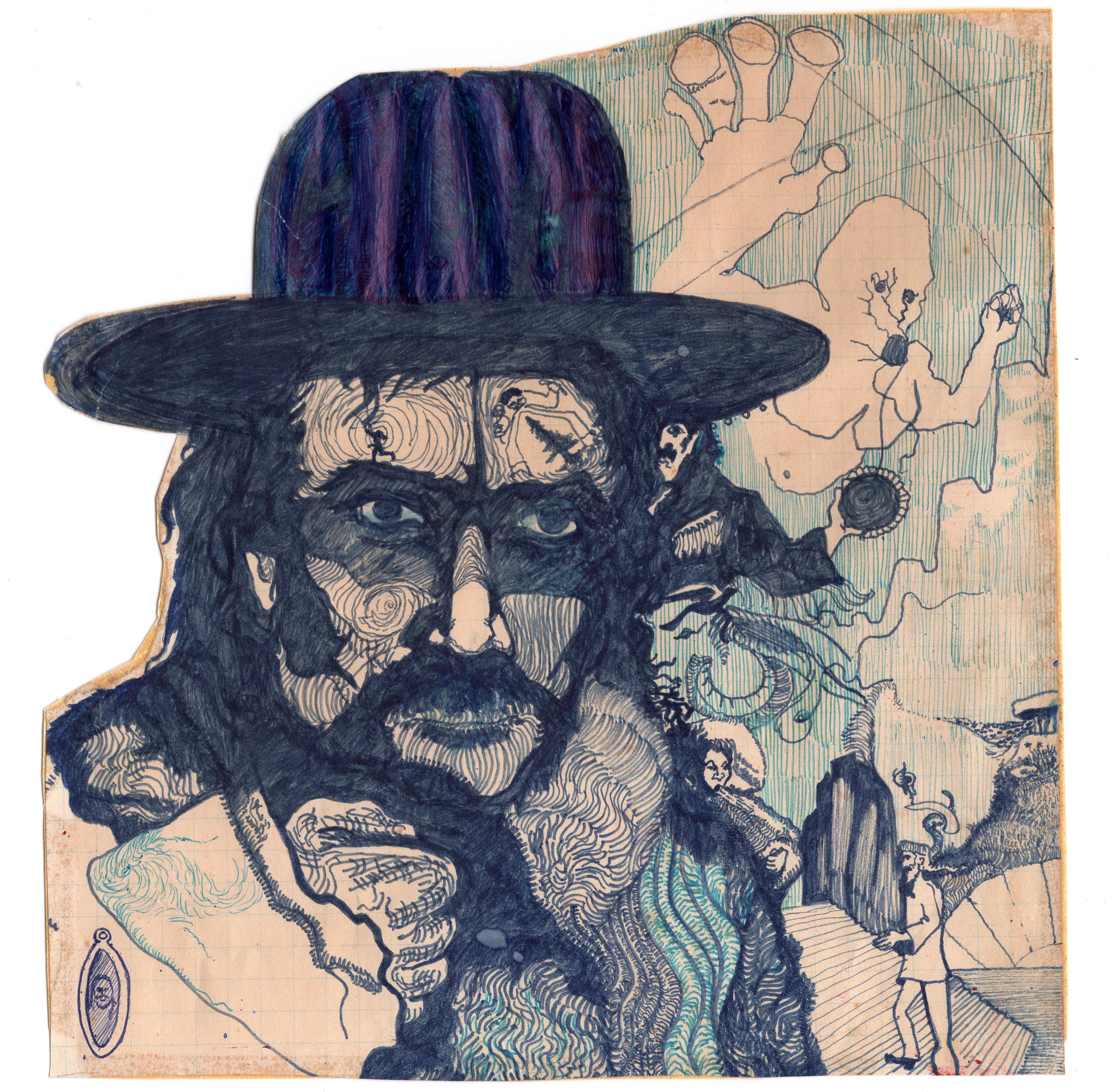
A picture drawn in 1968 of my older brother Jerry, which also reflects how I saw myself, especially after our dreams for the “Summer of Love” began to crumble and fall apart.

By the end of my first year at the University of Texas at Arlington (June 1969) the pain of staying the same had become greater than the pain of making some kind of change. Not only had I returned the previous summer from the debacle of Haight-Ashbury. I had now lived and partied with my friends on campus for a year. My girlfriend had become pregnant and had an abortion. I had played in a rock band, demonstrated with SDS, been arrested and put in jail with the band in Sherman,Texas for helping stage a curfew demonstration against the Sherman police. And I was aware that my personal life was a wreck, and my political ideals, though grand in scale (“Make love, not war!”) were also historically vague and practically incoherent.

When summer came, I moved home to live again with my parents. I had not reconciled myself to their culture or religious ideas; but I knew I needed something more stable  and more self-disciplined in my life.[i] I was still going out with my campus friends, partying at local lakes and rivers, and trying to live it up. Yet I was also dissatisfied with this scene. I knew it was empty of something more substantial that I was longing for. An early sign of this shift in perspective came when I resigned my summer job at a local music store where my friends often hung out, and took a job as a garbage man with the city of Fort Worth. I could make about twice as much per hour. Dad said to me, “Well, at least you can say that you started right at the bottom.”

I also began at this time to read more regularly in the New Testament, especially the stories in the four Gospels about Jesus: what he did, whom he met, and how he interacted with a wide variety of people. I would be out with my friends until late at night; then come home, fall into bed, and open my Bible to read until I fell asleep. I saw how Jesus interacted with a full range of everyday ordinary sinners: an adulterous woman, a greedy tax collector, power-hungry men like the Chief Priest and Pilate, and with his own failing followers (like Peter) who had wanted (like me and my friends) to be known for their revolutionary style and bravado, only to run away in confusion and bewilderment when their ideals proved groundless and self-indulgent.

As I read the gospel stories, I knew they were also about me; and given the ending of the Gospels, where the risen Jesus promises to continue to be present with his followers by the presence and power of his Spirit, I took a second step. Lying alone in my bed in the wee hours, after earlier efforts to live it up with the gang, I began to pray. The prayer was very simple, somewhat in the vein that my father later told me had also been one of his early prayers, “Lord, if you are there, can you also help me?” And the wonder of the thing was this: He was there. “Yes, I will help you. Trust me, Lean on me” (Matthew 11:28). The responding message came through very clear in my mind and heart. And, for the first time in a long time, I rested.

Thus began a couple of years of rather bumpy beginnings. Bumpy, yes, but not all that uncommon I think for a young believer, even in its bumpiness. A sort of two steps forward, one step back; start, stop, and start again, journey. One big step forward came as I found that my experiences of faith were inspiring me to write my own songs and music. Until then I had played mainly cover songs with the band (Cream, Dylan, etc.). Now I was writing about something that was rising up in my own life. Yet even now, my songs sometimes expressed a kind of ambivalence about leaving my old way of life and actually identifying myself as a Christian. One song in particular, the “Washday Blues,” expressed this ambivalence, drawing for its imagery on then popular TV ads about laundry soap. The song is addressed to Jesus, though he is never named explicitly. (You can hear an old recording of the song here.)

WASHDAY BLUES

I’ve been wondering, just what to do about You.

And you know, my mind needs laundering

Cause all I’ve got is dirty confusion.

And I’ve been looking for a brand-new recipe;

But I can’t seem to get nothing cooking:

Baked, broiled, fried, stewed, or fricasseed.

And you know, I need some real good enzymes to brighten up my day.

But it can’t be just any old detergent.

I need something strong to wash my dirt away.

I’ve got a ring around my collar, and a spot on my tie.

I’ve got the washday blues; I feel like I could cry.

If something doesn’t happen soon, I may lay down and die.

What can change my scene? Is it Mr. Clean?

O, I’ve been wondering just what to do about You.
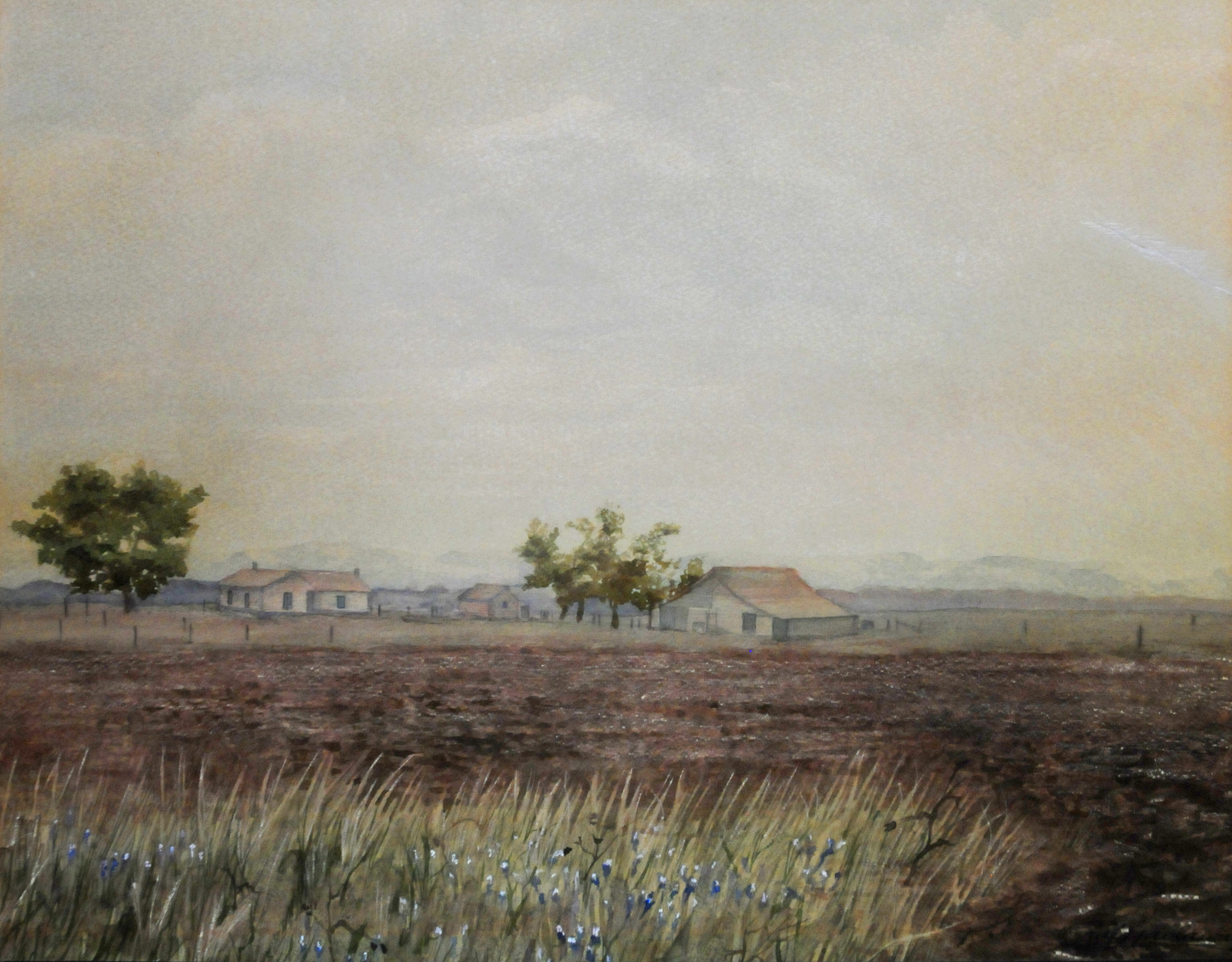
Glen Cove, watercolor by Craig Gallaway, copyright 1970. Based on a stock photograph and my own memories of my grandparents’ West Texas farm. I was trying to recall the atmosphere of their life and faith.

By the end of my second year at UTA (1970), still living at home with my parents, and hanging out with my rambling friends, the tension inherent in my double life was beginning to wear thin. Trying to live both as a cool neo-pagan rocker, and as a Christian (at least in private) has its fault lines and tremors. I had by then written a number of songs. I was surprised in a way to find myself in some of these songs (and in some of my paintings for watercolor class at UTA)  reaffirming the bonds of faith and country life that tied me to my family (for example, “The Hills of Coleman County”, mentioned at the end of Part 1). And though this kind of song resonated to some extent with a new turn in rock and roll at that time toward a more progressive country style (Dylan, the Birds, the Band), and wasn’t therefore a direct challenge to my revolutionary “style,” I think I knew at some level that this affirmation of family history was turning my political ideals toward something much more down to earth and grounded. I was letting go the world of sweeping claims about social justice and rediscovering the world of struggle, pain, and even joy in common life. This came out more explicitly in a Christmas song I wrote at the end of 1969, entitled “White Star.” (You can hear an early recording here.)

WHITE STAR

White star, how You came to be

shining down upon that country place

is beside me.

Bright and Morning Star, how you came to be

Walking around inside that country man

Is beside me.

And I was so surprised to find

That anything as ordinary as that country place

Could lighten every space

And brighten every face.

Bright and Morning Star, how you came to be

Looking right into these country eyes

Is beside me.

You’re inside me.

The tension inherent in my double life came to a head in the summer of 1970 when my father suggested that I might help out a young local preacher/evangelist named Billy Hanks. Billy was working with several young gospel singers, such as Cynthia Clawson, and he needed a guitarist for studio recording. I had a new red Guild guitar and I went straight to work. As a result, I myself became involved in some of Billy’s crusades, sharing my songs and my embryonic witness all over Texas, and eventually with the Youth for Christ organization in Europe. I also met a new set of friends and musicians; and this led later to my working with a popular Christian rock group called Love Song, as an opening act for concerts at various Texas colleges and universities.

Meanwhile, some of my old campus friends were wondering what was happening with my “music career.” I think some of them liked the music I was writing, and at least some of the lyrics. The band members even helped me, with various instruments, to produce some early recordings of the songs. But others in the troupe took offense at my increasingly public faith. The fellow on whose reel-to-reel tape machine we recorded even charged me with wanting to steal his tapes in order to get a music contract, get rich, and leave him out of the windfall. I had no such plans, and never pursued his vision for me; but I knew I had to walk away from that kind of suspicion and hatred. So, I did.

Another song that I wrote at about this time coincided with the decision to break more clearly from my old pattern. I was aware that my friends and I, with all of our ideals about social change and freedom and “love,” had long been disgruntled with life itself, working jobs that we didn’t really like or want, waiting for the weekend to come so we could party, get high, and escape our boredom, only to find ourselves worn out and starting another week in the same sort of stupor as the week before. I knew I needed to turn a corner, to spend my time differently. And what good did it do to keep sharing my songs when, as far as I could see, I might only be bugging them with my “witness”? I needed to strengthen what few real gains I had made (personal and spiritual) and begin with more effort to “redeem the time,” (Ephesians 5:16). The song I wrote about all of this was entitled “Time.” It was addressed in this case both to myself and to my old friends. It was a kind of farewell song and a wake-up call to make good use of time–and everything else we were being given. (You can hear an early recording of the song here.)

TIME

What can we do to save time that we think we can use

For a better time as soon as we have finished

What we’ve got to?

And what can we do to pass time when we find we’ve saved too much

And we’re spending all our time

Wondering just how we can pass it?

What does time mean to you?

Does it mean just that another day is through?

Are you rushing? Are you wishing? Are you lazy?

Do your days just pass you by, come and go?

Do you know the reason why?

I was letting go of one way of life. I was taking up another. In 1971, I began working as a youth director at the First Methodist Church in Carrollton, Texas, with pastor Ken Carter and his wife Freddie. I learned a lot at Carrollton about keeping a schedule and connecting with people who had regular jobs and families, people who were willing to work with me as we tried to make a difference in our surrounding community. In the summer of 1972, for example, instead of spending a lot of money, as we had done the year before, for the youth group to travel to Kentucky to work with the great Appalachian Service Project, we found a way to create our own service project in the rural countryside around Carrollton. Like ASP, we helped local people and families living in poverty to rebuild porches and roofs, and we enjoyed musical and cultural exchanges with the generous black congregations whose members welcomed us into their communities.

At the same time, among the people I had met through Billy Hanks, were two twin brothers, Brad and Stan Ferguson, who were part of the Inter-Varsity Christian Fellowship at North Texas State University in Denton. I lived with Brad and Stan on the NTSU campus for one semester in the fall of 1970, and then later spent time with them while I was completing my art degree at UTA. Among other things, my friendship with Brad and Stan helped me to clarify what it would mean to make a more grounded break from my old life of so-called “free love,” and to move into a new way of life in Christ that looked instead for a kind of wholeness, justice, joy, and wholesomeness in faithful marriage.

This was not a simple or easy time of transition for me. I was a young man in art school, taking life-drawing classes with nude models. I wrestled quite a bit with the meaning of my own desires. I even started at one stage in my art work, without really knowing the background or history, to drift toward the ancient gnostic heresy which once dogged the early Christians. This is the idea that the solution to our passions and unruly desires is in some way to get rid of the body itself, to be taken away to another world where there will be no body to bother with. I memorialized this in an etching that shows a young man, divided severally in his own mind, somehow breaking away from his brain and the world in order to find peace.
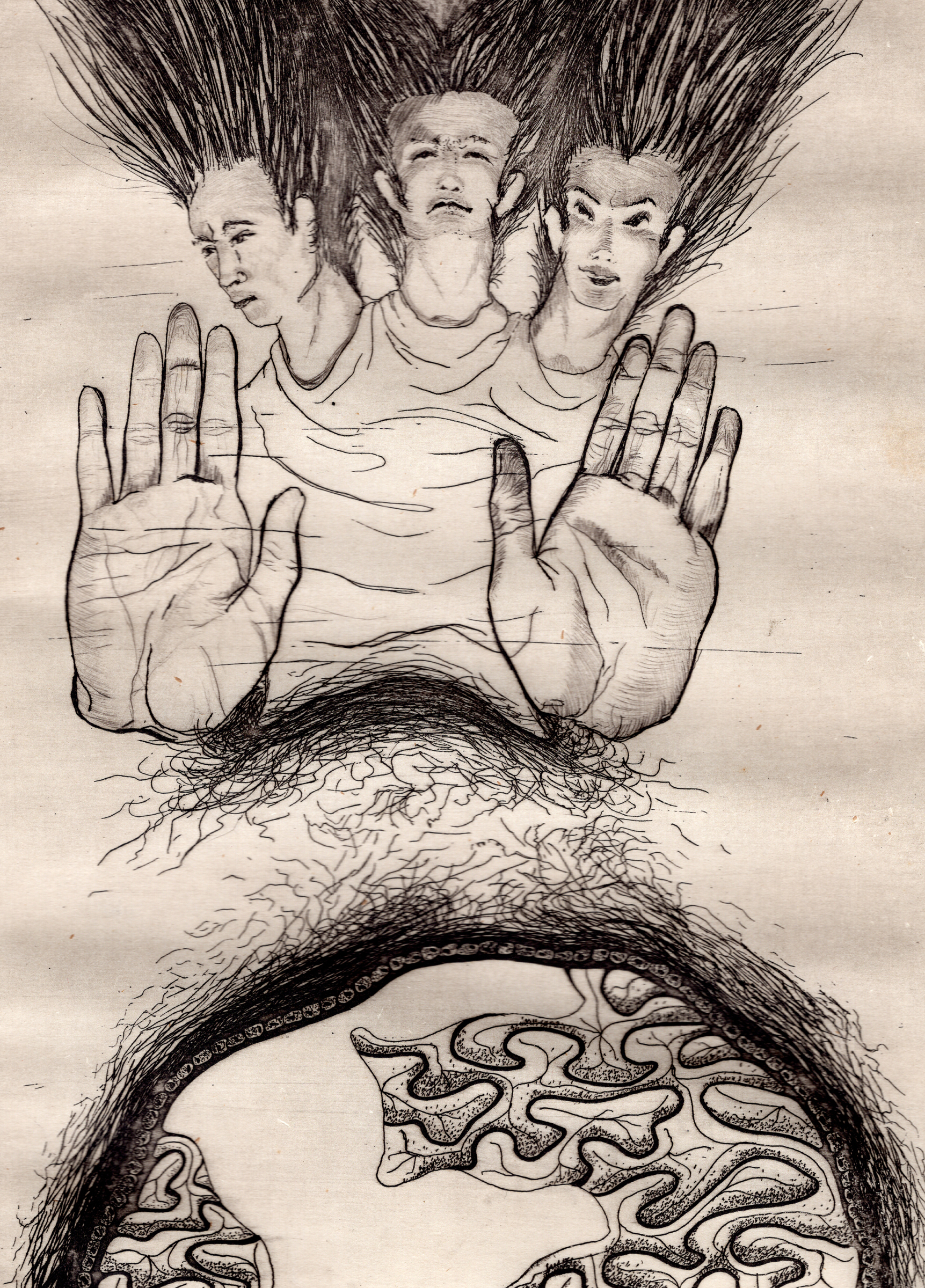
Gnostic Vision, etching by Craig Gallaway copyright 1970.

One day in Denton, when I was showing Brad some of my life drawings of nudes, I became embarrassed and said something about how he didn’t have to look at all of this “nasty” stuff. And Brad simply reminded me that for us as Christians, the body is not “nasty.” It is God’s good creation. Our task is not to escape it; but to learn to live faithfully with it and in it, in the physical world, with self-control, holiness, joy, and wisdom. Here, in a deeper connection, I was learning ever more clearly how the personal and the political, the social and the moral, far from being separate compartments, really belong together; and how practical and down to earth this way of Christian faith is designed to be. The Spirit was working with me, even as I at first misinterpreted what I thought the Spirit was aiming at. But this is how the Spirit often seems to work when one is in need of deconstruction and reconstruction!

In the summer of 1973, after graduating from UTA, I returned to the San Francisco area to live in Richmond and to work with a group known as “The Christian World Liberation Front.” Led by Jack Sparks on the campus of the University of California at Berkeley, CWLF sounded like another radical political group. And in a way it was. But it was focused on helping young people recover a sense of faith, hope, and grounding in Christ. I too was still learning how to bring my old revolutionary ideals down to earth, to embrace a way of life that was faithful in love, disciplined in work, focused on service, and open to all people under the guidance of the risen Lord and his Spirit. I came to see that these practical steps of faith, as common and ordinary as they seem, really are the Christian alternative to the overblown rhetoric that we often encounter in revolutionary circles, such as the Zealots in the New Testament, the hippies of the 1960s, and the recent cultural harangues from the riots of 2020. This is also, by the way, the kind of mission grounded in faith and individual responsibility that we find at work today among leading black Christians and public intellectuals such as Robert Woodson, Shelby, Steele, and Glen Loury.

So this is how I began to learn over time what it meant to sing the words of my own song: “Jesus’ blood, dripping on the stones, has set me free to soar.”  Set free not only from the physical confines of the SLO. CO. JAIL, but also from the spiritual and moral rabbit trails of my own limited vision, my story, my self-understanding. His death and resurrection, his defeat of the powers of sin and death, and his continuing power and presence by the Spirit, are the foundation for a real revolution that aims finally at resurrection and new creation. Nonetheless, like the Apostle Paul, those of us who follow him do not dare nor even wish to claim that we have already arrived, for we are still on the road hiking with purpose toward the final restoration and victory (Philippians 3:12-15). But we are “in him” and that makes all the difference: On the road of new creation, fighting back against the fallen powers, under the banner of the King!

[i] I wish I could say that I recognized clearly during the early years portrayed in this account just how much my father and my mother had been an ever-present help to me. After all, when Dad came to Haight-Ashbury to get Jerry and me out of trouble, he was, in a way, enacting the gospel in person. I didn’t see it so clearly then. Later, looking back, I was able to recognize how, to put it mildly, it had not been easy for him to come to that particular “far country” to find us, to bear the costs (monetary, personal, and emotional) and the drab ignominy of our sins and failures, and all of this in order to give us a second chance to start again; yet to see no immediate signs of gratitude or change in either of us. Dad was no more perfect than the Apostle Paul. But, like Paul, on behalf of the runaway slave, Onesimus, and like King Jesus who is the source and foundation of this whole endeavor, he was ready to take our debts upon himself in order to bring about, if possible, the desired reconciliation.
DESPERADO DECONSTRUCTED–1969-70, Part 2 of 3

A picture drawn in 1968 of my older brother Jerry, which also reflects how I saw myself, especially after our dreams for the “Summer of Love” began to crumble and fall apart.

After returning to Fort Worth from Haight-Ashbury in the summer of 1968, I was in an emotional and mental crisis. I had seen, and partially registered, some of the inconsistencies, some of the dysfunction, and the short-sightedness of the youth revolution in San Francisco at one of its central meccas; and yet I was also still alienated from my parents and their version of culture, religion, and life as well. They saw that I was suicidal for a while and, I am sure, prayed for me a lot. Yet, by the time the fall semester of what would be my first year in college rolled around, I had decided to make another stab at posing for the revolution with my old friends. I tried to register for the Vietnam draft as a conscientious objector in downtown Fort Worth; but was rejected and put into the normal lottery with everyone else, number 165. I moved into an apartment on the campus of the University of Texas at Arlington with a couple of friends, and our place became a hangout for a group of about twenty like-minded comrades. We formed a rock band, took drugs, played concerts at area colleges, preached and practiced “free love,” and looked for ways to make our mark as campus revolutionaries.

At the same time, I was constantly troubled by what, at an increasingly conscious level, I recognized as the weakness, ignorance, and arrogance of my and my friends’ positions. And I continued to read in secret other sources that put me in contact with a Christian view of things. Most significant in this regard was the Gospel of John, which gave me a window into the life of a person whose faithfulness was unlike anything or anyone else I knew, both scary and somehow reassuring. But I was in a state of cognitive dissonance, still trying to keep up appearances as a heroic young revolutionary. There was still a good deal of deconstruction left to do in my life, much more than I could have imagined.

As part of our revolutionary effort, I and several others in our group joined and helped to start the UTA chapter of the “Students for a Democratic Society” (SDS). This was a counterpart at that time to the kind of political philosophy one hears of today (in 2020) from people like A.O.C., Black Lives Matter, and others on the Left. Our group organized and participated in various public demonstrations, joining our voices with what were, in retrospect, perhaps sometimes “righteous” and sometimes not so righteous causes. We organized, for example, a “Pro Castro Rally” in one of Arlington’s public parks. We put up posters and sent out brochures. Bernie Sanders would have fit right in. On the day of the rally, as our speakers tried to hail the virtues of Castro and communist Cuba through a public address system, we were surprised to find that a large group of anti-Castro Cuban refugees (who had lost their homes, sometimes their families, and their country to Castro’s regime) showed up to shout and stare us down. I think we thought the crowd that day would be mostly other college kids out to demonstrate their political consciousness (like many of the “woke” today).

As I stood in the front line on our side, I looked across the gap between the two groups of demonstrators and saw my father looking back at me. He was standing in the second row of the counter-protestors, but he was not shouting. His face showed concern. When the rally was over, my friends and I went back to our apartment, proud of our demonstration and fairly sure of our righteousness though, truth be told, I could not at that time have told you anything beyond what our SDS speaker had asserted about Castro’s ideas, or what Castro had actually done on the island of Cuba. And I’m pretty sure the same could be said for most, if not all, of my friends. Being ill-informed and dogmatic is a heady, but a dangerous, cocktail. Dad never spoke to me about that day, or asked me any questions about it, though he had majored in International Law at UT Austin in his college days, and had also made a special study of Cuba, as I later learned.

I suppose someone reading this might interject, “Well, you were just being a normal adolescent, rebelling, striking out to find your own identity, etc.” And that would be true as far as it goes. But, remember, like those who are demonstrating and sometimes rioting today, we were taking positions on pivotal political issues, and we were beginning to vote, and to shape the future of this country. Indeed, the future we shaped then is in many ways fully visible in the present we are all living now. Yet, very often we were motivated (as seems also to be the case today) by little more than our hormones and a desire to appear bold and brave at the demonstration.

I might have continued to live, party, demonstrate, and accept the superficiality of our political and historical analyses at that time for who knows how long, had my own personal life not also been caught up in the inconsistency and self-indulgence of the scene. My friends and I saw, or at least we admitted, no contradiction between our high moral claims on selected social issues while, at the same time, rejecting any moral claims that might be placed upon our personal and sexual behavior. But in this, I reluctantly came to believe, we didn’t take account of the ways of the human heart, how we as human beings are made to live and love, and the need for faithfulness and commitment in any love that is worth having.

This finally came home to me when a young woman I was with at the time became pregnant, and we decided to have an abortion. I (and I think she) didn’t want to be tied down right then to a family, and I was already on the verge of taking up with someone else. But I also knew, somewhere in my gasping conscience, that there was something deeply wrong in all of this. Though my friends had no problem with it, it became a torment to me. I was reading The Problem of Pain, and realizing that much of our pain we bring upon ourselves, a lesson I had “learned” before. And I saw Jesus in the Gospel saying to the woman caught in adultery, “Neither do I condemn you. Go and sin no more.”

I wish I could say that I saw the light and decided to do the right thing, to marry this young woman, and to bring that child into the world. But I did not. She had the abortion, and I moved along to another relationship, which also later foundered. But in my secret reading of the Gospels, and in the beginning rudiments of prayer, I began to see myself for what I was. What I had become. Yet also to see a picture, in the face of Jesus the King, of the kind of person I might become. And, slowly, something began to turn inside of me. I finally came to a place with my “revolutionary” friends where, sitting together in a room of an evening, and listening to one of our more vocal leaders tell of how we were going to change the world, I objected. To everyone’s surprise, including mine, I found myself saying, “Do you really think that we are going to change anything?” Everyone’s jaws dropped open. But no one said anything.

Over the next two years, I continued to read, to think, to pray, to begin to apply myself to study, and gradually to separate from my old crowd as I found other people like myself who were trying to figure out what it would look like to care about social and political issues and yet, also, to be a Christian, a person of faith and of faithful relationships. And I continued to write songs, one of which was the story of the SLO. CO. JAIL, only now told with a further layer of deconstruction in place, and at least a hint of what reconstruction might look like. I realized even then, looking back on my journey since Haight-Ashbury, that I had gotten out of the SLO. CO. JAIL a long time ago; but I was still in jail in my heart and life.

THE SLO CO JAIL

Summer of 1968, San Luis Obispo County,

Peanut butter and jelly, standing on the street, waiting for him.

We stepped into a chapel and found the perfect gift

To set his mind on freedom.

It was Jesus, in a blood-red ruby stone.*

But the SLO CO JAIL, it’s a lonely place.

O, the men inside have such a lonely face.

Driving down the coast road, staring at the ocean.

And it’s so beautiful with the sun upon its motion.

We were heading down to Mexico, gonna make our fortune.

But we’re so fortunate we never made it.

  And the SLO CO JAIL, it’s a lonely place.

O, the men inside have such a lonely face.

What are those cagey shadows hanging on my wall?

No, I don’t think I’ve been here before.

And wild geese flying toward heaven, and Jesus in a blood-red ruby stone,

Cannot free this heart of mine.

But just as iron bars do not a prison make, neither can blue skies give freedom.

What are those cagey shadows hanging round my heart?

And wild geese flying toward heaven could only remind me

Of my desire for freedom.

But Jesus’s blood, dripping on the stones, set me free to soar.

And the SLO. CO. JAIL, it’s a lonely place.

O, the men inside, have such a lonely face.

And the SLO. CO. WORLD would be a lonely place

Had the Lion himself never shown his face.

*The reference to “Jesus, in a blood-red ruby stone” is about a trinket that one of our group bought in a small Catholic chapel to give to Jerry while we were waiting on the street in San Luis Obispo for him to be released. It appears in my 1968 drawing in the lower left corner.

In Part 3 of this reflection, I will take back up what it means to say that, unlike the trinket for Jerry, “Jesus’ blood dripping on the stones set me free to soar.” For that is finally what this reflection is all about. How the Gospel of Jesus’ death and resurrection has the power not only to deconstruct us from the false narratives, and the superficial posturing to which we become bound, but also to reconstruct us as the unique individuals that each of us is in the image of our Creator, who made and loves each one of us. Though that process may for some of us take a considerable amount of time.

DESPERADO DECONSTRUCTED–1968, Part 1 of 3

Desperado

A picture drawn in 1968 of my older brother Jerry, which also reflects how I saw myself, especially after our dreams for the “Summer of Love” began to crumble and fall apart.

In June of 1968 I graduated from high school in Fort Worth, Texas. I stood in the driveway of my family’s house on Danciger Street and bade my father “farewell,” hardly listening to his plea for me to take care of myself. I was heading to San Francisco, along with a couple of friends. I knew my older brother, Jerry, was already there, in the Haight-Ashbury district, and I and my friends couldn’t wait to leave our conventional families and neighborhood behind, and join in the “Summer of Love.” Indeed, I thought (very clearly in my own mind) that I would never return to my family again. I had had it with my parents, my grandparents, the whole scene of traditional religion, culture, and society. My friends and I would join the movement for free love, “make love not war,” “flower power.” We really believed that we might be able to usher in a new “age of Aquarius.” And so, we hit the road and drove to San Francisco. On the way, about the time we drove through Los Angeles, Robert Kennedy was killed there, following in the wake of the assassination of Martin Luther King, Jr., in April, and Kennedy’s brother John five years earlier.

As soon as we arrived, we learned rather abruptly that the “District” itself was not entirely free from the world’s problems. We found Jerry and his friends in one of the row houses that we so-called “hippies” occupied for several square blocks around the cross streets of Haight and Ashbury. No one paid rent. No one minded who came and went. The owners and the police had given up trying to enforce normal property laws (just like in Seattle today). On our first evening in the house, we encountered a young black man knocking from outside on the second story window of our house. He was leaning out of the window of the next-door house (those houses were only a few feet apart in many places). We opened the window and he shuttled through, running for the front door, and yelling back over his shoulder as he went that he had just shot someone in the other house, having been caught trying to rob it. Not exactly the welcoming party to the summer of love that we had expected, but perhaps this was just an aberration.

No. The next morning we found that everything we had left in our car parked on the street had been stolen as well, including all of our camping gear and most of our clothing. No problem, this was the place of the New Age, the new world of love, and we were going to make it happen, even if it cost us a little bit here and there. Revolutions do require sacrifice.

I began to have deeper doubts about the depth and soundness of our vision when I sat down with Jerry the next day to talk about our plans: How we were going to change everything for the better in our world of civil rights marches, assassinations, and the Vietnam war. I was only 18 years old, and I hadn’t really been a very committed student of history, philosophy, economics (or anything else, to put it mildly); but even I knew that something was deeply wrong and askew when Jerry explained to me that the way we were going to correct the imbalances of our society was to “Walk into the banks. Rob them. And then just redistribute the money equally to everyone” (a kind of defund the police solution if ever there was one). I remember thinking, though I didn’t say it out loud at the time because Jerry was the closest thing to a “Messiah” that I had, “But, Jerry, what will happen then? How will people behave with all of that cash? Will we all just suddenly become good?” I didn’t ask, so he didn’t get a chance to answer. But, had I asked, I imagine he might have regarded me as rather naïve or uncool, perhaps in need of some more LSD or marijuana, which we were all using a lot.

Jerry’s next plan sounded better, but it ended in disaster. We would take a homemade “house-truck” that belonged to one of his friends and drive down to Mexico. We would purchase a boatload of marijuana, and then bring it back into the country, literally, by boat, landing somewhere in the Big Sur area. We would distribute the weed, make some money, and everyone could get high and celebrate with a great “love-in,” which meant of course lots of sex with whomever was willing. Things went south when we were stopped on Highway 1 for making an illegal U-turn, and then arrested for having drugs in our possession. We were put into the county jail in separate cells at San Luis Obispo County ( or, as the name was ironically abbreviated on the building and on the side of police cars, “SLO. CO. JAIL,” and “SLO. CO. POLICE”). We spent several days in jail before they decided to let us go. They were arresting hundreds of kids every day along the coast, and had nowhere to keep all of us. They let all of us out except Jerry.

I hadn’t known it, but Jerry had been arrested a few days earlier for possession of marijuana in San Francisco, and was due for a court appearance. In leaving for Mexico, he had jumped bail and skipped town, so now there was a warrant for his arrest. After our release, the rest of us hung around for a couple of days in San Luis Obispo, before heading back to San Francisco where Jerry had been extradited. Back in Haight-Ashbury, without my brother, no money, and a head full of broken dreams (my Forth Worth friends had long since gone home) I tried to fit into the scene as best I could. But the social scene in the district was pretty much like the social scene anywhere, and the ideals of even a few months earlier were falling into disarray. Everyone pretty much looked out for themselves, and indulged their own appetites. People were taking drugs and having sex with pretty much anyone. And I had not eaten for about three days.

I remember getting very angry about the way things had turned out. At one point, I lay on a bathroom floor, cursing the god in whom I said I did not believe, the god in whom, even then, I did not want to believe. ”Why, god, have you put me in this position? Why did you let me come to this?” And some how, in my own mind, the words came through to me, “Craig, I did not put you here. You did this.”

As I began to starve, I felt I had no choice. I called my father and asked for help, the prodigal who couldn’t even make his own way home. But unlike the biblical prodigal, I wasn’t really repentant yet, or able to register what a fool I had been with all of my pseudo-romantic self-imagery and grandiose ideals. Dad said he would come right away, and told me where he would meet me. So, Dad came to Haight-Ashbury. He got a hotel room. Got some food into me. And then he went to talk with the judge in the court where Jerry was being held.

The judge agreed to release Jerry if Dad would pay the bail and promise to take Jerry out of the state, a deal to which Jerry agreed. The next morning, when Dad went to collect Jerry from the house where he had gone for the night, he was gone. No one knew where. Dad didn’t see Jerry again for at least three years. But he took me back to Fort Worth, where I felt alienated from everyone and everything. I felt I didn’t know my parents anymore. I thought of suicide. All of my dreams and visions had been deconstructed, and what was underneath was really just a desire to appear heroic, to indulge my desires, and to live my life free from the constraint of what others might want or need. All of the veneer of my social visions and commitments had crumbled. My friends and I didn’t really know how to save ourselves, much less the rest of the world. But that didn’t stop me from trying to hold on to the old narrative.

Back in Fort Worth, I took up with my old friends. I knew there were huge gaps in our world view, but where else could I turn? My world had been deconstructed by the raw data of experience; and I didn’t want to admit it. But I began secretly to read and ponder some other things, things that wouldn’t make any sense to my friends who still believed in the summer of love, things like the Gospel of John, C.S. Lewis’s Problem of Pain, and George Herbert’s 17th century poetry. And little by little I began to review the history of my life and to see resonances that I hadn’t seen before. And I began to write songs. One of the first was a surprising reversal of my rejection of family, called “The Hills of Coleman County,” a song about my grandparents’ old place out in the country:

I can still remember, back in my childhood days,

living with Mama and Papa, and eating the country way. . . .

And I am heading for the meadow that lies beyond those hills.

I feel there’s something calling to me, and I’ve got to take my fill.

Also, one of George Herbert’s poems (discovered in freshman English at the University of Texas at Arlington where I went with my friends in the fall) struck me like a shaft of light with images of something very like what had happened to me on the bathroom floor back in Haight-Ashbury some months earlier. I took Herbert’s poem “The Collar,” revised it for contemporary lyrics, and turned it into a rock song that I called “The Table.” This was indeed so very much like me on the floor cursing God:

I hit the table, and shouted, “No more do I want to spend any time
On this blasted living.
Why should I sigh. My lines and life are free, free as the road, loose as the wind.
Sure there was corn before my tears did drown it out.
Sure there was wine before my sighs did find it out.”
But as I grew more fierce and wild with every word, I thought I heard a voice
Calling, “My Child.”   “My Lord.”

In part two of this reflection, I will look further into how coming into contact with the Christian Gospel by various means affected my understanding of my time in San Francisco and the SLO. CO. JAIL.