
THE SPIRITUAL AND POLITICAL BATTLE OF OUR TIMES, PART 7: THE WAY OF FAITH (cont.)

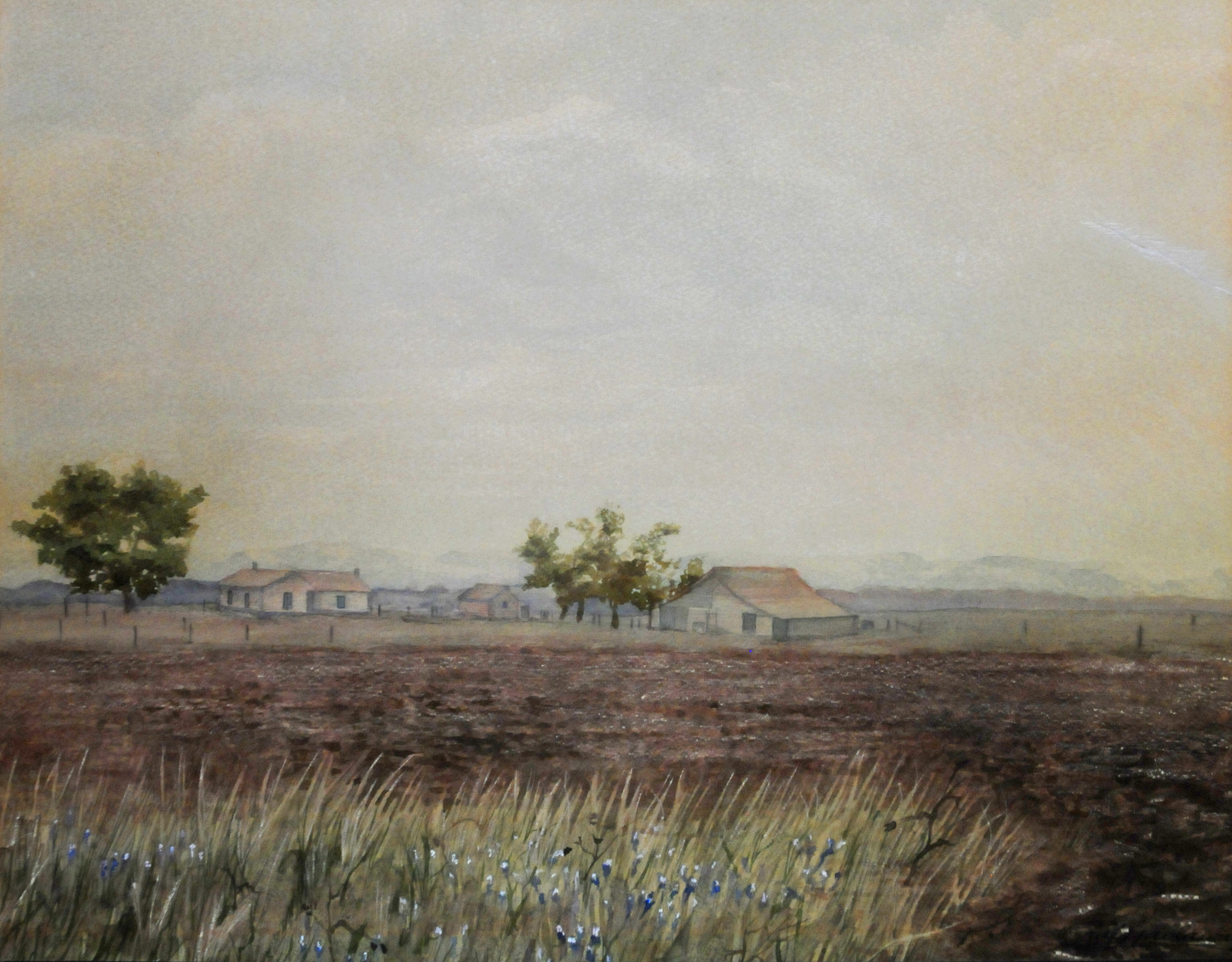
Title: Glen Cove, watercolor by Craig Gallaway, copyright 1970. After getting lost as an eighteen year-old in the free-wheeling idealism of the 1960s in the Haight-Ashbury district of San Francisco, I returned to my family in Texas and began to try to “re-member” what had been the deeper soil of my life, my upbringing, and my faltering faith. This painting was an attempt to remember and to honor the first fruits of that legacy from my grandparents little farm in West Texas. Remembering and honoring that legacy was a crucial step in my own recovery of our national heritage, and a preparation for the battle now at hand.

[In the previous part, Part 6, we looked at how a recovery of the biblical view of salvation, in its full scope, can help us to avoid the pitfalls of “cheap grace” and “passive faith”–pitfalls which, according to Dietrich Bonhoeffer and Eric Metaxas, were responsible for the failure of the German churches in the 1930s to resist and even to stop Hitler’s totalitarian buildup. In this final part, we shall look at two more features of biblical faith that can also help us to avoid these pitfalls in our own time, and to register more fully why a truly biblical faith holds such deep resonance with the principles of the Anglo-American Conservative Tradition (AACT), and therefore with our founders’ vision and our Constitutional heritage.]

2. The Active Nature of Faith. Both Bonhoeffer and Metaxas draw attention to the danger of regarding faith merely as a matter of mental assent. For example, Metaxas warns against Luther’s notion of sola fides (faith alone) which has seemed, at least to some, to imply an opposition between faith and good works or active human effort in any sense.[i] But Luther’s error lay in trying to read the problems of his own time (the medieval cult of indulgences and the debate about Pelagius from the fifth century) back into the writings of Paul and James on “faith and works” in the first. For Paul, however, the problem was not with good works or human effort in general, but with the very specific Torah works of circumcision, kosher, and sabbath keeping by which the Jews of his day boasted of an identity superior to everyone else, a “righteousness of their own” (Romans 10:3).  So, for Paul, as a believer in King Jesus, what mattered most was “neither circumcision nor uncircumcision, but faith working through love” (Galatians 5:6). And in this regard, Paul was in complete agreement with James. For just as James could warn of the dangers of mere mental assent (“Even the devils believe,” 2:19) and urge his readers to “show their faith by their works (2:18); so, Paul wrote, as above, of “faith working through love,” and of how “God has created us in King Jesus for the good works that he prepared ahead of time as the road we must travel” (Ephesians 2:10).  Indeed, once we set aside the false opposition between faith and good works, the theme of active faith appears everywhere in Paul’s instructions for the churches—for example, as when he calls them to stop “yielding their bodies to sin” (Romans 6:12-14) and “to present their bodies as living sacrifices to God so that they may test and discover his perfect will” (Romans 12:1-2).

This notion of a passive faith of mere mental assent is pernicious in America today in so far as it plays into the false segregation of religion to a private sphere of individual, merely inward experience. Had Jesus or the early Christians practiced such a “faith,” they would never have come into conflict with the powers of the Roman state or the Jewish establishment of their own time. Furthermore, the administrative state today (like the German state in the 1930s) will also readily accept our religion so long as we are willing to keep it private, leaving the ordering of the public sphere (such as our public schools and businesses and media, etc.) to them. But this would be to abandon not only our biblical mandate for a faith that actively embraces the full scope of salvation, but also our founders’ hope for a religious and a moral people who actively promote the values upon which our nation’s highest hopes are grounded.

3. The Synergy of Grace and Faith. The biblical way of full salvation and active faith leads finally to a way of life that unfolds daily in our families and congregations and neighborhoods. It is a way of life grounded in what God has done for us in Jesus and the Spirit by sheer grace; and, at the same time, a way of life that requires our whole-hearted commitment and obedience (Romans 12:1-2). We cannot save ourselves. No! But God will not save us without our full participation. Indeed, what he wants above all is a willing and mature partner who acts out of freedom and love to be his partner, made in his image, helping to restore the fallen, broken, and disordered world.[ii] And so, after calling the Christians at Philippi to “have this mind in you which was also in Christ Jesus,” the Apostle Paul goes on calling them to “work out your salvation with fear and trembling, for it is God who is at work within you both to will and to do his good pleasure” (Philippians 2:5-13).

This synergy of grace and faith takes place, moreover, in the hard won and remedial path of daily discipleship that unfolds as we give thanks for our sufferings through which God is inwardly restoring our own character (Romans 5:3-5). And it takes place, further, in the outward suffering that comes from being persecuted by those who oppose the way of grace and faith (whether in Xi’s CCP or in the Biden-Harris administrative state) because it opposes their demands for dominance and control (Philippians 1:27-30). This is the way of faith that embraces Jesus’s call to purity of heart in marriage, and mercy even to enemies (Matthew 5:21-48). It is Paul’s call to “take every thought captive for Christ’ (2 Corinthians 10:5). It is the way of moral freedom in Christ, and of the fruits of his Spirit such as self-control, kindness, and patience (Galatians 5). It is the way of costly discipleship which Paul himself described as “knowing the power of his resurrection, and the partnership of his sufferings” (Philippians 3:10). And it is a direct response to Jesus’s own invitation, “If anyone would be my disciple, he must deny himself, take up his cross and follow me” (Matthew 16:24). 

Such a synergy of grace and faith embodies, note well, the freedom of moral conscience and religious practice that are protected by our American Constitution and Bill of Rights, protected against the overreach of our own government. We are free, and should be left free, to pursue this way of faith and life. The government has a role to play, to be sure, in restraining evil by the rule of law (Romans 13:1-7), but it has no role to play in the synergy of grace and faith, except to encourage its free operation and exercise (as the First Amendment says). Furthermore, the synergy of grace and faith takes place within and rises up from the most basic levels of our familial, communal, congregational, and personal lives—the daily path of conscious, intentional, and prayerful discipleship with each other. And because of this the synergy of grace and faith has far-reaching social, cultural, and political consequences, for it shapes how we see the issues that the government itself would address (for example, the false “crises” of the Biden-Harris state) as well as how we see the limited role of government in responding to real needs or crises when they arise. Why would we cede the sovereignty of this relationship between God and his people to any agent or officer of the state? Such agents are themselves in need of grace and faith.

In this way, the biblical synergy of grace and faith provides a remarkable framework within which to hear again the words of James Madison from The Federalist Papers: “If men were angels,” Madison wrote, “no government would be necessary.” And, “If angels were to govern men, neither external nor internal controls on government would be necessary.”[iii] But as it is, so long as “reason is fallible,” and human passions distort human judgement, we will need a form of government that can control not only the lawless among us, but also itself.[iv] And so, the biblical doctrine of salvation by grace through faith finds deep and abiding resonance with the constitutional legacy of the Anglo-American Conservative Tradition.

Conclusion

If these reflections have been at all on target, then we may now be in a better position than when we began this study seven weeks ago to respond faithfully to the “Spiritual and Political Battle of Our Times.” In particular, these reflections may help us decide how to vote in the coming presidential election. At this stage in our recent history, in my estimation, and based on the whole sequence of arguments and evidence presented above, there can be no real question that Donald Trump and the common sense conservative tradition, stands much closer to the principles of both the AACT and of the Christian synergy of grace and faith than does Joe Biden or his protégé, Kamala Harris. This is so despite Trump’s personal fallibilities; and, of course, the fallibilities of both Biden and Harris, both as a persons and as politicians, are now constantly emerging into fuller and wider view as well.[v] But if we take the long view required by the full scope of biblical salvation, and by the synergy of grace and active faith, we must also look beyond all of these candidates by themselves. We must consider the principles that each of them has tried to promote, and we must think of candidates for the future in 2028 and 2032 and beyond, who will carry forward the strengths of the AACT and dismantle the corruptions of the administrative state. We must think of grace and faith, and of principles and policies, and of candidates always in that light.

Therefore, for all who are willing, along with Deborah and me, to take up the task at hand, let us embrace whole-heartedly the prayer that the Apostle prayed for the Christians at Philippi (1:9-11). He wanted to encourage them in the midst of their own sufferings under a different administrative state, and to steal their wills for the ongoing synergy of grace and faith that lay before them. And so, he wrote to them,  

“This is what I am praying: that your love may overflow still more and more, in knowledge and in all astute wisdom. Then you will be able to tell the difference between good and evil, and be sincere and faultless on the day of the Messiah, filled to overflowing with the fruit of right living, fruit that comes through King Jesus to God’s glory and praise.” 

Endnotes


[i] Metaxas, Letter, pp. 67-70.

[ii] This insight is expressed with great power by C. S. Lewis in his Screwtape Letters, chapter eight, on the “law of undulation,” and how God uses the troughs of life more than the peaks to achieve the perfect freedom of willing obedience and love that he intends for us.

[iii] Alexander Hamilton, James Madison, John Jay, The Federalist Papers (New American Library: New York, 1961) No. 51, p. 322.

[iv] Ibid, Nos. 10 and 51, pp. 78, 322.

[v] I say this fully aware of President Trump’s former playboy lifestyle and marital infidelities. But I also note that these moral failures were all in the past when he ran for office the first time in 2016; and that he seems to have turned away from (that is, repented of) his former way of life in the intervening decade or more. Furthermore, the Christian doctrine of repentance and forgiveness does not promote holding on to an unforgiving spirit toward others (of either party) whom we may consider less righteous than ourselves. Sheesh!     

THE SPIRITUAL AND POLITICAL BATTLE OF OUR TIMES, PART 6: THE WAY OF FAITH

Title: Glen Cove, watercolor by Craig Gallaway, copyright 1970. After getting lost as an eighteen year-old in the free-wheeling idealism of the 1960s in the Haight-Ashbury district of San Francisco, I returned to my family in Texas and began to try to “re-member” what had been the deeper soil of my life, my upbringing, and my faltering faith. This painting was an attempt to remember and to honor the first fruits of that legacy from my grandparents little farm in West Texas. Remembering and honoring that legacy was a crucial step in my own recovery of our national heritage, and a preparation for the battle now at hand.

[In the previous part of this series, Part 5, we tried to come to grips with the dreadful seriousness of the political, cultural, and spiritual choices that stand before us now in the approaching electoral decision between a continuation of the Biden-Harris administrative state, on the one hand, and a brave recovery of the basic principles of the Anglo-American Conservative Tradition, upon which our country was founded, on the other. In this part and the next and final part, we shall be looking even more closely at the role of religious faith in the ACCT as this provides the critical foundation in our families, our congregations, and our communities for the kind of deep recovery that is needed if we as a nation are to navigate the embattled road ahead. Again, we turn initially to Metaxas and Bonhoeffer for clues about what went wrong in 1930s Germany.]

The Way of Faith

If it is true, and no exaggeration, that the administrative state under Joe Biden has now become—like the dictatorial Nazi state of Adolf Hitler (or the totalitarian state of the CCP with its plans to defeat the West from within)—the direct enemy of the religious and moral principles of the Anglo-American Conservative Tradition, then how is it possible that the churches in America today (like those in 1930s Germany) have allowed this to happen? Why have our churches failed to stand up sooner or push back harder against the enemy who stands at the door? Why have the churches in some cases even become advocates for the state’s corrupt agenda?[i] Both Dietrich Bonhoeffer and Eric Metaxas have tried to answer these questions in their own contexts. Let us look briefly at their answers as we work together to bring these reflections to a proper conclusion.

Bonhoeffer gave his answer in his remarkable book, The Cost of Discipleship (1937). The problem, says Bonhoeffer, is that the churches in Germany had too often settled for a “gospel” that contained only “cheap grace” instead of following their master, Jesus, in the way of “costly grace.” They settled for a message of forgiveness without the call to discipleship. They had become comfortable with the idea of being forgiven (“justified”) without seeing the need for a full-bodied, whole-of-life response to the God who gave his Son that we might live. Luther himself was deeply committed to “the justification of the sinner in the world,” says Bonhoeffer; but the German churches had allowed this to degenerate into something completely different, “the justification of sin and the world.”[ii] When Luther spoke of grace, says Bonhoeffer, he “always implied that it cost him his own life, the life which was now subjected for the first time to the absolute obedience of Christ.”[iii] Such grace is costly because it “costs a man his life, and it is grace because it gives a man the only true life.”[iv] “Above all, it is costly because it cost God the life of his Son; ‘ye were bought at a price,’ and what has cost God much cannot be cheap for us.”[v] Thus, according to Bonhoeffer, a cheapened idea of “grace” divorced from the call to discipleship allowed the German churches to ignore the cultural, political, and spiritual tragedy that was taking place right in front of them. They were already “saved,” so they did not need to concern themselves with these other “political” matters. 

Like Bonhoeffer in Germany, Eric Metaxas has also worked diligently to decipher what has gone wrong in many American churches today. Why have our churches failed to stand up against the atrocities of the Biden state?[vi] According to Metaxas, we have repeated the errors of the German church by making faith a matter of mental assent to a doctrine of forgiveness that does not include our Lord’s call to the way of costly, whole-hearted discipleship.[vii] This false separation of faith and discipleship is reinforced, moreover, by defining “faith” as though it were opposed to “works” of any kind.[viii] As a result, many of our churches think of their role only in terms of “evangelism,” but even that is defined to exclude the good news of moral effort and recovery in Christ, especially anything that might be construed as “political.”[ix] Of course, Metaxas objects strongly to this conclusion, as he himself cannot conceive in scriptural terms of a truly Christian Church that does not take strong public positions on matters such as abortion, racial harmony, radical gender ideology, the role of parents in our public schools, and the coercive overclaims of the administrative state.[x]

Turning Around and Looking Forward

If we are to recover the religious dimension of our Anglo-American Conservative Tradition in America today, we must somehow correct the missteps of cheap grace and passive faith that Bonhoeffer and Metaxas have identified. To this end, I want to highlight three basic principles from Scripture that can help us move faithfully in this direction. For present purposes, I will not go into these in detail. Rather, I want only to outline them in a way that suggests their relevance to the cultural and spiritual battle at hand, even for readers who are not themselves at present active Christian believers.[xi] The principles do provide, however, a solid biblical footing for avoiding the pitfalls in question. Moreover, they may also help us to discern more clearly the deep resonance that exists between biblical faith and the Anglo-American Conservative Tradition itself, as well as the necessary opposition of both to the dictatorial pretensions of the administrative state.

1. The Full Scope of Salvation. In keeping with the insights of Bonhoeffer and Metaxas, we need to recover a more biblical conception of the full scope of salvation—that is, what it means for God to save us. In Philippians 1:6, for example, the Apostle Paul encourages the struggling Philippians with the following declaration of his own faith. “Of this I am convinced: the one who began a good work in you will thoroughly complete it by the day of King Jesus.” Paul clearly has in mind the same framework for salvation that he portrays in amazing detail in Romans 8:22-30, where he speaks of how the whole creation is waiting in eager expectation for the day of resurrection when the children of God will be set free to lead all creatures in proper praise and stewardship. The full scope of salvation, thus, includes forgiveness of sins, to be sure, but it also reaches to the restoration of the image of God in human life (after the pattern of the Son of God, v. 29) and to the restoration of creation itself. What is more, as in 1 Corinthians 15:20-28, this restoration is an ongoing project, for the risen Jesus continues to reign as Lord “until he has put all his enemies under his feet,” and then God the Father will become “all in all” (v. 28). The picture of the full scope of salvation is then rounded out in Revelation 21-22 with the vision of a new heaven and a new earth, where death is no more and God comes down to dwell with his people.

When we understand the scope of salvation in this full and biblical way, there can be no question of a merely private or individual experience of forgiveness as an end in itself. Nor can the sphere of religion be reduced (as the modern liberal state would prefer) to a merely private realm of individual piety that has no effect in the sphere of public life and culture. Our Lord is the Lord of human life and of all creation. His purpose is to put everything in the fallen world back in order (to “save” it) and all areas of life are subject to his Lordship. His forgiveness paves the way for his restoration (Romans 5:6-11). If we in America today are to recover our own tradition as a religious and a moral people, we will need to embrace this great vision for the full scope of salvation, and endeavor faithfully in our families, our congregations, and our communities to work it out with our Lord’s guidance in every sphere of life—including public, political, and cultural life.

Looking ahead to Part 7

In the final part of this series, we shall look at two more features of biblical faith that further embody what it means to embrace the full scope of salvation. These are: 1) the active nature of faith demonstrated by good works, and 2) the synergistic nature of faith as an ongoing journey of discipleship in response to the grace of the living God–Father, Son, and Spirit. How do these dimensions of faith echo and reinforce the principles of the AACT that our founders intentionally built into our Constitutional tradition? That is the final question that I ask you to consider as we conclude this study into the spiritual and political battle of our times.

Endnotes


[i] My own former denomination, The United Methodist Church, for example, has recently split itself apart as those who retain the UMC name have, nevertheless, turned their backs completely on the moral and biblical guidance of their own Wesleyan tradition. At least a quarter of the congregations of the former denomination have now disaffiliated to join other orthodox Methodist branches or to establish independent congregations. If the leaders of the now apostate UMC continue in the direction they have chosen, many more people and congregations will, I believe, eventually join this mass exodus as the unbiblical, anti-Christian, and anti-nature implications of the wayward denomination become more and more obvious.

[ii] Dietrich Bonhoeffer, The Cost of Discipleship (New York: MacMillan, 1937) p. 53.

[iii] Ibid. 

[iv] Dietrich Bonhoeffer, The Cost of Discipleship (New York: MacMillan, 1937) p. 47.

[v] Dietrich Bonhoeffer, The Cost of Discipleship (New York: MacMillan, 1937) p. 48.

[vi] Metaxas, Letter, chapters 7-8, pp. 55-73, deal with matters of defining “faith.” 

[vii] Ibid, pp. 68-73.

[viii] Much of the problem in this regard arose from Martin Luther’s own confusion about the Pauline contrast between “faith” and “works” (e.g., Ephesians 2:8-10). Paul had in mind the “works” of Jewish ethnic purity (such as circumcision, kosher, sabbath, etc.) which are not a substitute for the life of faith and good works that he promotes everywhere in his letters (Ephesians 2:10). Luther, however, confused the concept of “works” with the pseudo-Pelagian notion of human effort in general and with the medieval Catholic practices of indulgences. Thus, Luther also had difficulty recognizing the complete agreement between Paul and James on the relation between faith and good works. This confusion still misleads many today, who regard themselves as orthodox or conservative Christians. 

[ix]Metaxas, Letter, pp. 75-85, 95-105. 

[x] Ibid, pp. 84, 99.

[xi] It is interesting to note, in this regard, the recent avowal of atheist Richard Dawkins that, though he is not a Christian believer himself, he recognizes the irreplaceable importance of the Christian faith as a foundation for the moral order of freedom in the West. And that order he does very much affirm and wish to preserve.